audiobriefs
8:59in productionCh. 1 · Six Algorithms, Named/ 8:59 · ceiling 15 min
Effects & pedals

TC Electronic Nova Delay

Six named delays in one box—but no way to bend them.

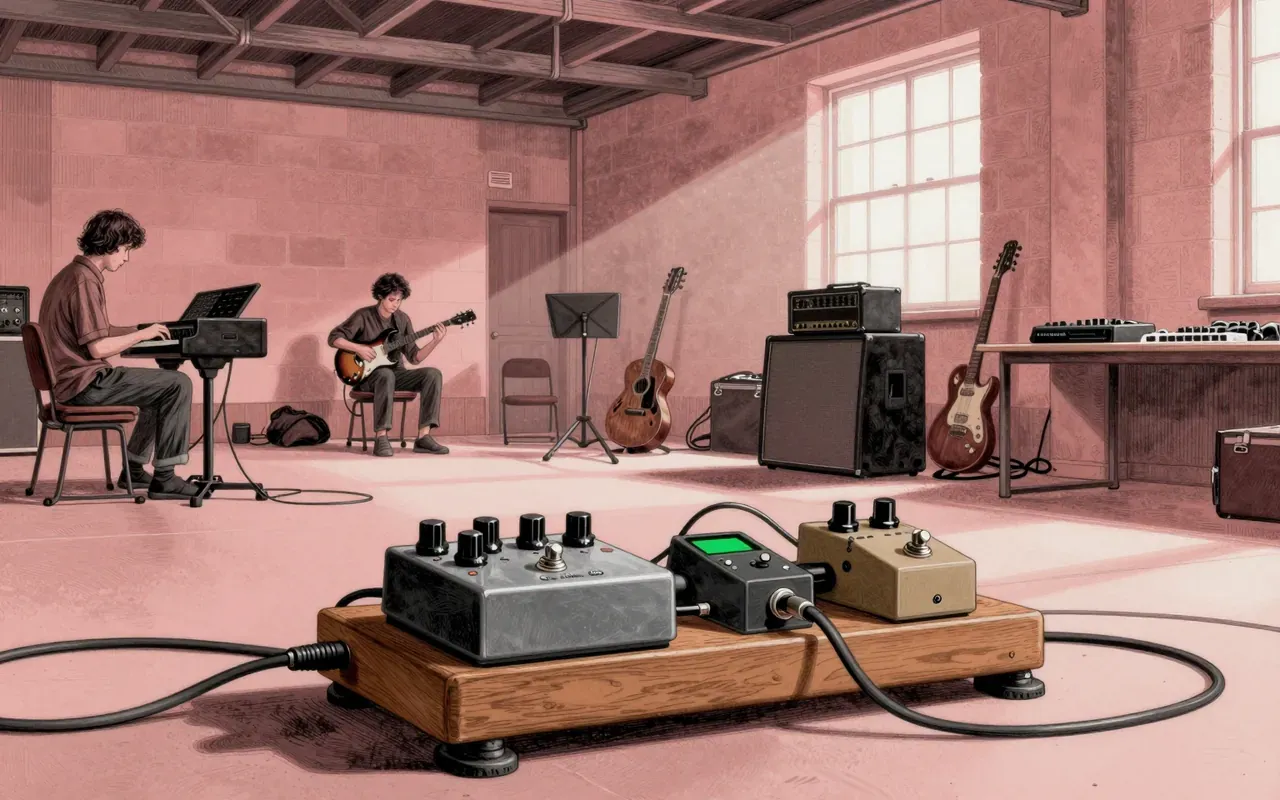
The TC Electronic ND-1 Nova Delay is a digital guitar effects pedal offering six studio-quality delay types—including Delay line, Dynamic, Reverse, Ping-pong, Pan, and Slap-back—with up to 2290 ms delay time, audio-generated tap tempo, delay spillover, true stereo I/O, true bypass, and nine user-programmable presets; it operates in manual or preset mode and includes analog-tone emulation via a tone knob.

Chapters & takeaways4
  1. 1:01
    Six Algorithms, Named

    Six discrete delay types—no hybrids, no tweaks, just names and results.

  2. 2:12
    Manual or Preset

    Nine presets and two modes: manual for tweaking, preset for switching.

  3. 4:14
    Audio Tapping, 2.3 Seconds

    2290 ms max delay, set by audio tap—not footswitch or MIDI.

  4. 5:18
    Digital Core, Analog Tone Knob

    Studio-quality digital delay, but no analogue circuit path—only tone-knob emulation.

Worth your time?

Yes. Use the whole thing.

3.5/ 5
What works
  • six named digital delay types
  • audio-generated tap tempo
  • delay spillover
  • true stereo I/O
What does not
  • looping
  • granular manipulation
  • tape saturation
  • self-oscillation
Use it if
  • guitarists needing quick-switching between tonally distinct delays
  • pedalboard minimalists requiring high functional density
Skip it if
  • anyone needing tape saturation
  • anyone needing self-oscillation
  • anyone needing custom waveform shaping
The written brief1 min read

What it is and what it was built for

The TC Electronic ND-1 Nova Delay is a digital guitar effects pedal built for live and studio use. It adds echo, texture and spatial movement to guitar signals using six fixed delay algorithms.

How it works, in terms a player would use

It runs in manual mode—dial in delay time, feedback, tone and mix on the fly—or preset mode, where nine user-programmable slots recall full settings. Tap tempo is audio-generated: strum or clap to set rate. Delay types are selected by name: Delay line, Dynamic, Reverse, Ping-pong, Pan, Slap-back. True stereo I/O and true bypass are built in.

What it does better than anything else

It delivers six distinct, named digital delay types with spillover and analog-tone emulation in one pedal—more variety than most single-delay units at this size and price.

What it does badly

It does not offer looping, sampling beyond phrase-level capture, or multi-tap or dotted-eighth subdivisions. It gives no control over filter slope, modulation depth or delay regeneration shape.

What people made with it

No verified examples of specific recordings, performances or artists appear in the source material.

Who should use it, and who should not

Guitarists who want quick-switching between tonally distinct delays without a rack or multi-FX unit should use it. Pedalboard minimalists who require only one delay with high functional density should use it. Anyone needing tape saturation, self-oscillation or custom waveform shaping should not.

Is it worth your time

Yes—if you need a compact, studio-grade digital delay with flexible routing and phrase-level control. No—if you rely on analogue warmth, infinite decay, or granular manipulation.
Same bench · Effects & pedals4 of 121
Up next in Audio

Yamaha NS-10M

Yamaha · 9:14

It lies about bass—but tells the brutal truth about everything else.

9:14