audiobriefs
7:37in productionCh. 1 · The First/ 7:37 · ceiling 15 min
Effects & pedals

Boss RV-2 Digital Reverb

Boss’s first reverb pedal is a locked box: six sounds, no tweaks, no stereo input, no future.

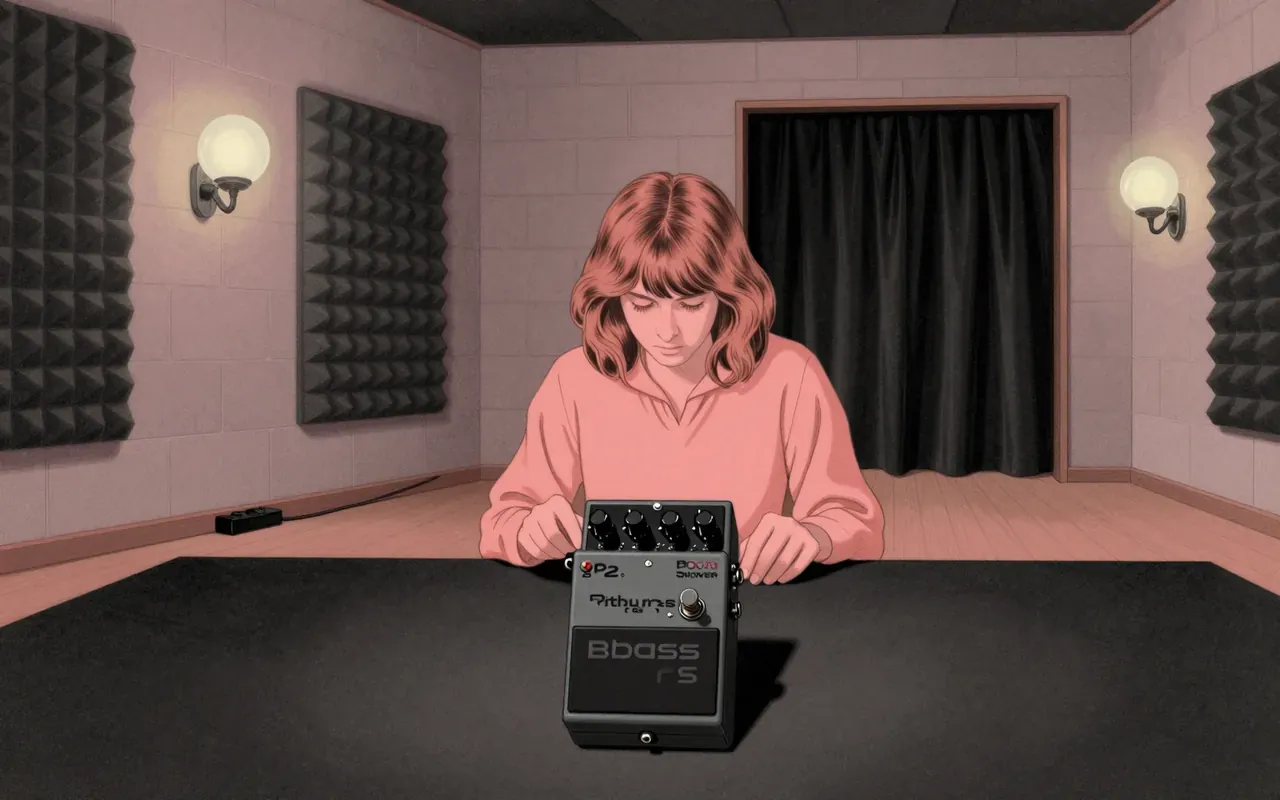
The Boss RV-2 is a fixed-function digital reverb pedal. It gives guitarists six preset spaces — no editing, no tone control, no stereo input. It is stomp-box-only. It runs on nine volts. It is discontinued. It was Boss’s first reverb.

Chapters & takeaways4
  1. 0:59
    The First

    It was Boss’s first reverb pedal — and the first of its kind in stomp-box form.

  2. 2:23
    Form Factor

    It is strictly a stomp box: one input, two outputs (A and B), no rack option.

  3. 3:22
    Power and Discontinuation

    It runs on nine volts and is no longer sold — replaced by the RV-5.

  4. 4:41
    Outputs Only

    Its dual outputs are mono — not stereo-in or true stereo-out.

Worth your time?

No. The brief is enough.

2.5/ 5
What works
  • six-preset-modes
  • stomp-box-form
  • battery-or-power-supply
What does not
  • stereo-in
  • adjustable-decay
  • rack-mountable
  • serviceable
Use it if
  • guitarist-needing-simple-reverb
Skip it if
  • player-needing-stereo-routing
  • studio-engineer-needing-editing
The written brief1 min read

What it is and what it was built for

The Boss RV-2 is a stomp-box-format digital reverb pedal built for guitarists. It was Boss’s first dedicated reverb effect.

How it works, in terms a player would use

It runs on a nine-volt battery or external power supply. It has one 1/4-inch input and two 1/4-inch outputs (A and B). A player selects one of six reverb modes with a single knob: Room, Hall 1, Hall 2, Plate, Gate, or Panning Delay.

What it does better than anything else

It delivers the first compact, stomp-box-format digital reverb from Boss — a fixed-function unit with immediate mode selection and rugged, pedalboard-ready build.

What it does badly

It offers no stereo input or true stereo reverb processing — only dual mono outputs. It lacks tone shaping, decay adjustment, or mix control beyond the single level knob. It cannot be rackmounted.

What people made with it

No verified claims describe what people made with it — the sources do not name recordings, artists, genres, or musical outcomes.

Who should use it, and who should not

A player who needs a working, simple, battery-powered reverb with six preset spaces — and who accepts its fixed architecture and lack of editing — should use it. Anyone needing stereo-in, adjustable decay, or modern reliability should not.

Is it worth your time

It is not worth your time if you need stereo routing, modern clarity, or serviceable parts. It is worth your time only as a functional relic — the first Boss reverb pedal, now discontinued and superseded.
Same bench · Effects & pedals4 of 121
9:13
Boss PS-2 Digital Pitch Shifter/DelayBossThe Boss PS-2 is a mono digital pitch shifter and delay pedal with fixed +1/−1 octave modes and three delay time ranges. It delivers immediate, stable octave doubling and atmospheric delay tails — but offers no stereo output, no expression control, and no fine pitch adjustment. It belongs on a gigging guitarist’s board, not in a stereo studio chain.
8:23
Boss VB-2 VibratoBossThe Boss VB-2 Vibrato is an analog foot pedal that modulates pitch — not volume — for electric guitar and other electronic instruments. It uses depth, rate, and rise time controls, plus a mode switch. It has no MIDI, no rack mounting, and no presets. Its strength is expressive, natural-sounding vibrato. Its weakness is inflexibility and a learning curve. It belongs in the hands of players who value analog immediacy over convenience.
9:58
Boss PH-2 Super PhaserBossThe Boss PH-2 Super Phaser is a discontinued analog guitar stompbox pedal built from 1984 to 2001. It adds a rate knob and two-mode switch to the PH-1 lineage. Mode 1 uses 10-step phasing. Mode 2 uses 12-step phasing. Controls are Rate, Depth, Res, and a 2-way Mode switch. LFO speed ranges from 100 ms to 14 s. Input impedance is 1 Mohm (FET). Residual noise is -80 dBm (IHF-A). Current draw is 20 mA at 9 V DC. Early Incubus used it for its distinctive ‘in-your-face’ phase character—especially in mode 2.
13:06
Boss OC-2 OctaveBossThe Boss OC-2 Octave is a stompbox that adds one or two sub-octaves to a guitar signal. Its three knobs control each layer. It runs on 9V DC or battery. Higher notes track smoothly — without digital harshness. But notes below the 12th fret on the low E string mis-track badly: wobbly, out-of-tune, uncorrectable. It is unfit for conventional use. Only noise or experimental players gain anything from its failure.
Up next in Audio

Rane/Serato Scratch Live SL1

Rane/Serato · 8:50

It doesn’t make sound. It doesn’t shape sound. It just lets vinyl move MP3s — and does that one thing with quiet, unshowy reliability.

8:50