audiobriefs
9:13in productionCh. 1 · Mono by design/ 9:13 · ceiling 15 min
Effects & pedals · Guitars & amps

Boss PS-2 Digital Pitch Shifter/Delay

A mono digital pedal that gives you octaves and delay — fast, fixed, and flat.

The Boss PS-2 is a mono digital pitch shifter and delay pedal with fixed +1/−1 octave modes and three delay time ranges. It delivers immediate, stable octave doubling and atmospheric delay tails — but offers no stereo output, no expression control, and no fine pitch adjustment. It belongs on a gigging guitarist’s board, not in a stereo studio chain.

Chapters & takeaways4
  1. 0:51
    Mono by design

    It is a mono digital pedal — no stereo, no analogue path, no bypass options beyond true bypass.

  2. 2:14
    Delay in three fixed bands

    Three delay ranges cover slapback, rhythmic, and ambient repeats — but no tap tempo or modulation.

  3. 3:57
    Octaves, not harmonies

    +1, −1, and manual pitch shift — no expression, no fine control, no tracking adjustment.

  4. 5:28
    No space, just depth

    No stereo output means no amp panning — just one rich, unspreading delay tail.

Worth your time?

Yes. Use the whole thing.

3.5/ 5
What works
  • instant +1/−1 octave shifts
  • cohesive delay depth across three bands
  • battery-powered live durability
What does not
  • stereo output
  • expression pedal input
  • fine manual pitch control
  • polyphonic tracking
Use it if
  • guitarists needing reliable mono octave + delay
Skip it if
  • players requiring spatialisation or expressive pitch control
The written brief2 min read

What it is and what it was built for

The Boss PS-2 is a mono digital effects pedal built for guitarists who want instant octave doubling and simple delay in one stompbox. It was built for live use: rugged casing, true bypass, and straightforward switching with no menus or presets.

How it works, in terms a player would use

The PS-2 is a mono digital pedal with three physical switches: one for delay time range (30–125 ms, 125–500 ms, or 500–2000 ms), one for pitch shift mode (+1 octave, −1 octave, or manual), and one to engage the effect. It has no expression pedal input. The manual pitch mode offers no fine-tuning dial — only coarse up/down shifting via footswitch.

What it does better than anything else

It does better than most budget digital pedals at delivering stable, immediate +1/−1 octave shifts with low latency and no noticeable pitch wobble on single-note lines. Its delay depth creates a cohesive atmospheric wash within each time range — especially in the 500–2000 ms band — without self-oscillation or digital artefacts at moderate mix levels.

What it does badly

It does badly at spatialisation: no stereo output prevents panning or dual-amp setups. Manual pitch shifting is crude — no continuous control, no fine resolution, no tracking refinement. Delay repeats lack modulation or filtering, so they stack flatly without movement or texture.

What people made with it

People made layered lead lines, faux-harmoniser textures, and lo-fi ambient swells with it — using the fixed octaves for thickening riffs and the long delay for slow-building echoes that sit behind the dry signal without competing.

Who should use it, and who should not

Guitarists who play solo or in small bands and prioritise reliability, simplicity, and mono stage rig compatibility should use it. Anyone needing stereo imaging, expressive pitch control, or clean polyphonic shifting should not.

Is it worth your time

It is worth your time if you need a compact, battery-powered mono pitch shifter with fixed octave shifts and delay ranges that cover slapback to long ambient repeats. It is not worth your time if you need stereo output, real-time pitch control, or clean harmonies at high gain.
Same bench · Effects & pedals4 of 121
13:06
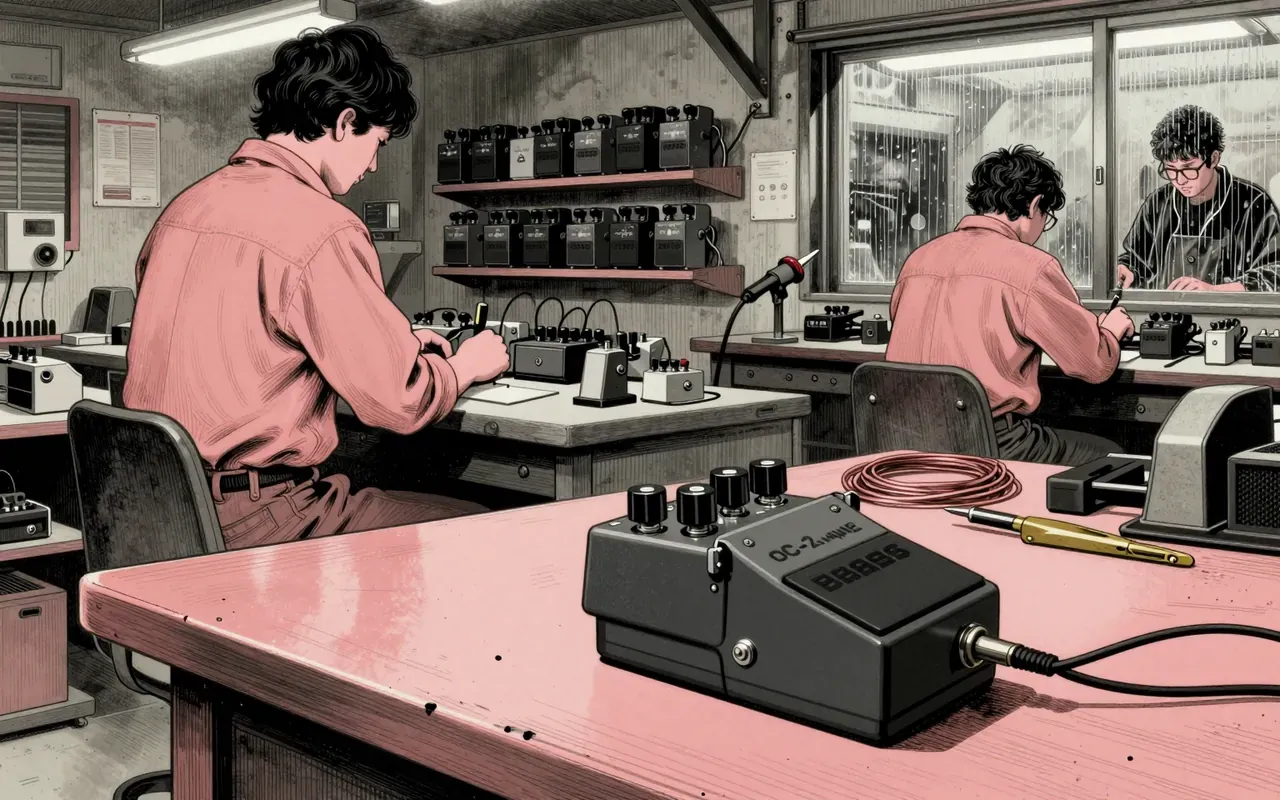
Boss OC-2 OctaveBossThe Boss OC-2 Octave is a stompbox that adds one or two sub-octaves to a guitar signal. Its three knobs control each layer. It runs on 9V DC or battery. Higher notes track smoothly — without digital harshness. But notes below the 12th fret on the low E string mis-track badly: wobbly, out-of-tune, uncorrectable. It is unfit for conventional use. Only noise or experimental players gain anything from its failure.
7:37
Boss RV-2 Digital ReverbBossThe Boss RV-2 is a fixed-function digital reverb pedal. It gives guitarists six preset spaces — no editing, no tone control, no stereo input. It is stomp-box-only. It runs on nine volts. It is discontinued. It was Boss’s first reverb.
9:25
Boss SD-1Boss · 1981The Boss SD-1 is a 1981 overdrive pedal. It is the second overdrive made by Boss. It adds a tone control and refines the OD-1’s circuit for more gain and aggression. Its asymmetrical soft-clipping uses two diodes on the positive waveform peak and one on the negative—producing both even and odd harmonics. It is midrange-focused at 800Hz and rolls off less bass than the OD-1. Its circuit has remained unchanged since release.
8:47
Boss BD-2 Blues DriverBossThe Boss BD-2 Blues Driver is an overdrive pedal sold since at least 2003. Users report its tone as round, expressive, smooth, and sultry. It responds sharply to small knob adjustments. It covers a wide sonic range — from clean overdrive to heavy grunge. It is available new and second-hand. Prices recorded are $50 (used), $79.99 (Kayes Music Scene), and $80 (Sam Ash).
Up next in Audio

Boss RV-2 Digital Reverb

Boss · 7:37

Boss’s first reverb pedal is a locked box: six sounds, no tweaks, no stereo input, no future.

7:37