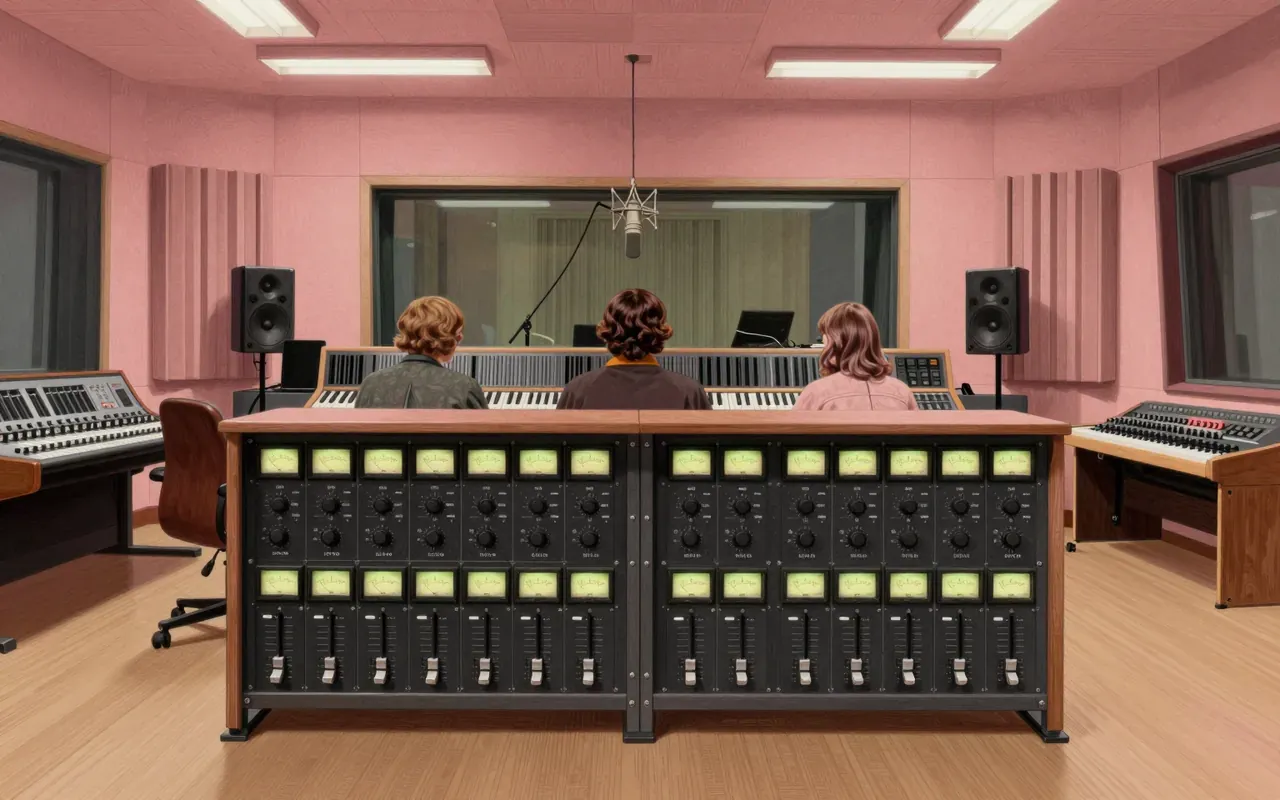
It forces you to choose between compression and limiting—but lets you run both at once, on the same channel.
The Neve 33609 is a dual-channel, all-analog studio compressor and limiter occupying two rack units. Each channel contains independent compressor and limiter sections. The compressor section provides threshold, recovery, gain, ratio, and bypass. The limiter section provides threshold, recovery, fast/slow attack, and bypass. It supports dual-mono or stereo operation with per-channel gain reduction metering.
A 2U, dual-channel analog unit with separate compressor and limiter sections per channel.
1:59
No shared controls. No shared path.
Compressor and limiter are independent: each has its own threshold and recovery, plus dedicated controls.
3:30
Attack is a limiter-only decision.
The limiter gives fast/slow attack choice. The compressor gives none.
4:32
Metering stays per-channel, even in stereo mode.
Dual-mono or stereo operation—with metering for gain reduction on each channel.
Worth your time?
Yes. Use the whole thing.
4.5/ 5
What works
simultaneous dual-path dynamics per channel
tactile, channel-isolated control
2U footprint for full dual-channel function
What does not
offer variable compressor attack
support recallable settings
provide sidechain inputs
Use it if
engineers who treat compression and limiting as distinct signal stages
studios committed to all-analog workflow
Skip it if
producers relying on automation or A/B comparison
users requiring precise timing control
The written brief1 min read
What it is and what it was built for
The Neve 33609 is a dual-channel, all-analog studio compressor and limiter built for tracking and mix bus duties where parallel dynamic control per channel is required.
How it works, in terms a player would use
Each channel has two independent sections: a compressor and a limiter. The compressor offers threshold, recovery, gain, ratio, and bypass. The limiter offers threshold, recovery, fast/slow attack, and bypass. Both sections feed into per-channel gain reduction meters. Operation is dual-mono or stereo.
What it does better than anything else
It delivers simultaneous, fully independent compression and limiting on one channel—each with its own threshold and recovery—more directly than any other hardware unit of its era or form factor.
What it does badly
It gives no control over attack time in the compressor section. It gives no control over release shape or time constants beyond ‘recovery’. It cannot operate as a single mono channel with summed inputs or shared controls.
What people made with it
The sources do not state what people made with it.
Who should use it, and who should not
Engineers who route signals through dedicated compression and limiting stages—and who value physical separation of those functions—should use it. Anyone needing recallable presets, fine-grained timing control, or integrated sidechain routing should not.
Is it worth your time
Yes—if you need analog dual-path dynamics control with tactile, channel-independent limiting and compression in a single 2U rack unit. No—if you need transparent peak control, variable attack beyond two settings, or digital recall.