audiobriefs
10:18in productionCh. 1 · Resolution/ 10:18 · ceiling 15 min
Effects & pedals · Sound design & sampling

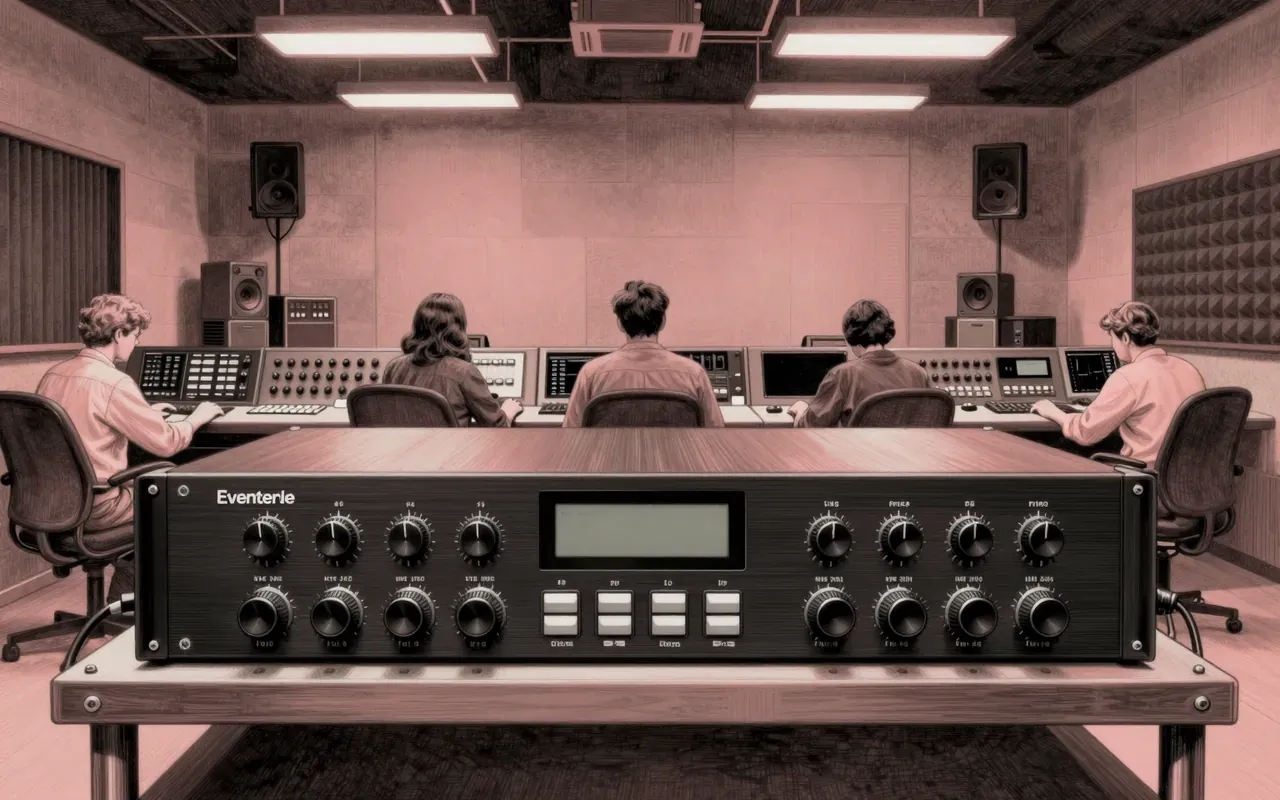
Eventide DSP4000

It doesn’t bend to your will—it makes you bend to its sound.

The Eventide DSP4000 is a discontinued multi-effects processor. It converts at 18 bits. It includes pitch shifting, reverb, and compression. Its effects span from subtle to cataclysmic. Learning it requires time and the manual.

Chapters & takeaways4
  1. 0:47
    Resolution

    18-bit conversion defines its resolution ceiling—and its sonic weight.

  2. 2:21
    Learning Curve

    The manual isn’t optional—it’s the first effect you load.

  3. 3:51
    Range

    It spans from discreet texture to dimensional cataclysm—no other unit covers that range so densely.

  4. 5:25
    Core Effects

    Pitch shift, reverb, and compression aren’t just included—they’re foundational building blocks.

Worth your time?

Yes. Use the whole thing.

4.5/ 5
What works
  • extreme textural transformation
  • high-resolution processing
  • deep parameter control
What does not
  • accommodate beginners
  • offer instant recall
  • prioritise workflow over depth
Use it if
  • sound designers
  • engineers who treat effects as instruments
Skip it if
  • live performers needing preset banks
  • those avoiding documentation
The written brief1 min read

What it is and what it was built for

The Eventide DSP4000 is a discontinued multi-effects processor built for professional studio and live sound design, where precision, depth, and sonic extremity were prioritised over speed or simplicity.

How it works, in terms a player would use

It processes audio through 18-bit analog-to-digital and digital-to-analog conversion. Editing effects demands time and the manual. Navigation uses front-panel controls and a menu-driven interface.

What it does better than anything else

It delivers an unusually wide dynamic and textural range—from subtle colouration to extreme, dimension-shifting transformations—within a single unit.

What it does badly

It does not accommodate beginners. Configuration is not fast. The learning curve is steep and requires sustained engagement with the manual.

What people made with it

People made extraordinary effects—subtle textures and cataclysmic shifts—in studios and on stage. Specific applications are not documented in the source material.

Who should use it, and who should not

Experienced engineers and sound designers who value deep control and radical transformation should use it. Beginners and those needing rapid workflow should not.

Is it worth your time

Yes—if you need extreme, texturally rich effects and are willing to invest in learning. No—if you need immediate, intuitive operation or rely on presets alone.
Same bench · Effects & pedals4 of 121
Up next in Audio

Beyerdynamic DT 48

Beyerdynamic · 7:20

The DT 48 doesn’t flatter—it exposes. And that’s exactly why it’s still on heads in studios and clinics eighty-five years later.

7:20