audiobriefs
10:53in productionCh. 1 · A stake in the game/ 10:53 · ceiling 15 min
Effects & pedals · Guitars & amps

TC Electronic SCF Stereo Chorus Flanger

It does chorus better than any flanger — and that’s the point.

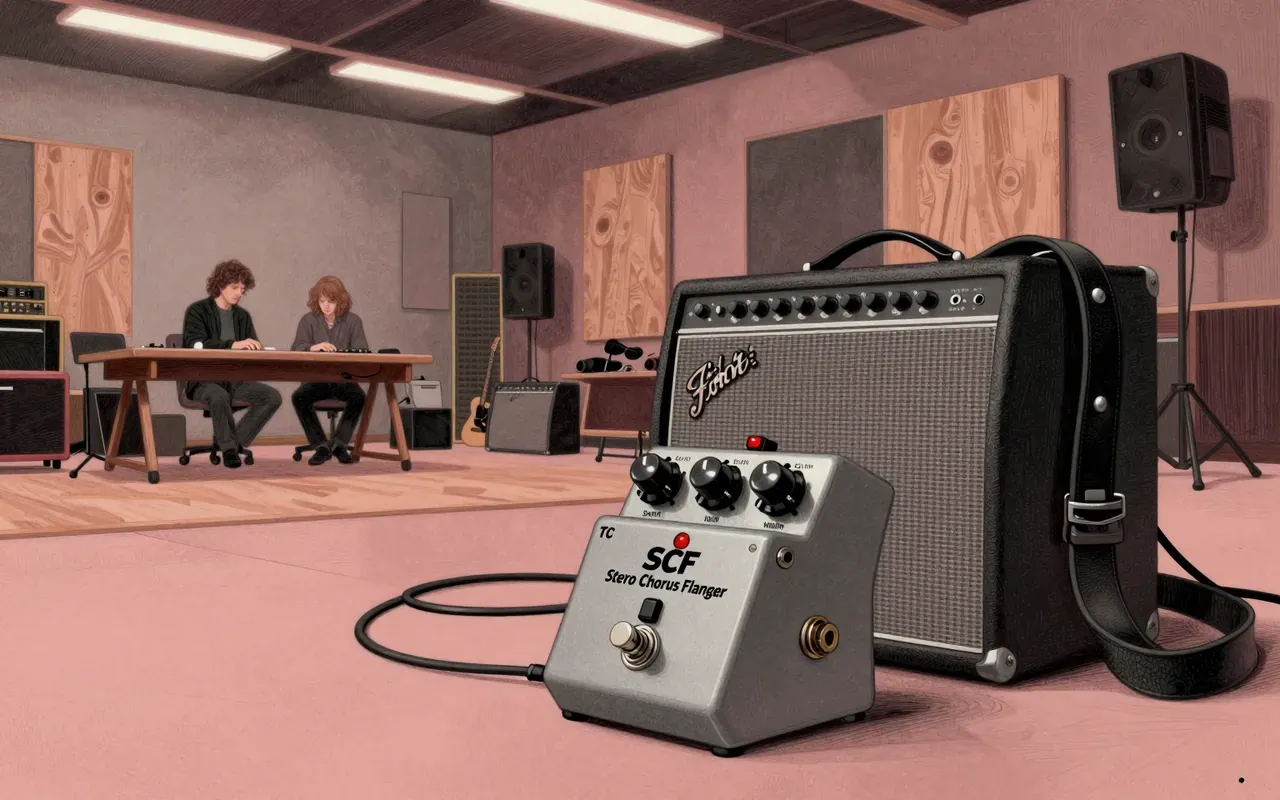
The TC Electronic SCF Stereo Chorus Flanger is an analog guitar pedal introduced in the mid-1980s. It offers Chorus, Pitch Mod, and Flanger modes via a 3-way switch. Controls include Speed, Width, and Intensity knobs, independent input gain, and a momentary footswitch. It has mono/stereo outputs, an overload LED, an external bypass jack, and draws power directly from AC mains. Its chorus mode is widely praised for its clean, studio-grade sound — but its flanger and pitch mod modes are less consistent. It is discontinued, replaced by the SCF Gold.

Chapters & takeaways4
  1. 1:05
    A stake in the game

    It was TC Electronic’s first analog modulation pedal — launched in the mid-1980s to compete in a booming guitar effects market.

  2. 2:58
    How it’s wired

    Three modes, three knobs, one momentary switch — all wired for direct AC power and stereo output.

  3. 4:44
    Analog chorus, not digital gloss

    Its analog circuitry delivers a warm, studio-grade chorus that digital units can’t match.

  4. 6:02
    What it withholds

    The overload LED and independent input gain let you dial in clean headroom — but there’s no buffer, no expression input, and no way to save settings.

Worth your time?

Yes. Use the whole thing.

3.5/ 5
What works
  • chorus
What does not
  • flanger
  • pitch mod
Use it if
  • guitarist
  • analog enthusiast
Skip it if
  • live performer without AC access
  • flanger specialist
The written brief1 min read

What it is and what it was built for

It is an analog stomp-box effect pedal built for guitarists in the mid-1980s. It was TC Electronic’s first entry into tone-modulating pedals — designed for live and studio use where stereo width and modulation clarity mattered.

How it works, in terms a player would use

It uses a momentary footswitch, not latching, so it only engages while pressed. A 3-way switch selects Chorus, Pitch Mod, or Flanger. Speed, Width, and Intensity knobs shape the effect in real time. Input gain is adjustable before modulation, with an overload LED to warn of clipping. Mono or stereo outputs are available. An external bypass jack allows remote switching. It draws power directly from AC mains — no adapter needed.

What it does better than anything else

Its chorus mode delivers a clean, lush, stereo-spread sound that stands out against digital units. The analog signal path gives warmth and organic movement that digital pedals do not replicate.

What it does badly

Its flanger mode lacks sweep depth and resonance compared to dedicated flangers. Pitch Mod voicing is inconsistent — some users report thinness or instability. It offers no rate sync, no expression input, and no preset storage.

What people made with it

Guitarists used it to add dimension to clean tones, thicken rhythm parts, and create subtle motion in solos — especially in genres prioritising texture over aggression, like post-punk, jangle pop, and ambient guitar work.

Who should use it, and who should not

Players who value analog chorus, have access to AC power, and want tactile, real-time control. Not for players needing battery portability, deep flanger control, or modern features like MIDI or presets.

Is it worth your time

Yes, if you want an analog modulation pedal with studio-grade chorus and hands-on, immediate control. No, if you need reliable flanger depth, pitch mod predictability, or battery operation.

Same bench · Effects & pedals4 of 121
8:40
Ibanez CS9 Stereo ChorusIbanezThe Ibanez CS9 Stereo Chorus is an early-1980s analog chorus pedal using Bucket Brigade Delay chips. It has two knobs (speed and width), one switch, one analog input, and two outputs (L(mono) and R stereo). It operates on 9V battery or AC/DC adapter. Its metal case ensures durability and repairability. The effect is subtle: cranking both knobs yields only gentle thickening—not pronounced modulation. It warms the clean tone rather than applying overt chorus. It does not deliver strong, fast, or wide modulation. It belongs in the rig of players who prioritise warmth, stereo spread, and reliability over dramatic movement.
9:39
Boss DM-3 DelayBossThe Boss DM-3 is the last compact analog delay Boss made. It runs from 1984 to 1988. Its 20ms–300ms delay is set by Repeat Rate, Echo, and Intensity knobs—the only Boss pedal with this shape and layout. It has an unlabeled stereo output and revised filtering to reduce noise. It does not do digital, modulation, or long delays. It does warm, decaying repeats with physical immediacy.
9:26
DigiTech WhammyDigiTech · 1989The DigiTech Whammy is a treadle-controlled digital pitch shifter pedal introduced in 1989. It uses a licensed IVL Technologies algorithm to shift pitch up to two octaves. Early models were monophonic and produced artificial, wobbly artifacts on chords. Later models improved chord tracking accuracy. It was developed by DOD Electronics (branded as DigiTech), a company founded in 1974.
8:00
Boss BF-2 FlangerBossThe Boss BF-2 Flanger is an analog stomp-box flanger pedal sold from June 1980 to December 2001. It has 1/4-inch inputs and outputs, four controls (Manual, Depth, Rate, Res), and runs on 9V battery or AC adapter. It is not rackable. It was succeeded by the digital BF-3.
Up next in Audio

Manikin Electronic Schrittmacher

Manikin Electronic · 6:57

A sequencer with no specs is a locked box — you can hold it, but you cannot connect it.

6:57