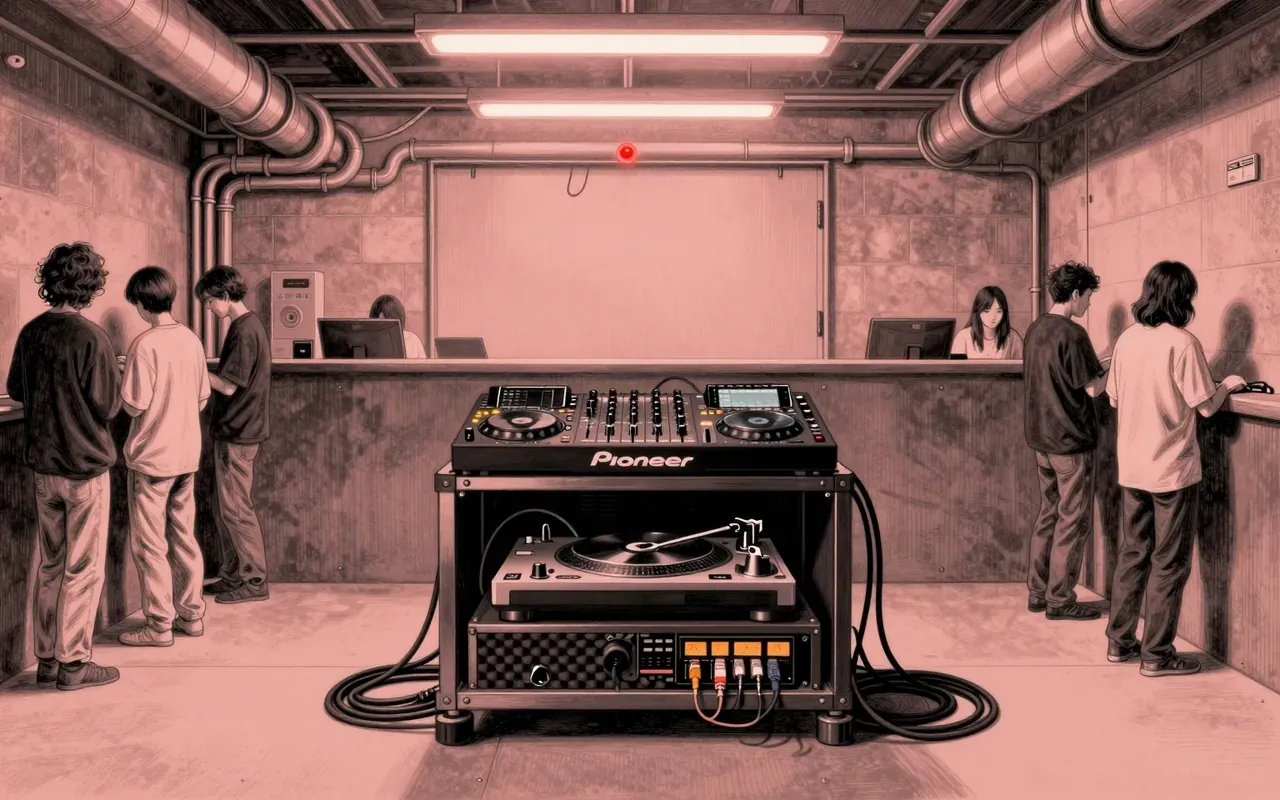
A rack-mountable DJ mixer that sacrifices every sonic and ergonomic standard to fit in a 19-inch frame.
The Pioneer DJM-1000 is a rack-mountable 4+ channel DJ mixer with two master outputs and one booth output sharing a single volume control. It has no built-in effects. Its equalizer is low quality and offers parametric control only on mic channels. Its preamps and potentiometers are poor. Its output level of 2V + 6dB causes distortion across frequency ranges.
It is one of the few DJ mixers designed for 19-inch rack mounting.
2:06
One Knob, Three Outputs
Two master outputs and one booth output share a single volume control — no independent level management.
3:41
Distorted by Default
Distortion hits across lows, mids and highs due to a weak 2V + 6dB output level and poor preamps.
4:44
EQ That Fails at the Inputs
The equalizer is low quality, and parametric control exists only on mic channels.
Worth your time?
No. The brief is enough.
1.5/ 5
What works
fitting into a 19-inch rack
What does not
distort across frequency ranges
offer independent volume control for master and booth outputs
provide high-quality preamps or potentiometers
include built-in effects
Use it if
no one
Skip it if
anyone requiring reliable signal integrity or independent output control
The written brief1 min read
What it is and what it was built for
The Pioneer DJM-1000 is a rack-mountable 4+ channel DJ mixer built for club and mobile DJ use.
How it works, in terms a player would use
It routes four input channels to two master outputs and one booth output, all sharing a single volume control. The equalizer offers parametric adjustment only on mic channels. There are no built-in effects.
What it does better than anything else
It fits into a 19-inch rack — a rare practical advantage among DJ mixers of its era.
What it does badly
It distorts across frequency ranges due to a low output level of 2V + 6dB. Its preamps are poor. Its potentiometers are unreliable. Its equalizer is low quality and non-parametric on line inputs.
What people made with it
No verified claims describe what people made with it.
Who should use it, and who should not
No one should use it today. It lacks the signal integrity, control independence, and build quality required for professional or even serious amateur work.
Is it worth your time
No. Its distortion-prone output, poor preamps, and shared volume control undermine reliability and sonic fidelity in live or studio use.