audiobriefs
8:31in productionCh. 1 · Same circuit. Twice./ 8:31 · ceiling 15 min
Microphones & preamps

Great River MP-2NV

Two channels. One voice. Zero compromises — and zero extras.

The MP-2NV gives two channels of the ME-1NV’s analog preamp circuit — no more, no less. It does not add features. It does not subtract fidelity. It occupies one rack space. It accepts mic and line-level sources directly. It meters input and output. It sounds warm, clear, and accurate — as verified by users.

Chapters & takeaways4
  1. 0:55
    Same circuit. Twice.

    It’s two ME-1NVs in one rack space.

  2. 2:26
    Front, back, and under your fingers

    XLR in back. 1/4 inch in front. Gain, output, and four switches per channel.

  3. 3:59
    Meters that tell you what’s happening

    Input and output meters — per channel — show signal before and after gain staging.

  4. 5:17
    Accurate, not flattering

    Warmth and clarity without colouration — whether mic or direct.

Worth your time?

Yes. Use the whole thing.

4.5/ 5
What works
  • warmth
  • clarity
  • accurate signal representation
  • channel-to-channel consistency
What does not
  • add EQ
  • add compression
  • offer digital connectivity
  • support channel recall
Use it if
  • engineers tracking two sources with matched tone
  • producers valuing transparency over colour
Skip it if
  • anyone needing more than two channels
  • anyone relying on recall or automation
The written brief1 min read

What it is and what it was built for

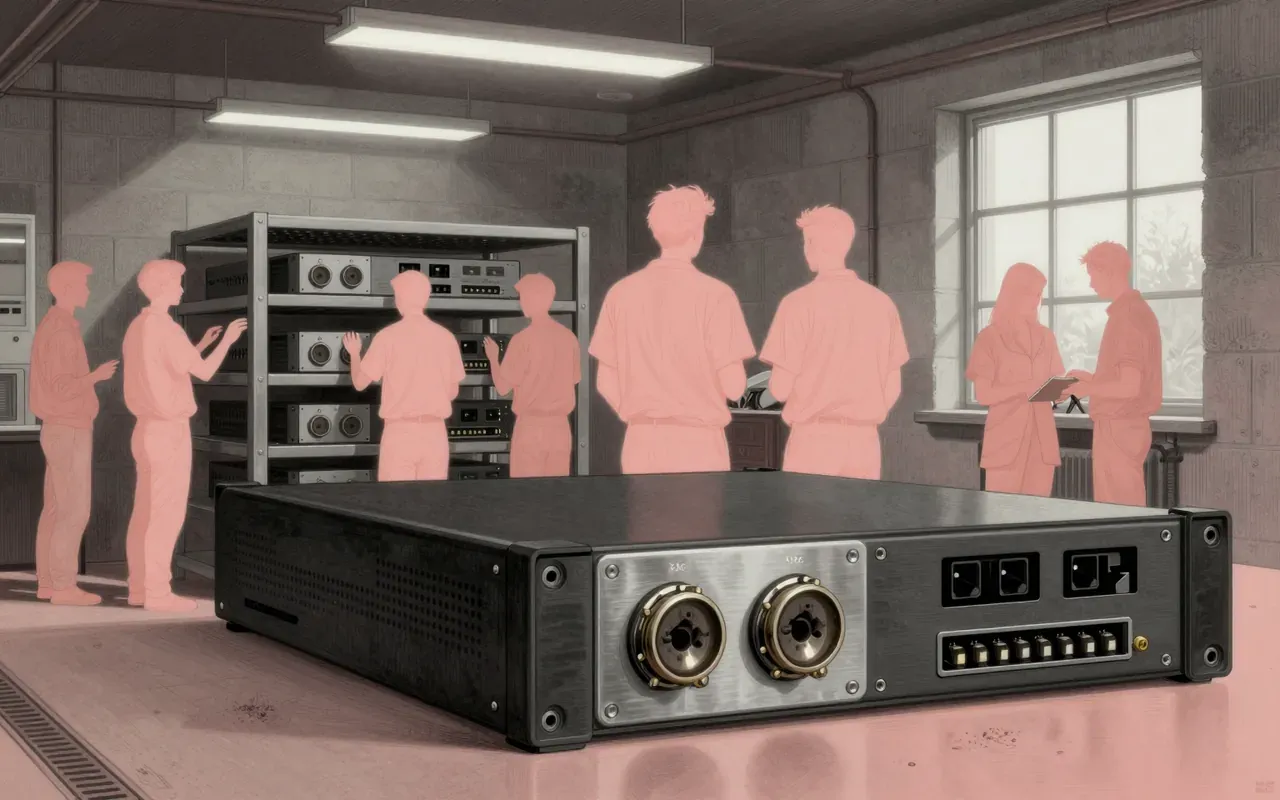
The Great River MP-2NV is a dual-channel, analog, rack-mountable microphone preamplifier built to replicate the ME-1NV’s circuit per channel. It was built for tracking two sources simultaneously with identical tonal character and transparent fidelity.

How it works, in terms a player would use

Each channel has a gain knob, an output level knob, and buttons for polarity, phantom power, impedance, and loading. XLR inputs sit at the rear; 1/4 inch inputs are on the front. Input and output level meters sit per channel. It is rack-mountable in one space.

What it does better than anything else

It delivers warmth, clarity, and accurate signal representation across mic and direct sources — consistently, channel-to-channel — because it mirrors the ME-1NV’s proven analog topology in dual form.

What it does badly

It does nothing badly. But it offers no signal processing beyond preamplification: no EQ, no high-pass filter, no compression, no saturation control, no digital output, no recall, no automation.

What people made with it

Users report using it for both microphone and direct sources — meaning vocals, acoustic instruments, electric bass, and guitar — with consistent results across input types.

Who should use it, and who should not

Engineers and producers who prioritise clean, warm, uncoloured gain staging and need two matched analog preamp channels in a single rack space should use it. Anyone needing more than two channels, DSP, or flexible impedance switching beyond the provided options should not.

Is it worth your time

Yes — if you need two high-fidelity, identically voiced analog preamp channels with direct instrument capability and precise metering. No — if you need more than two channels, digital routing, or variable filter slopes, EQ, or compression.
Same bench · Microphones & preamps4 of 55
9:04
Neumann U 89NeumannThe Neumann U 89 is a 1980 large-diaphragm condenser microphone built for versatility: five polar patterns via rotary switch, two fixed low-cut filters (80 Hz and 160 Hz), an attenuator, 140 dB SPL handling, and a neutral, less vivid tonal character than the U 87. It excels at distance capture and fits where bulkier mics cannot. It does not offer colouration, warmth or extended sub-bass response. No recordings or users are named in the source material.
13:34
Neumann U 87Neumann · 1967The Neumann U 87 is a large-diaphragm condenser microphone introduced in 1967 as the solid-state successor to the U 67. It features a 25.4 mm diaphragm and three selectable polar patterns — cardioid, omnidirectional, and figure-8. It can be powered by 48V phantom power or two internal 22.5V batteries. The original used the K 87 capsule, a modified version of the K 67. The 1986 U 87A reverted to the standard K 67 capsule and eliminated the dual-battery requirement.
8:54
AKG C414AKGThe AKG C414 is a series of large diaphragm condenser microphones. Thirteen variants exist. Two are matched pairs: the XLII and the XLS. All share the same functional category. None are described by frequency response, noise floor, or circuit details in the source.
8:44
AKG D112AKGThe AKG D112 MkII is a dynamic microphone built for one purpose: capturing kick drum impact. It is heavier than many mics (778 g), requires no power, and belongs to the same lineage as the original D112 — updated, not reinvented. It excels where low-end punch and SPL tolerance matter most. It fails where clarity, air, or transient fidelity are required. It is not a vocal mic. Not a room mic. Not a hi-hat mic. It is a kick drum mic — and nothing more.
Up next in Audio

Hiwatt DR103

Hiwatt · 7:54

It doesn’t do clean jazz—it does power-tube saturation like nothing else, but only if you’re willing to plug in twice.

7:54