
audiobriefs
9:26in productionCh. 1 · Built to be cheap, not quiet/ 9:26 · ceiling 15 min
Guitars & amps

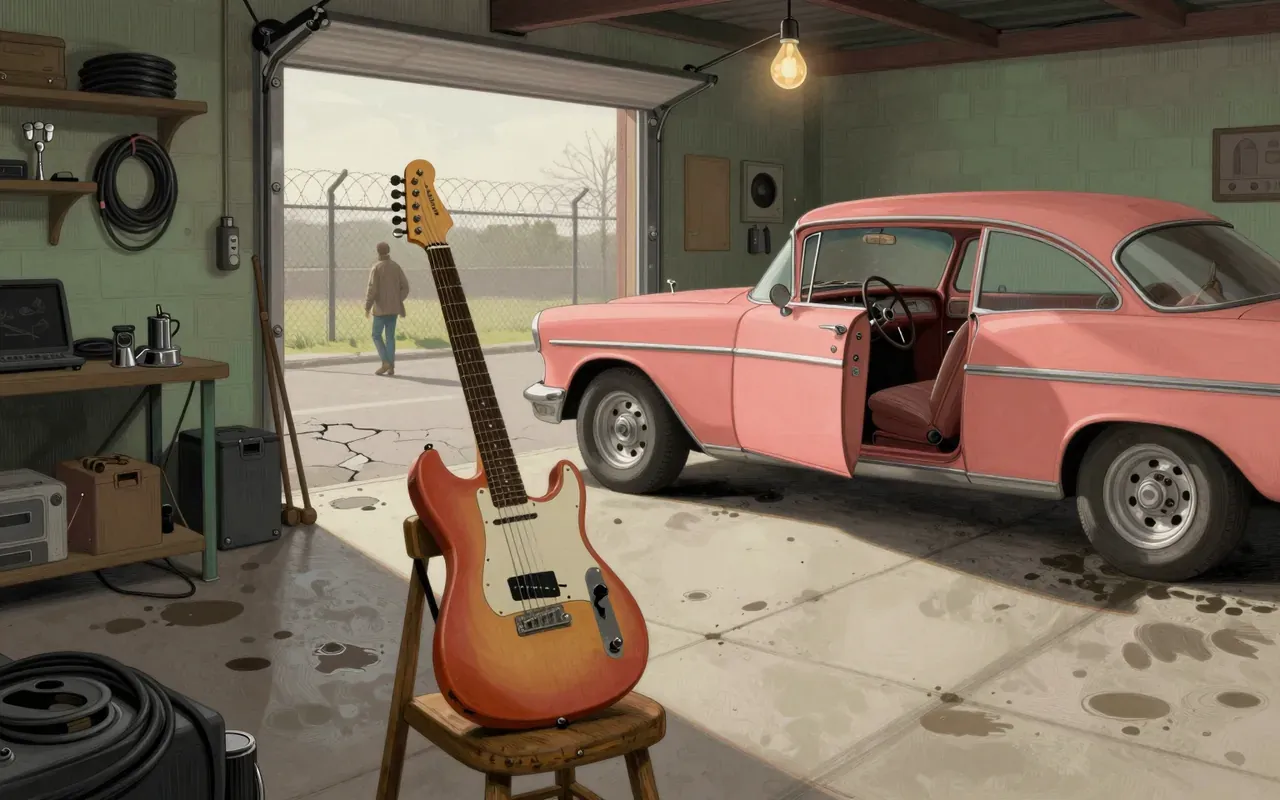
Danelectro Silvertone 1448

It stays out of tune on purpose—and that’s why it sounds like nothing else.

The Danelectro Silvertone 1448 is a 1963 masonite-bodied guitar built by Danelectro, designed by Nat Daniels, and sold by Sears as part of an 'Amp in Case' set. It has a rosewood fretboard, shorter scale, six-in-line tuners, wooden-saddle bridge, and typically one neck-position lipstick pickup. It does not intonate or stay in tune for very long.

Chapters & takeaways4
  1. 1:04
    Built to be cheap, not quiet

    Masonite body, 1963 USA build: lightweight, resonant, and unforgiving.

  2. 2:26
    Three parts, two problems

    One lipstick pickup, wooden saddle, six-in-line tuners: simple signal path, maximum friction.

  3. 4:45
    Easier to play, harder to trust

    Shorter scale helps fretting—but worsens intonation and tuning stability.

  4. 6:13
    A department-store guitar that got away

    Designed by Nat Daniels, sold by Sears: mass-market gear with accidental personality.

Worth your time?

Yes. Use the whole thing.

3.5/ 5
What works
  • as a characterful, low-cost source of gritty, mid-forward tone
  • with slide and open tunings
  • in lo-fi recordings where imperfection is part of the aesthetic
What does not
  • integrate well into modern live rigs
  • suit players requiring stable tuning
Use it if
  • lo-fi home recorders
  • slide players
  • beginners exploring open tunings
Skip it if
  • studio session players
  • tuning-sensitive genres like jazz or metal
The written brief1 min read

What it is and what it was built for

A 1963 USA-made masonite-bodied electric guitar designed by Nat Daniels for Danelectro and sold by Sears as part of an ‘Amp in Case’ set. Built for affordability and portability, not precision or longevity.

How it works, in terms a player would use

It has a single neck-position lipstick pickup, six-in-line tuners, and a wooden-saddle Danelectro bridge. The shorter scale length eases fretting but compounds intonation issues. Players must constantly retune and adjust phrasing to compensate for the bridge’s inability to set accurate string length.

What it does better than anything else

It delivers a gritty, immediate, slide-friendly tone unmatched by most budget guitars of its era—tight, nasal, and cutting through without compression or bloom.

What it does badly

It does not intonate or stay in tune for very long. The wooden-saddle bridge offers no individual string compensation. The six-in-line tuners lack precision and hold.

What people made with it

Players used it for garage rock, blues shuffles, and lo-fi recordings where its tonal character outweighed its mechanical shortcomings.

Who should use it, and who should not

Beginners exploring slide or open tunings. Lo-fi home recorders. Players who prioritise immediacy over stability. It is not for anyone needing reliable intonation, fast chord changes, or studio-tight tracking.

Is it worth your time

Yes—if you want a low-cost, slide-ready instrument with a raw, mid-forward tone and accept its tuning and intonation limits as part of the voice, not flaws to fix.
Same bench · Guitars & amps4 of 148
9:11
Danelectro ShorthornDanelectroThe Danelectro Shorthorn is a lightweight, hollow-bodied electric guitar built from Masonite and poplar. Introduced in 1959, it features dual cutaways, stacked tone/volume knobs, and a distinctive 'Coke Bottle Style' headstock. Reissues varied in manufacturing location and control layout. It excels in clarity and responsiveness at low gain but lacks sustain and feedback resistance.
9:32
Gibson Flying VGibson · 1958The Gibson Flying V is an electric guitar introduced in 1958 with a radical futuristic body design, initially made from korina (limba) wood, with only 98 units produced in its first run due to poor sales. It was reissued in 1967 using mahogany and design updates including a new bridge and larger pickguard. Its physical design — including 17-degree headstock angle and central pickup placement — was intended to enhance sustain.
10:14
Vox AC50VoxThe Vox AC50 is a loud, clear, live-performance amplifier head introduced in 1964. It uses EL34 output tubes, ECC82 and ECC83 preamp tubes, and evolved from GZ34 to diode rectification. Its dual then quad inputs offer immediate tonal contrast. It pairs with a trolley cabinet featuring Alnico speakers and a Goodmans Midax Horn for crowd-piercing clarity. It sacrifices compactness, low-volume usability, and modern features for authoritative stage presence.
9:55
Gibson Les Paul CustomGibson · 1954The Gibson Les Paul Custom is a luxury electric guitar introduced in 1953 at Les Paul’s request for a black, tuxedo-like instrument. It featured the ABR-1 bridge from 1954, adopted the PAF pickup in mid-1957, and switched to Grover Rotomatics by 1958. It remained a double-cutaway model until 1963, when it was renamed the SG Custom after Les Paul’s endorsement ended.
Up next in Audio

Technics SL-1100

Technics · 9:04

Four zones. One keyboard. Zero USB.

9:04