audiobriefs
8:15in productionCh. 1 · Volume First/ 8:15 · ceiling 15 min
Guitars & amps · Studio & recording

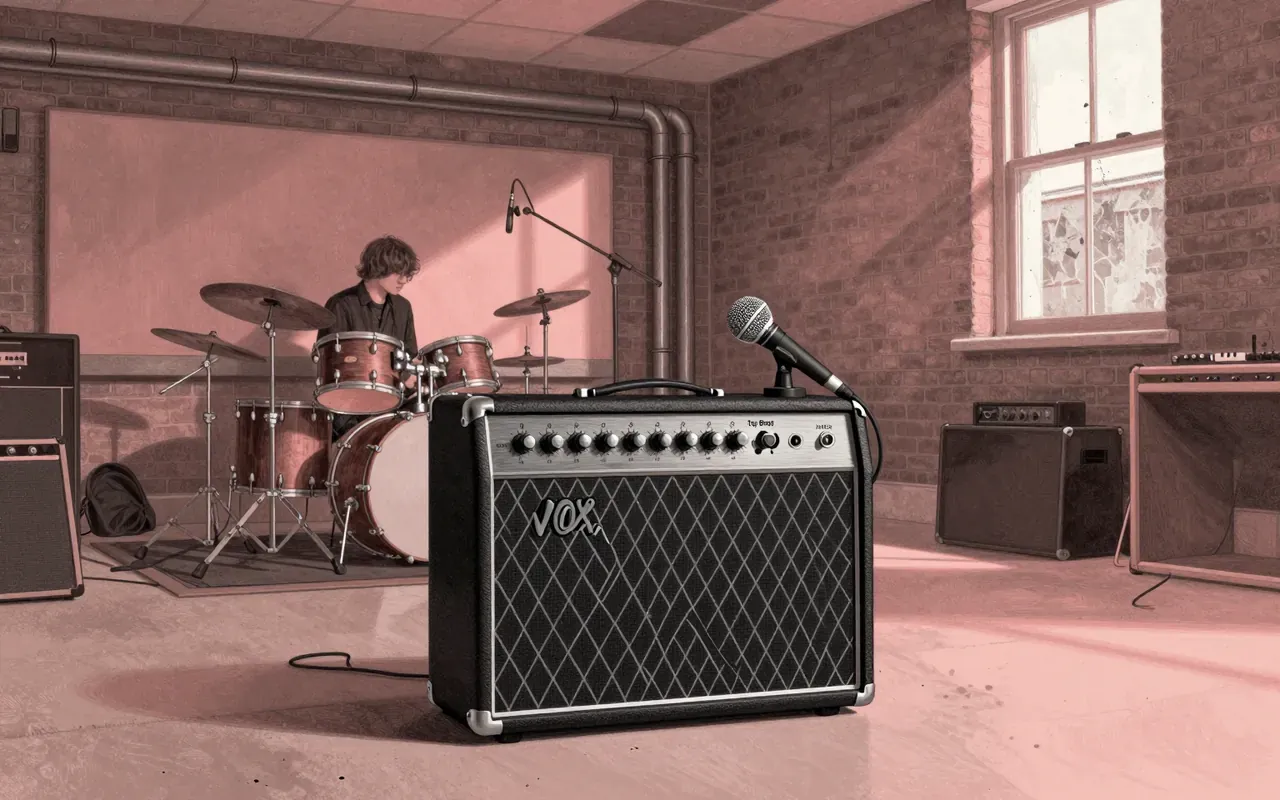
Vox AC30

It doesn’t warm up—it cuts through. And it won’t fill your room unless you turn it up.

The Vox AC30 is a valve-powered guitar amplifier introduced in 1959 to provide higher wattage and greater volume than the AC15. Its class AB operation, cathode-biased EL84 push-pull output stage, and Celestion Blue speaker pairing produce a jangly, mid-forward, high-clarity tone with limited low-end at low volumes but strong headroom and smooth overdrive. It is not synthesizer-based and does not employ digital or solid-state synthesis methods.

Chapters & takeaways4
  1. 0:55
    Volume First

    Built in 1959 to out-volume the AC15.

  2. 1:44
    How It Actually Works

    Four cathode-biased EL84s in class AB push-pull—not EL34s, not class A.

  3. 3:13
    The Tone Circuit That Defined a Sound

    Top Boost creates honky mids and sparkling highs—clarity that records and cuts live.

  4. 4:42
    Clean Until It Isn’t

    Clean headroom gives definition—until it breaks up fast, but always stays articulate.

Worth your time?

Yes. Use the whole thing.

4.5/ 5
What works
  • honky midrange and sparkling highs
  • clean headroom with fast, musical breakup
  • cutting presence in dense mixes
What does not
  • deliver warmth at low volumes
  • replace full-range bass amplifiers
  • operate in class A
Use it if
  • guitarists needing articulate cleans
  • players recording jangly rhythm parts
  • live performers who can run it loud
Skip it if
  • bedroom players needing silent practice
  • bassists or extended-range guitarists
  • anyone relying on low-end heft at moderate volume
The written brief1 min read

What it is and what it was built for

A valve-powered guitar amplifier introduced in 1959 to provide higher wattage and greater volume than the AC15.

How it works, in terms a player would use

It runs class AB, not class A. Four cathode-biased EL84 valves drive two 12” speakers in push-pull. The Top Boost tone circuit reshapes the preamp for mid-forward clarity. It does not use EL34s in its archetypal form.

What it does better than anything else

It delivers honky midrange and sparkling high-end clarity unmatched by Fender or Marshall equivalents—ideal for chiming arpeggios and cutting lead lines in live and studio settings.

What it does badly

It lacks low-end warmth, especially at low volumes or with Top Boost engaged. It does not deliver full-range frequency balance without volume.

What people made with it

Players used it to define the British Invasion sound: bright, clear, articulate rhythm and lead tones that sit upfront in dense mixes.

Who should use it, and who should not

Guitarists who prioritise midrange presence, clean headroom, and organic breakup at stage volume. Not for players needing deep bass at bedroom levels or consistent low-end across all settings.

Is it worth your time

Yes—if you need jangly, articulate clean tones that cut through a mix, and accept limited low-end at low volumes. No—if you rely on warm bass response or silent practice.

Same bench · Guitars & amps4 of 66
9:31
Gretsch Country ClubGretschNo verified source links the term 'Country Club' to any specific Gretsch instrument feature, specification, or design rationale beyond its model name and mid-1950s introduction alongside the 6120 Nashville, 6128 Duo Jet, and White Falcon. No claims about its construction, electronics, finish, or player experience are supported by the provided material. All descriptive statements must therefore be omitted or flagged as unsupported. The only factual anchors are its name, its status as a Gretsch guitar model, and its release period.
9:30
Gretsch TennesseanGretschThe Gretsch Tennessean is a hollow-body electric guitar built for vintage tone and playability. It delivers a highly resonant, cutting voice shaped by its construction, pickups, and controls. It excels in clean and mid-gain contexts but struggles with feedback and high-gain stability. Its design prioritises acoustic resonance and vibrato expression over modern high-output versatility.
10:06
Rickenbacker 325Rickenbacker · 1958The Rickenbacker 325 is a compact, bright, feedback-prone hollow-body guitar defined by its short scale, semi-hollow construction, and visual signature — the crescent moon cutaways and angled sound hole. It was designed for clarity and portability, not warmth or power.
9:15
Vox AC15VoxThe Vox AC15 is a foundational British guitar amplifier — simple, immediate, and sonically specific. It trades versatility for character. Its design choices are constraints, not oversights. It remains relevant not as a relic, but as a functional tool with an unrepeatable voice.
Up next in Audio

Vox AC50

Vox · 10:14

The AC50 isn’t louder than the AC30 — it’s clearer at volume, and that’s the point.

10:14