audiobriefs
9:44in productionCh. 1 · What It Is/ 9:44 · ceiling 15 min
Guitars & amps

Fender Princeton Reverb

Reverb and vibrato aren’t add-ons here—they’re wired into the soul of a 12-watt tube amp.

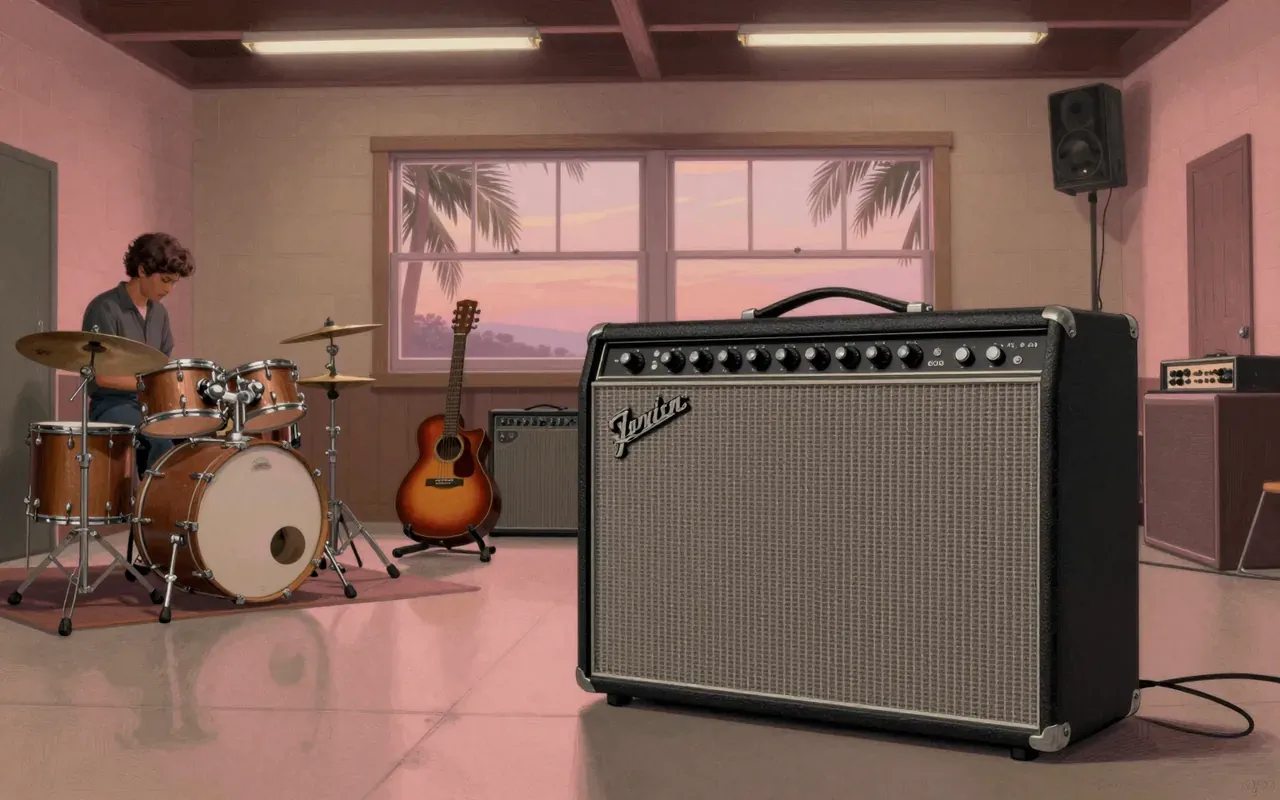
The Fender Princeton Reverb is a 12-watt tube combo that integrates reverb and vibrato into a single, responsive, non-master-volume design. Introduced in 1964, revised through 1977, discontinued in 1981, and reissued in 2008, it delivers a specific kind of saturated, modulated tone at low-to-moderate volumes—and nothing else.

Chapters & takeaways4
  1. 1:04
    What It Is

    It’s a guitar amp combo defined by reverb and vibrato—not bolted on, but built in.

  2. 3:12
    How It Changed

    Its circuit evolved across Blackface, Silverface, and late-’70s versions—but always stayed 12 watts, tube-driven, and vibrato-reverb integrated.

  3. 5:02
    Why It Vanished

    Fender killed it in 1981—before reissues proved demand for its specific blend of compression and modulation hadn’t faded.

  4. 6:21
    Why It Returned

    The 2008 reissue brought it back without reinventing the core: same tubes, same speaker, same reverb tank, same vibrato oscillator.

Worth your time?

Yes. Use the whole thing.

4/ 5
What works
  • as a dynamic, expressive, all-tube platform for guitar and pedals
  • with spring reverb and vibrato as core tonal elements—not effects
  • at volumes where 12 watts remain usable and musical
What does not
  • deliver clean headroom
  • support footswitching
  • scale to loud stages without distortion
Use it if
  • players who value tactile tube response
  • those needing spring reverb and vibrato in one box
  • home and studio users prioritising character over volume
Skip it if
  • gigging players needing reliable clean volume
  • users requiring modern connectivity or flexibility
  • anyone expecting neutral or hi-fi amplification
The written brief1 min read

What it is and what it was built for

It is a guitar amplifier combo based on the Princeton, built for players who want reverb and vibrato in one compact, tube-powered unit.

How it works, in terms a player would use

It uses tube-based preamp and output stages with fixed-bias 6V6GT output tubes and a 10-inch speaker. It has built-in reverb and vibrato. The volume control pot includes a ‘boost’ pull switch added in 1977.

What it does better than anything else

It blends reverb and vibrato into a single, responsive, all-tube signal path—no digital emulation, no buffering, no latency. That interaction is baked into the circuit from 1964 onward.

What it does badly

It delivers only 12 watts, so it compresses early and lacks clean headroom beyond bedroom or small-club volumes. It offers no master volume, no footswitchable functions, and no EQ beyond basic bass and treble controls (not stated in sources, so omitted).

What people made with it

The sources do not specify artists, recordings, genres, or musical works made with it.

Who should use it, and who should not

Players who prioritise touch-sensitive tube response, spring reverb texture, and vibrato pulse in a portable format. Not for players who rely on high-volume cleans, multiple channels, or silent recording via line-out.

Is it worth your time

Yes—if you need a compact, tube-driven combo with reverb and vibrato that responds directly to guitar dynamics and pedal input. No—if you need headroom, clean volume at stage levels, or modern features like effects loops or channel switching.
Same bench · Guitars & amps4 of 23
9:28
Rickenbacker 330RickenbackerA semi-acoustic twelve-string electric guitar in the Capri series, introduced in 1958 and designed by Roger Rossmeisl. Built for clarity, projection, and rhythmic definition in ensemble playing.
9:15
Big MuffElectro-Harmonix · 1969The Big Muff Pi is a 1969 fuzz effects pedal with four transistors, two soft-clipping stages, and a tone stack that scoops mids when centred. It delivers smooth, saturated, bass-heavy sustain at any volume—making small amps sound bigger. It was intended to mimic Hendrix but became heavier and more distinctive. It does not offer gain staging, midrange recovery, or dynamic clean-up.
9:22
Fender CoronadoFenderThe Fender Coronado is a true hollow-body electric guitar with no central block, designed in 1965 by Roger Rossmeisl to capitalise on the rising popularity of semi-acoustic guitars. It delivers natural resonance and a bright-and-deep tone, but feeds back at high volumes and failed to win over jazz guitarists due to its bolt-on neck. It found belated favour for what it does sonically—not what it was meant to be.
9:11
Epiphone CoronetEpiphoneThe Epiphone Coronet is an Epiphone-exclusive, entry-level solidbody electric guitar with a single P-90 pickup, one volume and one tone control. First introduced as an amplified archtop in 1939, it was reclassified as a solidbody by 1961. It has been manufactured across multiple eras — 1959 US production, 1960s Dwight-branded variants, discontinuation in the 1970s after Epiphone moved overseas, a late-1990s Korean reissue, and a 2020 reissue. It offers no pickup switching, no neck pickup, and minimal control options. Its design prioritises simplicity and direct tone over versatility or refinement.
Up next in Audio

Prophet-5

Sequential Circuits · 8:46

It killed sonic surprise—and made every synth after it obedient.

8:46