audiobriefs
34:32in productionCh. 1 · Origin: Clean from the start/ 34:32 · ceiling 15 min
Guitars & amps

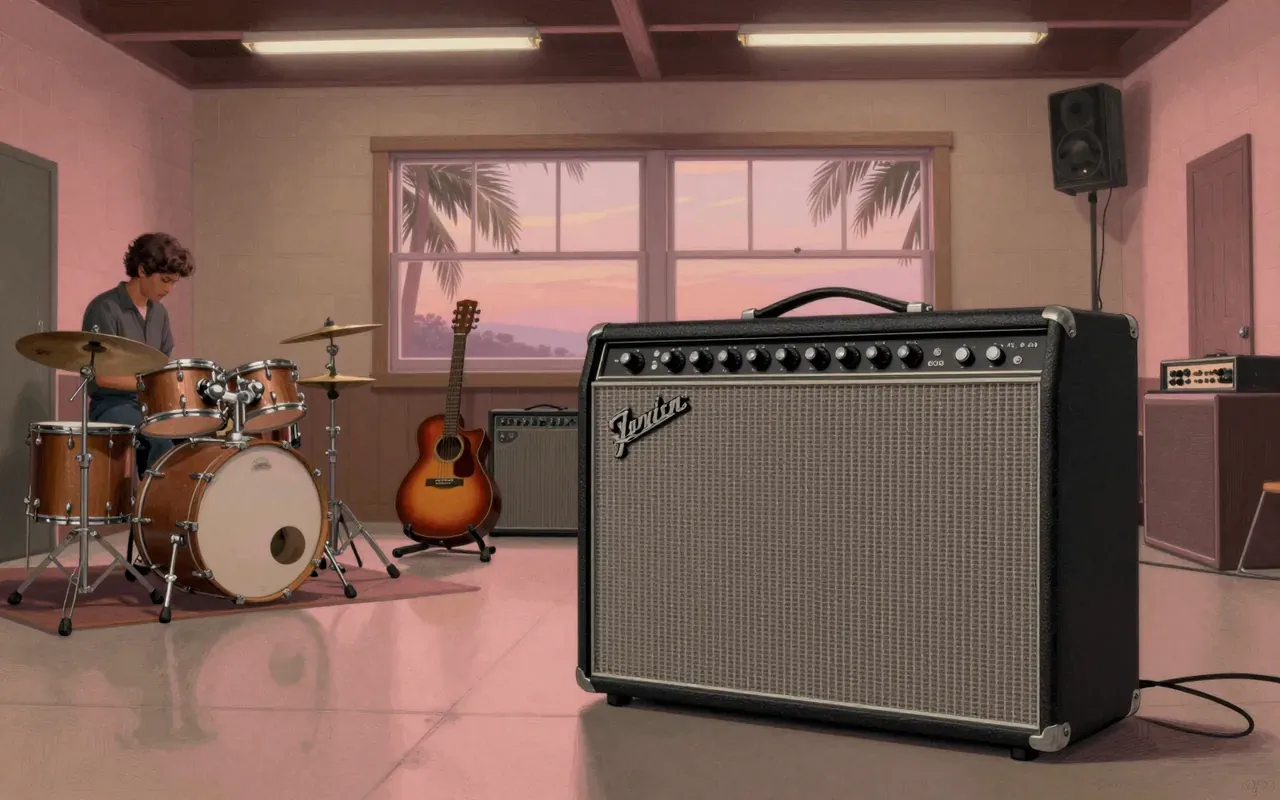
Fender Twin

It doesn’t sing — it broadcasts. The Twin is the anti-breakup amp, built for clarity, not character.

The Fender Twin is a clean-headroom amplifier built for volume and clarity — not saturation or convenience.

Chapters & takeaways4
  1. 1:07
    Origin: Clean from the start

    Born in 1952 as a 25W dual-12" tube combo, the Twin was built for projection — not personality.

  2. 2:12
    Evolution: More power, same purpose

    The 1957 upgrade to four 5881s and the 1963 shift to Twin Reverb added volume and reverb — but kept the same clean mission.

  3. 29:04
    Circuit: Headroom over harmonics

    Six preamp tubes, four 6L6GCs, solid-state rectification, and tube-driven reverb give clean headroom and channel independence — not warmth or sag.

  4. 30:51
    Legacy: Uncompromising consistency

    Revisions were constant — but never toward distortion, portability, or player convenience.

Worth your time?

Yes. Use the whole thing.

4.5/ 5
What works
  • clean headroom
  • reliable reverb integration
  • channel separation at volume
What does not
  • break up early
  • fit in a hatchback
  • offer master volume
Use it if
  • studio engineers
  • clean-tone players
  • large-venue performers
Skip it if
  • bedroom players
  • overdrive-dependent guitarists
  • touring musicians needing lightweight gear
The written brief1 min read

What it is and what it was built for

The Fender Twin is a 1952 all-tube guitar amplifier built for volume, clarity, and reliability. It was designed to project cleanly in large venues and recording studios — not to overdrive.

How it works, in terms a player would use

It runs two independent channels — Normal and Vibrato — each with its own tone stack and volume control. Reverb is tube/transformer-driven into a low-impedance spring tank. It uses a solid-state rectifier, four 6L6GC output tubes, and six preamp tubes: four 7025/12AX7 and two 12AT7.

What it does better than anything else

It delivers uncoloured, loud, clean amplification better than almost any guitar amp ever made. Its dual-channel architecture gives independent EQ and gain staging without crosstalk. The tube-driven reverb integrates seamlessly into the signal path without colouring the dry tone.

What it does badly

It does not break up early. Its high headroom and solid-state rectifier withhold power-tube distortion until extreme volumes. It offers no master volume, no effects loop, and no footswitchable reverb or channel switching.

What people made with it

Players used it for jazz, country, surf, and studio work where pristine clean tone and dependable reverb were required. Its 80W blackface-era version anchored live sound before PA systems could handle guitar frequencies.

Who should use it, and who should not

Use it if you play clean or mildly driven styles and need consistent, uncoloured tone at high volume. Do not use it if you gig in small rooms, need weight under 40kg, or rely on amp breakup for texture.

Is it worth your time

Yes — if you need clean headroom, studio-grade reverb integration, and channel separation that holds up at stage volume. No — if you rely on power-tube saturation or want portability.

Same bench · Guitars & amps4 of 66
9:31
Gretsch Country ClubGretschNo verified source links the term 'Country Club' to any specific Gretsch instrument feature, specification, or design rationale beyond its model name and mid-1950s introduction alongside the 6120 Nashville, 6128 Duo Jet, and White Falcon. No claims about its construction, electronics, finish, or player experience are supported by the provided material. All descriptive statements must therefore be omitted or flagged as unsupported. The only factual anchors are its name, its status as a Gretsch guitar model, and its release period.
9:30
Gretsch TennesseanGretschThe Gretsch Tennessean is a hollow-body electric guitar built for vintage tone and playability. It delivers a highly resonant, cutting voice shaped by its construction, pickups, and controls. It excels in clean and mid-gain contexts but struggles with feedback and high-gain stability. Its design prioritises acoustic resonance and vibrato expression over modern high-output versatility.
10:06
Rickenbacker 325Rickenbacker · 1958The Rickenbacker 325 is a compact, bright, feedback-prone hollow-body guitar defined by its short scale, semi-hollow construction, and visual signature — the crescent moon cutaways and angled sound hole. It was designed for clarity and portability, not warmth or power.
9:15
Vox AC15VoxThe Vox AC15 is a foundational British guitar amplifier — simple, immediate, and sonically specific. It trades versatility for character. Its design choices are constraints, not oversights. It remains relevant not as a relic, but as a functional tool with an unrepeatable voice.
Up next in Audio

Yamaha TX81Z

Yamaha · 9:22

The TX81Z isn’t cheaper DX7 — it’s the first FM synth that sounds like something else.

9:22