audiobriefs
8:18in productionCh. 1 · The First One You Could Buy/ 8:18 · ceiling 15 min
Effects & pedals · Guitars & amps

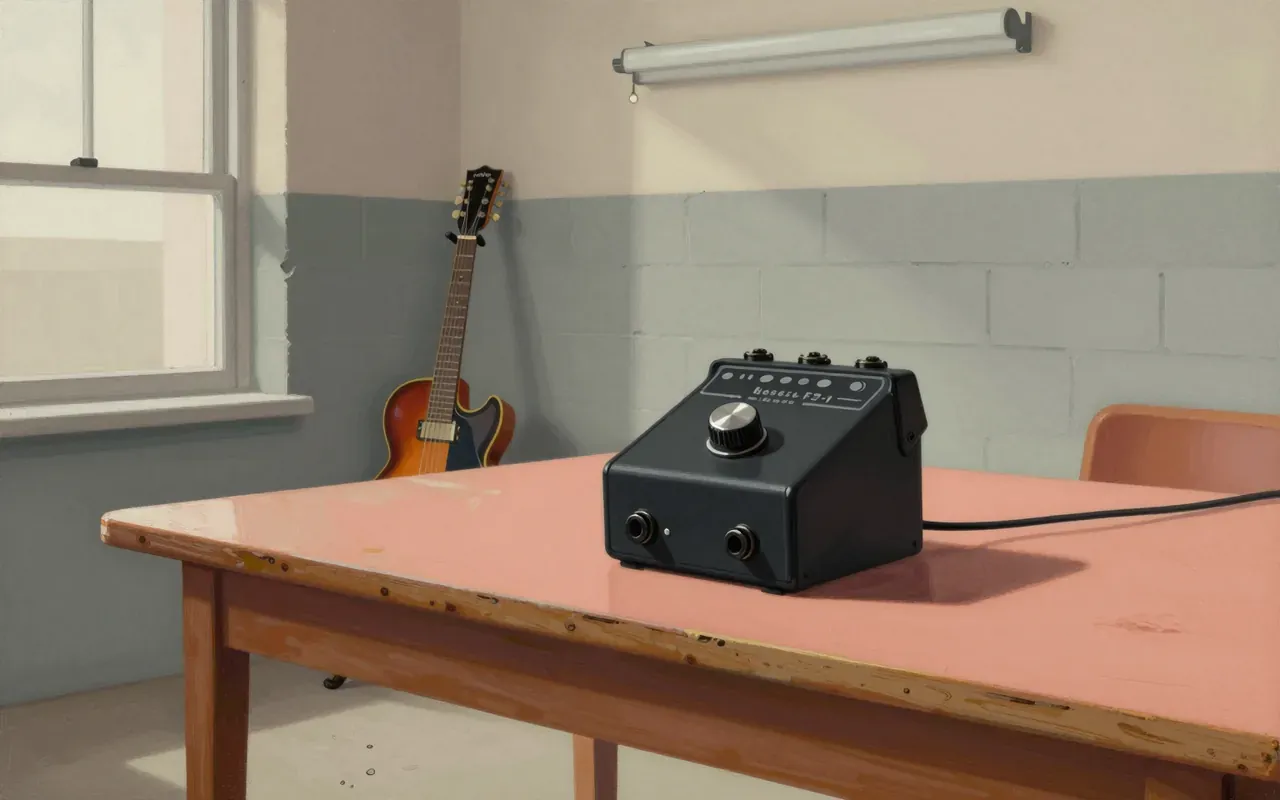
Maestro FZ-1 Fuzz-Tone

It doesn’t shape tone — it hijacks your signal with brass-like chaos, and it still won’t behave.

The Maestro FZ-1 Fuzz-Tone is the first widely marketed fuzz effect. Introduced in 1962. Achieved mainstream impact in 1965 via Keith Richards on 'Satisfaction'. Uses three germanium transistors. Powered by two 1.5V batteries (later one). Responds directly to input amplitude. Temperature sensitive. Delivers brass-like tones. Integrated into Gibson EB-0F basses circa 1964. Revised as FZ-1a in late 1965.

Chapters & takeaways5
  1. 1:03
    The First One You Could Buy

    It was the first widely marketed fuzz — not the first fuzz, not the first prototype, but the first you could buy.

  2. 2:04
    Fame Arrived Late

    Its fame arrived in 1965 — not 1962 — when Keith Richards turned it into a riff-making weapon.

  3. 2:52
    No Controls, Just Consequences

    Three germanium transistors. Two batteries. One input-level dependency. No apologies.

  4. 3:50
    Brass, Not Buzz

    Gibson’s demo disc didn’t call it ‘fuzzy’ — it called it ‘brass-like’.

  5. 4:50
    Inside, Updated, Unchanged

    It lived inside basses. It got a battery downgrade. It kept the same wedge.

Worth your time?

Yes. Use the whole thing.

3.5/ 5
What works
  • as a blunt-force tonal disruptor
  • when paired with a loud tube amp
  • to make bass cut like a horn section
What does not
  • offer tone control
  • clean up with guitar volume
  • run on standard 9V power
  • maintain stable bias in warm rooms
Use it if
  • players chasing 1960s rock texture
  • collectors of foundational effects
  • builders studying early germanium circuits
Skip it if
  • performers needing silent switching
  • studio engineers requiring repeatable gain staging
  • anyone without a battery tester
The written brief1 min read

What it is and what it was built for

The first widely marketed fuzz distortion effect for guitar and bass. Built for live and studio use by players wanting saturated, aggressive tone — originally intended for bass, then adopted by guitarists.

How it works, in terms a player would use

It uses three germanium transistors — RCA 2N270 in the original, later 2N2614 or 2N2613 — wired into a simple circuit powered by two 1.5-volt batteries (one battery after late 1965). It responds directly to input signal amplitude: louder playing yields more distortion. Its germanium devices shift with temperature.

What it does better than anything else

It delivers a brassy, spluttering, harmonically aggressive fuzz that cuts through a mix like nothing else from 1962–1965. Nothing else at the time gave players that exact response to picking dynamics and amp input overload.

What it does badly

It is temperature sensitive. It offers no tone control, no volume taper, no bypass switch. It cannot clean up with guitar volume rolls. Its output level jumps unpredictably across settings.

What people made with it

Keith Richards used it on the Rolling Stones’ ‘Satisfaction’ in 1965. Gibson built its circuit into EB-0F fuzz basses around 1964. Early adopters used it to define the sonic edge of 1960s rock.

Who should use it, and who should not

Players who want authentic 1960s fuzz texture and accept its limitations: heat drift, battery dependency, no tone shaping. Not for gigging musicians needing reliability or silent tuning.

Is it worth your time

Yes — if you want the raw, unstable character of early fuzz as heard on ‘Satisfaction’. No — if you need consistency, low noise, or modern pedalboard compatibility.

Same bench · Effects & pedals4 of 9
9:15
Big MuffElectro-Harmonix · 1969The Big Muff Pi is a 1969 fuzz effects pedal with four transistors, two soft-clipping stages, and a tone stack that scoops mids when centred. It delivers smooth, saturated, bass-heavy sustain at any volume—making small amps sound bigger. It was intended to mimic Hendrix but became heavier and more distinctive. It does not offer gain staging, midrange recovery, or dynamic clean-up.
8:52
Watkins CopicatWatkinsThe Watkins Copicat is a valve-based tape echo unit introduced in 1958. It features three replay heads, a selector switch, and a feedback loop for variable echo-repeat. It was designed to be simple, affordable, and portable. It was one of the first commercially available tape delay units and preceded other major European echo units. The first production run of 100 units sold out on the first day.
9:18
Fuzz FaceArbiter · 1966The Fuzz Face is a minimal, high-character fuzz pedal built for affordability—not precision. Its two-knob interface and six-component design deliver immediate, touch-sensitive distortion, especially with NKT275 germanium transistors. But its crude biasing makes germanium units thermally unstable. Silicon versions trade warmth for harshness and reliability. It excels at organic, swelling fuzz tones shaped by the player—not the pedal.
9:32
Eventide, IncEventide · 1971There is no instrument called 'Eventide, Inc.' from 1971. Eventide, Inc. is a company. Its earliest instruments were the 1745 Digital Delay Line (1971), the PS 101 Instant Phaser (1971), the Omnipressor (1974), and the H910 Harmonizer (1975). Only the PS 101 is confirmed as rack-mount. No instrument described has polyphony, synthesis architecture, or format beyond rack-mount. Claims about sound, feel, or musical use are absent from the source material.
Up next in Audio

Eventide, Inc

Eventide · 1971 · 9:32

Eventide, Inc. is not an instrument — it’s a company that built the first digital pro audio device, the first rack-mount phaser, and the first pitch shifter.

9:32