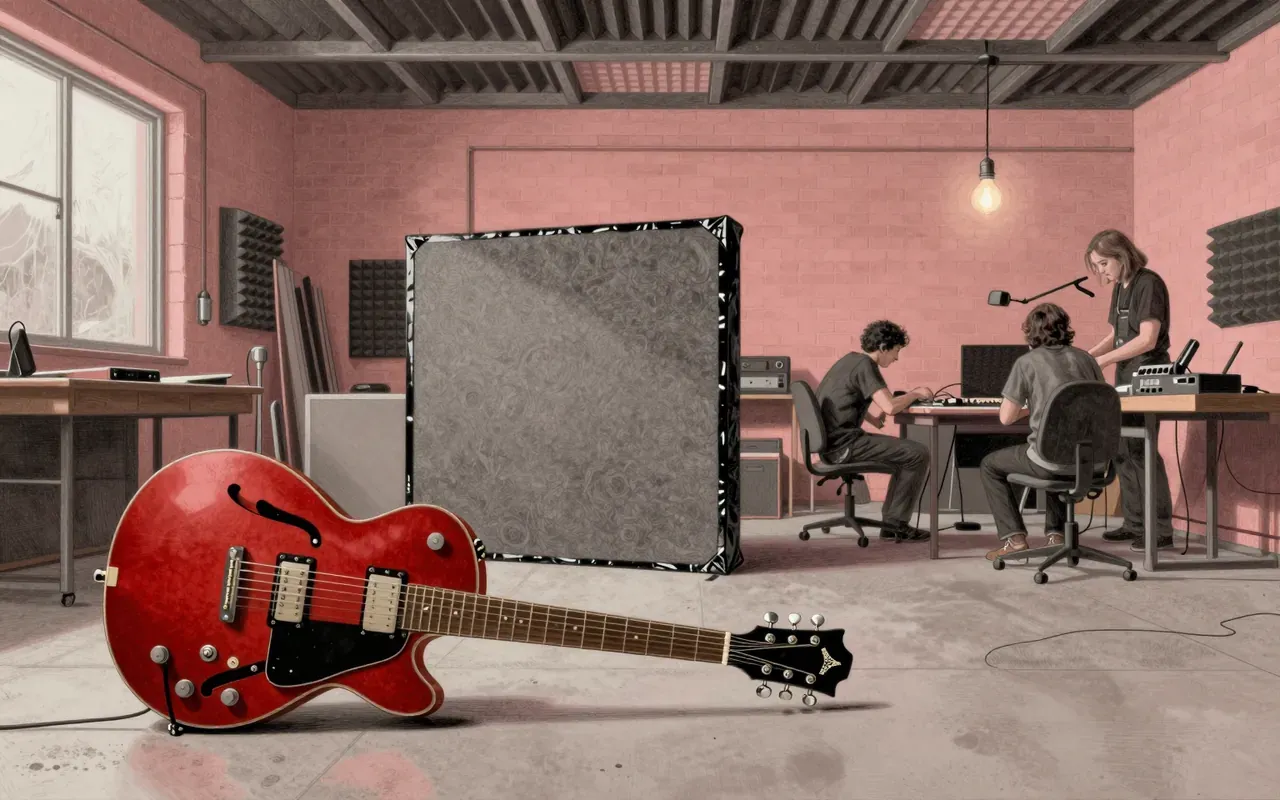
It doesn’t sing—it shimmers, cuts, and decays: a purpose-built jangle machine, not a versatile guitar.
The Rickenbacker 360/12 is a narrowly optimised instrument: its reversed string courses, angled headstock, semi-hollow body and thru-neck combine to produce a bright, cutting, fast-decaying jangle. It excels in one role—rhythmic texture in mid-60s pop—and falls short everywhere else: tuning stability, ergonomic playability, tonal range. It was developed in 1963, prototyped with Dick Burke’s headstock, entered production in 1964, and became essential to the Beatles’ A Hard Day's Night sound. It is not a general-purpose guitar. It is a specialist tool.
It is a 12-string variant of the 360, built into the 300 Series—not an afterthought, but a deliberate expansion.
2:44
How it works
Its headstock angles machine heads; its courses reverse octave placement; its body is semi-hollow with a thru-neck—all working together to shape its timbre.
4:20
What people made with it
It defined the Beatles’ sound on A Hard Day's Night—not as colour, but as structural texture.
6:01
How it came to be
It was the second electric 12-string Rickenbacker built—developed in 1963, prototyped with Dick Burke’s headstock, and refined for production in 1964.
Worth your time?
Yes. Use the whole thing.
4/ 5
What works
delivers bright, shimmering jangle
fits twelve strings on a standard headstock
defines rhythmic texture in 1964 pop recordings
What does not
deliver low-end warmth
support expressive vibrato
stay in tune under aggressive playing
Use it if
players needing jangly rhythm texture
recording contexts where upper-mid clarity cuts through dense mixes
Skip it if
players prioritising tuning stability
lead guitarists requiring sustain or dynamic range
The written brief1 min read
What it is and what it was built for
It is a 12-string electric guitar, a variant of the Rickenbacker 360. It was built to deliver a distinctive jangly timbre for studio and stage, using compact engineering to solve the physical constraints of 12-string design.
How it works, in terms a player would use
It places the octave string on the treble side of each course, not the bass. Its headstock mounts alternate pairs of machine heads at right angles to fit all twelve on a standard-length headstock. It uses a semi-hollow body and a thru-body neck. It belongs to the Rickenbacker 300 Series.
What it does better than anything else
It does better than any other guitar at delivering a bright, shimmering, tightly focused jangle with pronounced upper-mid presence and fast decay—ideal for arpeggiated chords in pop and rock arrangements.
What it does badly
It does badly at staying in tune under aggressive strumming or bending. The reversed course order makes string replacement fiddly. The thru-body neck and semi-hollow construction offer little low-end warmth or sustain for lead lines.
What people made with it
George Harrison used it on A Hard Day’s Night and other Beatles songs through late 1964. It became a key part of their recorded sound in that period.
Who should use it, and who should not
Players who prioritise that specific jangly texture in rhythm work should use it. Players who rely on expressive vibrato, frequent retuning, or extended soloing should not.
Is it worth your time
Yes—if you need that bright, cutting, sustained jangle for rhythm parts in a band context. No—if you need tuning stability, ergonomic comfort for long sessions, or tonal versatility beyond its narrow, ringing character.