audiobriefs
9:15in productionCh. 1 · Not a copy. A correction./ 9:15 · ceiling 15 min
Effects & pedals · Guitars & amps

Big Muff

It doesn’t mimic Hendrix—it drowns the mids and doubles down on bass-heavy saturation.

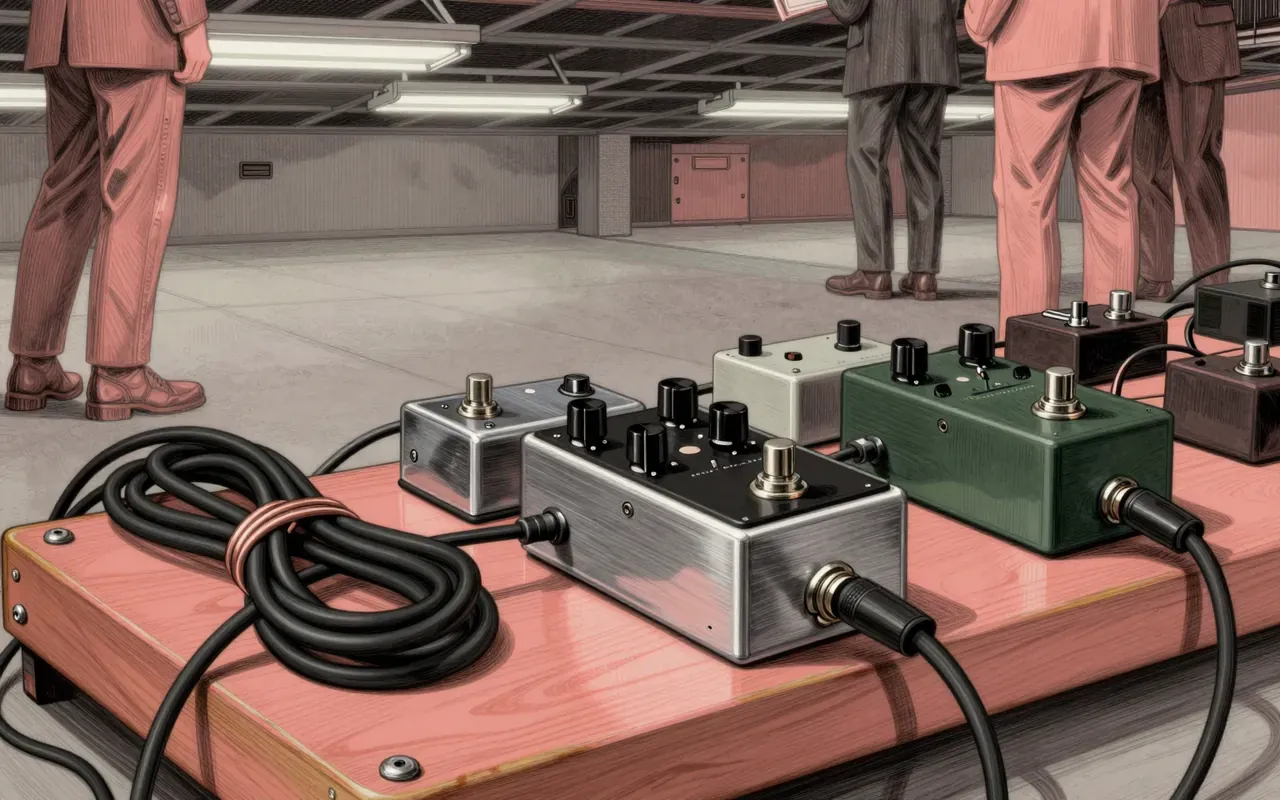
The Big Muff Pi is a 1969 fuzz effects pedal with four transistors, two soft-clipping stages, and a tone stack that scoops mids when centred. It delivers smooth, saturated, bass-heavy sustain at any volume—making small amps sound bigger. It was intended to mimic Hendrix but became heavier and more distinctive. It does not offer gain staging, midrange recovery, or dynamic clean-up.

Chapters & takeaways4
  1. 0:57
    Not a copy. A correction.

    It was meant to copy Hendrix—but gave guitarists something heavier and more bass-forward instead.

  2. 2:22
    Double clipping, not double talk

    Two soft-clipping stages back-to-back create harsh distortion normally reserved for hard-clipping circuits.

  3. 4:02
    Scoop by circuit, not compromise

    The tone knob doesn’t shape tone—it blends filters, and centre position kills mids by design.

  4. 5:21
    Big sound, small amp

    It sustains smoothly at any volume—and makes small amps sound bigger without cranking them.

Worth your time?

Yes. Use the whole thing.

4/ 5
What works
  • long sustain without fizz
  • low-end weight without flub
  • mid-scoop that cuts through dense mixes
What does not
  • add versatility
  • respond to picking dynamics
  • retain clarity at extreme settings
Use it if
  • players who want bass-heavy sustain
  • those stacking distortion layers
  • engineers tracking thick lead tones
Skip it if
  • players needing midrange punch
  • clean-boost users
  • modular or DAW-based workflows
The written brief1 min read

What it is and what it was built for

A 1969 fuzz effects pedal built to add bass-heavy sustain. Designed to mimic Hendrix’s fuzz but landed as a heavier fuzz/distortion hybrid. Updated from the two-transistor Muff Fuzz to four transistors.

How it works, in terms a player would use

It boosts and buffers the signal first, then soft-clips it twice—each time with a pair of diodes in a feedback loop. A tone control blends a low-pass and high-pass filter before the output. Centre the tone knob and midrange vanishes.

What it does better than anything else

It delivers long, smooth, saturated sustain with unshakable low-end weight. It distorts heavily while retaining note definition—even at high gain. It makes small amps sound fuller and louder without speaker breakup.

What it does badly

It collapses midrange when the tone is centred. It offers no gain staging options between clipping stages. It cannot clean up with guitar volume—distortion stays heavy at any setting.

What people made with it

Guitarists used it to sustain notes indefinitely, stack with other drives, and cut through dense mixes—especially where mid-scooping worked: solos over thick rhythm parts, bass guitar distortion, synth leads needing woolly weight.

Who should use it, and who should not

Players who want one-pedal sustain with thick lows and a scooped mid signature. Not for players needing transparency, touch sensitivity, or tonal flexibility. Not for bassists expecting tight low-end control—it saturates broadly.

Is it worth your time

Yes—if you need bass-heavy sustain that cuts through without midrange presence, and can work within its fixed architecture. No—if you need dynamic response, clean headroom, or adjustable EQ beyond the single tone knob.
Same bench · Effects & pedals4 of 9
8:52
Watkins CopicatWatkinsThe Watkins Copicat is a valve-based tape echo unit introduced in 1958. It features three replay heads, a selector switch, and a feedback loop for variable echo-repeat. It was designed to be simple, affordable, and portable. It was one of the first commercially available tape delay units and preceded other major European echo units. The first production run of 100 units sold out on the first day.
9:18
Fuzz FaceArbiter · 1966The Fuzz Face is a minimal, high-character fuzz pedal built for affordability—not precision. Its two-knob interface and six-component design deliver immediate, touch-sensitive distortion, especially with NKT275 germanium transistors. But its crude biasing makes germanium units thermally unstable. Silicon versions trade warmth for harshness and reliability. It excels at organic, swelling fuzz tones shaped by the player—not the pedal.
8:18
Maestro FZ-1 Fuzz-ToneMaestro · 1962The Maestro FZ-1 Fuzz-Tone is the first widely marketed fuzz effect. Introduced in 1962. Achieved mainstream impact in 1965 via Keith Richards on 'Satisfaction'. Uses three germanium transistors. Powered by two 1.5V batteries (later one). Responds directly to input amplitude. Temperature sensitive. Delivers brass-like tones. Integrated into Gibson EB-0F basses circa 1964. Revised as FZ-1a in late 1965.
9:32
Eventide, IncEventide · 1971There is no instrument called 'Eventide, Inc.' from 1971. Eventide, Inc. is a company. Its earliest instruments were the 1745 Digital Delay Line (1971), the PS 101 Instant Phaser (1971), the Omnipressor (1974), and the H910 Harmonizer (1975). Only the PS 101 is confirmed as rack-mount. No instrument described has polyphony, synthesis architecture, or format beyond rack-mount. Claims about sound, feel, or musical use are absent from the source material.
Up next in Audio

Watkins Copicat

Watkins · 8:52

The Copicat doesn’t delay sound—it delays your decision-making, then rewards you for it.

8:52