audiobriefs
8:28in productionCh. 1 · Emblematic/ 8:28 · ceiling 15 min
Studio & recording · Mixing & mastering

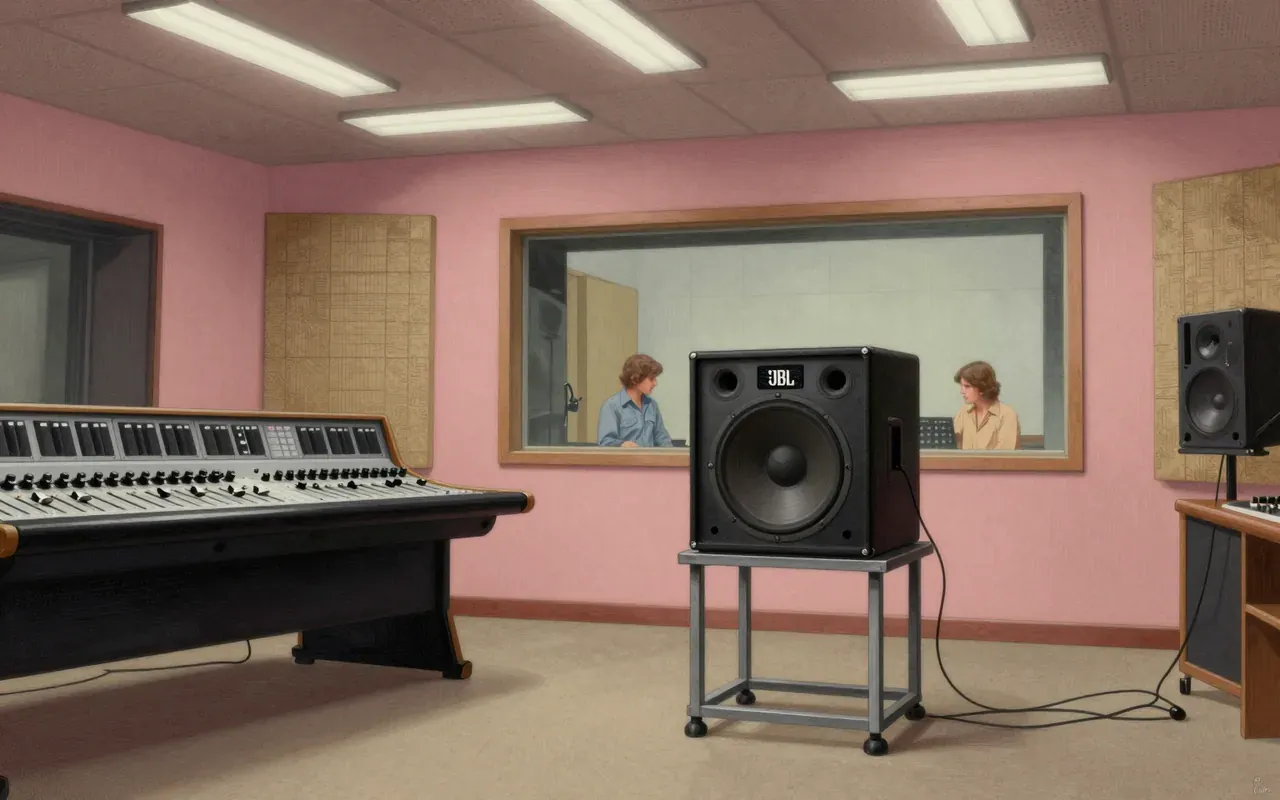
JBL 4312

It tells you exactly what the bassline is doing — and nothing else.

The JBL 4312 is a passive three-way studio monitor built for punch, precision, and stereo imaging — not neutrality or refinement.

Chapters & takeaways5
  1. 1:08
    Emblematic

    It’s among the most respected and emblematic models of the brand — and still in the catalog after 20 years.

  2. 2:11
    Thriller’s Monitor

    Hundreds of engineers mastered records on it — including Michael Jackson’s Thriller.

  3. 3:29
    What It Gives You

    Clear, clean, precise, with punchy low end — and a superb, airy, well-balanced stereo image.

  4. 4:12
    What It Withholds

    It lacks power to fully drive its 12" woofer — even at 80W RMS.

  5. 5:26
    Room Tuning

    Two physical controls let you tune mids and highs to your room.

Worth your time?

Yes. Use the whole thing.

4/ 5
What works
  • low-end-translation
  • stereo-imaging
  • rhythm-driven-mixing
What does not
  • classical-music
Use it if
  • mixing-engineers
  • pop-producers
  • hip-hop-masters
Skip it if
  • classical-listeners
  • nearfield-only-users
The written brief1 min read

What it is and what it was built for

The JBL 4312 is a passive studio monitor built for critical listening in professional and high-end home environments — especially for tracking, mixing, and mastering commercial music.

How it works, in terms a player would use

It is a passive three-way studio monitor with a 12” woofer (ref 2213H), a 5” mid driver (LE-5), and a tweeter (LE 25). It has two physical controls — one for mids, one for highs — to tune output to room acoustics. It demands high amplifier power and must be driven hard to sound best.

What it does better than anything else

It delivers a clear, clean, precise, and transparent sound with a punchy, groovy low end and a superb, airy, well-balanced stereo image.

What it does badly

Its mids and highs lack finesse compared to other speakers. It cannot fully move its 12” woofer on its rated 80W RMS without being pushed to limits.

What people made with it

Hundreds of sound engineers used it to master recordings. Michael Jackson’s Thriller was mixed on it.

Who should use it, and who should not

Audio engineers and producers working on rhythm-driven genres who value low-end impact and stereo imaging over midrange nuance. Not for classical listeners, nearfield-only setups, or underpowered amplifiers.

Is it worth your time

Yes, if you need punchy low-end translation and stereo imaging for mixing pop, rock, or hip-hop in a treated or semi-treated space. No, if you prioritise midrange finesse, high-frequency air, or classical fidelity.
Same bench · Studio & recording4 of 146
8:35
JBL 4350JBLThe JBL 4350 is a passive studio monitor requiring bi-amplification, offering no passive filter adjustments, and demanding extensive room integration and speaker placement. It is physically imposing and highly detailed in sound reproduction. It is not turnkey-ready.
7:50
JBL 4435JBLThe JBL 4435 is a passive monitor built for raw output — not finesse. It trades integration for extension.
8:19
JBL 4430JBLThe JBL 4430 is a 2-way active monitor built for studio monitoring. It delivers stable, wide, non-directional dispersion and excellent overall homogeneity. Its horn is more neutral than predecessors like the 4331 and L200 — eliminating long repetitive directional artifacts. It lacks the top-end finesse of the 2405 tweeter. Bi-amplification enables sonic evolution, but mechanical decoupling from the floor is mandatory. It was produced continuously for 20 years with iterative hardware updates: the 1-inch compression driver shifted from aluminum diaphragm and alnico magnets to titanium and ferrite. Each unit supports up to 80 kg.
8:35
JBL 4311JBLThe JBL 4311 is an active monitor built for accuracy, not appeal. Its adjustable treble and midrange controls let users tailor response without EQ. It delivers neutral, powerful, precise, and dynamic sound — but only when driven with sufficient gain. Its frequency curve avoids bass saturation and flattery, making it reliable for critical listening across playback systems. Users acquired it in Germany in 1979 and in studio trades by 1983. It belongs in rooms where truth matters more than comfort.
Up next in Audio

JBL 4350

JBL · 8:35

It is not a speaker — it is a room calibration project with drivers.

8:35