It does low-end magic by breaking the rules — then forces you to live with the compromise.
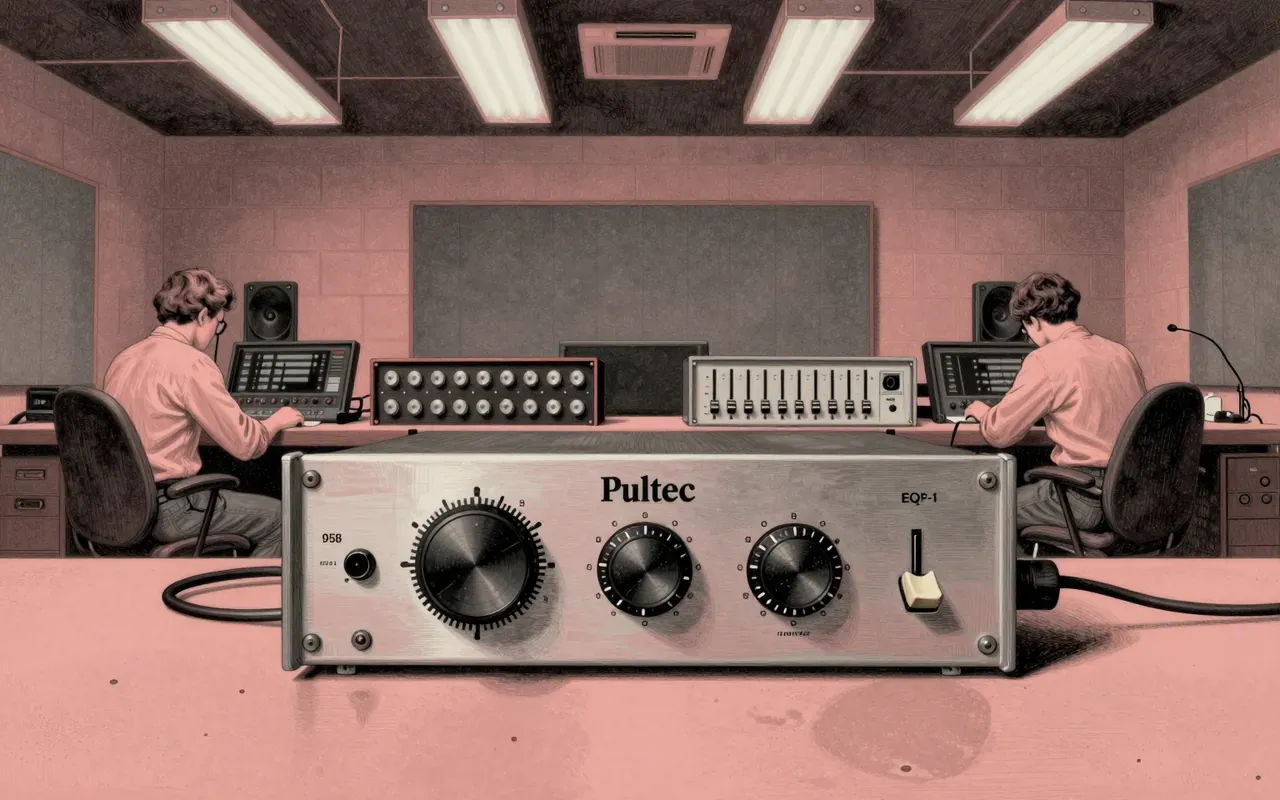
The Pultec EQP-1 is a passive, tube-amplified equalizer introduced in 1956 in a 3U 19-inch rack chassis, designed specifically for professional recording studios to overcome noise issues in existing film-industry equalizers. It features a low-frequency shelving filter with three bands (30, 60, 100 Hz) and a parametric high-frequency section with boost frequencies at 3, 5, 8, 10, and 12 kHz plus adjustable bandwidth. Its design enabled simultaneous boost and attenuation of adjacent low frequencies — a technique later adopted despite being discouraged in the original manual.
It was built for studios — not film — because existing EQs were too noisy.
2:56
No active filters. Just passive networks and tubes.
Passive EQ + tube makeup gain defines its signal path and feel.
4:08
Two sections, zero midrange
Low shelf at 30/60/100 Hz. High boost at 3–12 kHz with adjustable Q.
5:56
Standard issue, not status symbol
It became a studio standard — not by accident, but by solving real workflow problems.
Worth your time?
Yes. Use the whole thing.
4.5/ 5
What works
low-end fullness without muddiness
simultaneous low boost and attenuation
consistent tube saturation under drive
high-end lift with controllable presence
What does not
cut high frequencies
offer mid-band controls
provide recallable settings
allow independent low-band boost or cut
Use it if
engineers working with acoustic sources
mixers prioritising low-end weight and high-end air
producers committed to hands-on, fixed-path workflows
Skip it if
those needing surgical mid-scoops
digital-first workflows requiring preset recall
anyone requiring high-frequency attenuation
The written brief2 min read
What it is and what it was built for
A 3U 19-inch rack-mounted passive equalizer built in 1956 for professional recording studios. It was designed to replace noisy film-industry equalizers. It uses tubes to make up passive EQ loss, enabling clean, usable gain staging in broadcast and recording chains.
How it works, in terms a player would use
It is a passive EQ with a tube amplifier stage that restores gain lost in the passive network. Low frequencies use a shelving filter at 30, 60 or 100 Hz — boost and attenuation can be applied simultaneously. High frequencies use a parametric section with boost only at 3, 5, 8, 10 or 12 kHz, plus a separate bandwidth control to adjust Q.
What it does better than anything else
It gives low-end fullness while preserving definition — the 30/60/100 Hz shelving design lets you lift weight and dial out boom in one motion. Its tube stage imparts consistent harmonic saturation when driven, not colouration that shifts with frequency or gain.
What it does badly
It cannot cut high frequencies. Its high-frequency section offers boost only. It has no mid-band controls. It offers no low-frequency cut-only or boost-only isolation — the simultaneous boost-and-cut interaction is baked in and non-bypassable per band.
What people made with it
It became a studio standard. Engineers used it on bass, kick drum and vocals to shape tone with weight and presence — especially where low-end clarity and high-end sheen had to coexist without phase chaos or noise.
Who should use it, and who should not
Engineers who work with acoustic sources, live drums, upright bass or vintage-style mixes — and who want predictable, hands-on low-end shaping and gentle high-end lift. Not for producers needing surgical mid-scoops, digital recall, or high-frequency attenuation.
Is it worth your time
Yes — if you need low-end weight without mud, or high-end air without glare, and accept its fixed architecture and lack of cut in the high band.