audiobriefs
10:12in productionCh. 1 · What it was made for/ 10:12 · ceiling 15 min
Guitars & amps

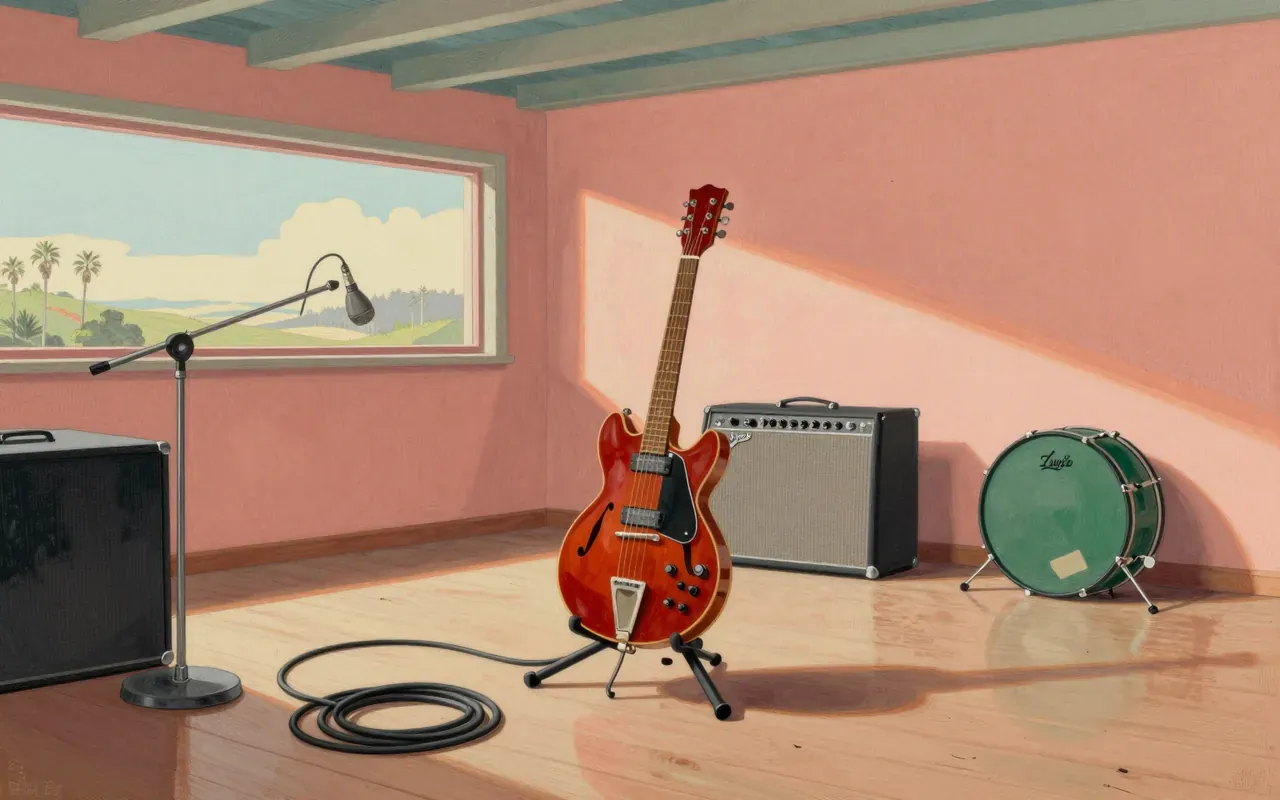
Gibson ES-175

The ES-175 didn’t invent jazz guitar — it gave it upper-fret freedom, then refused to evolve beyond it.

The ES-175 is a purpose-built hollowbody jazz guitar: functional, focused, and frozen in time.

Chapters & takeaways4
  1. 1:10
    What it was made for

    Built in 1949 as a hollowbody archtop with a florentine cutaway — for jazz players who needed volume and reach.

  2. 2:52
    How the pickups changed

    P-90s until 1953. Then two pickups. Then Humbuckers — including the first PAF on any Gibson Spanish guitar.

  3. 4:22
    Why the cutaway mattered

    The cutaway and amplification worked together to unlock the uppermost frets — live and unamplified alternatives couldn’t match it.

  4. 6:23
    When it ended

    Discontinued in 2019 — after 70 years of unchanged core design and purpose.

Worth your time?

Yes. Use the whole thing.

4/ 5
What works
  • articulate midrange response
  • clear chord definition
  • ergonomic upper-fret access
What does not
  • offer modern electronics
  • resist feedback at high volume
  • support alternate tunings or extended range
Use it if
  • jazz guitarists
  • players valuing acoustic-electric balance
  • performers needing upper-fret access
Skip it if
  • high-gain players
  • studio producers requiring tonal flexibility
  • travel musicians needing ruggedness
The written brief1 min read

What it is and what it was built for

A hollowbody electric archtop guitar introduced in 1949 for jazz players who needed amplified projection and upper-fret access without sacrificing acoustic responsiveness.

How it works, in terms a player would use

It has a hollowbody electric archtop construction with a single florentine cutaway. Early models (1949–1953) used one P-90 pickup. From July 31, 1953, a two-pickup version (ES-175D) was available. In 1957, Humbucker options appeared — including the first PAF humbucker on any Gibson electric Spanish guitar.

What it does better than anything else

It gives immediate, clear articulation in the midrange with natural acoustic resonance. The florentine cutaway and amplification let players use the uppermost frets reliably in live performance — more so than non-cutaway archtops of the era.

What it does badly

It feeds back easily under high gain or loud stage volume. It offers no onboard tone shaping beyond basic volume and tone knobs. The hollowbody design limits note decay control and aggressive pick attack response.

What people made with it

Jazz guitarists used it for chordal comping, single-note lines, and melodic improvisation — relying on its clarity, warmth, and cutaway-enabled reach.

Who should use it, and who should not

Players who prioritise woody resonance, clean headroom, and ergonomic upper-fret access in jazz, swing, or mainstream pop contexts. Not for metal, high-gain rock, or anyone needing feedback immunity or extended-range tuning stability.

Is it worth your time

Yes — if you need a responsive, articulate hollowbody jazz guitar that delivers upper-fret access and clean amplification. No — if you require feedback resistance at high volume, solid-body sustain, or modern switching or tone-shaping controls.
Same bench · Guitars & amps4 of 66
9:43
Epiphone CrestwoodEpiphoneThe Epiphone Crestwood is a solid-body electric guitar introduced in 1958. It has no Gibson equivalent. It evolved through named variants—Crestwood Custom, Crestwood DeLuxe—before ending production in 1970. Its construction is mahogany. Its pickups are New Yorker. Its headstock changed from three-on-a-side to six-on-a-side. Its pickguard changed design and lost the Epiphone logo. Its fretboard markers changed from dots to ovals. Its plating changed from gold to nickel. Its upper horn lengthened slightly by 1963. The Crestwood DeLuxe added a third pickup and an ebony fretboard with block inlays.
9:31
Gretsch Country ClubGretschNo verified source links the term 'Country Club' to any specific Gretsch instrument feature, specification, or design rationale beyond its model name and mid-1950s introduction alongside the 6120 Nashville, 6128 Duo Jet, and White Falcon. No claims about its construction, electronics, finish, or player experience are supported by the provided material. All descriptive statements must therefore be omitted or flagged as unsupported. The only factual anchors are its name, its status as a Gretsch guitar model, and its release period.
9:30
Gretsch TennesseanGretschThe Gretsch Tennessean is a hollow-body electric guitar built for vintage tone and playability. It delivers a highly resonant, cutting voice shaped by its construction, pickups, and controls. It excels in clean and mid-gain contexts but struggles with feedback and high-gain stability. Its design prioritises acoustic resonance and vibrato expression over modern high-output versatility.
10:06
Rickenbacker 325Rickenbacker · 1958The Rickenbacker 325 is a compact, bright, feedback-prone hollow-body guitar defined by its short scale, semi-hollow construction, and visual signature — the crescent moon cutaways and angled sound hole. It was designed for clarity and portability, not warmth or power.
Up next in Audio

Gibson ES-295

Gibson · 8:28

A gold-plated archtop built to stand beside the Les Paul — not to replace it, but to answer it.

8:28