Saved
Maker

Gibson

28
briefs
9:28
average
265 min
in total
On audio.briefs28
10:35

Gibson RD Artist

Gibson

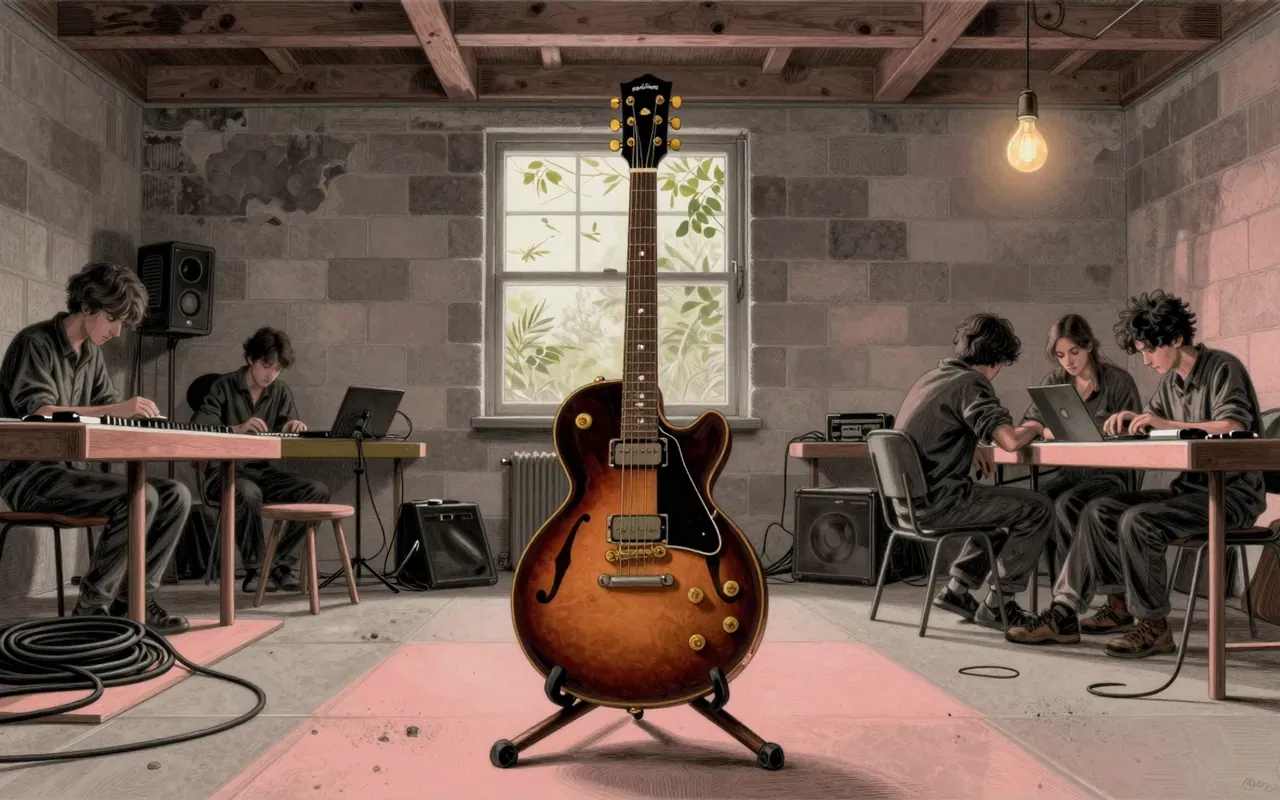
The Gibson RD Artist is a 1978 solid-body electric guitar with active Moog electronics, all-maple construction, a 25.5-inch scale, two humbuckers, and no vibrato. Its controls enable compressor (bridge), expander (neck), bright mode, or neutral, plus bass/treble boost/cut. Stock humbuckers are weak for rock. It was built for precise, processed tone — not vintage warmth or expressive pitch play.
8:03

Gibson Super 400 CES

Gibson

The Gibson Super 400 CES (2011) is a discontinued hollow/semi-hollow electric guitar. Its name, category, and discontinuation are the only verified facts. It has no technical specifications, no availability, and no documented use. It does not function as an instrument today.

9:01

Gibson EB-3

Gibson

The Gibson EB-3 is a short-scale bass built for midrange punch, not low-end authority. Its 30.5" scale, slim SG-style body, and asymmetric pickup pair — large humbucker at the neck, mini-humbucker at the bridge — define its physical and sonic identity. The four-way rotary switch offers distinctive tonal options, including two that deliberately roll off low frequencies. It was produced from 1961 to 1979. Exactly 14,167 were made.

8:39

Gibson Thunderbird

Gibson

The Gibson Thunderbird is a 34-inch scale electric bass introduced in 1963. Designed by auto stylist Raymond H. Dietrich, it features neck-through construction and a reverse body shape. It was Gibson’s first bass at that scale and originally came in two models: the single-pickup Thunderbird II and dual-pickup Thunderbird IV. Its soapbar humbuckers deliver focused midrange. In 1966, Gibson altered the design to a non-reverse body and set-neck construction following a lawsuit from Fender.

8:12

Gibson Victory Bass

Gibson

The Gibson Victory Bass is a four-string solid-body electric bass designed by Wayne Charvel for Gibson from 1981 to 1986. It shares its lineage with the Gibson Victory, uses fixed materials (maple body, three-ply maple neck, rosewood fingerboard), and offers a fretless option — but nothing more. It was not a successful model. No evidence confirms distinctive tone, player adoption or recorded use.

8:37

Gibson EB-0

Gibson

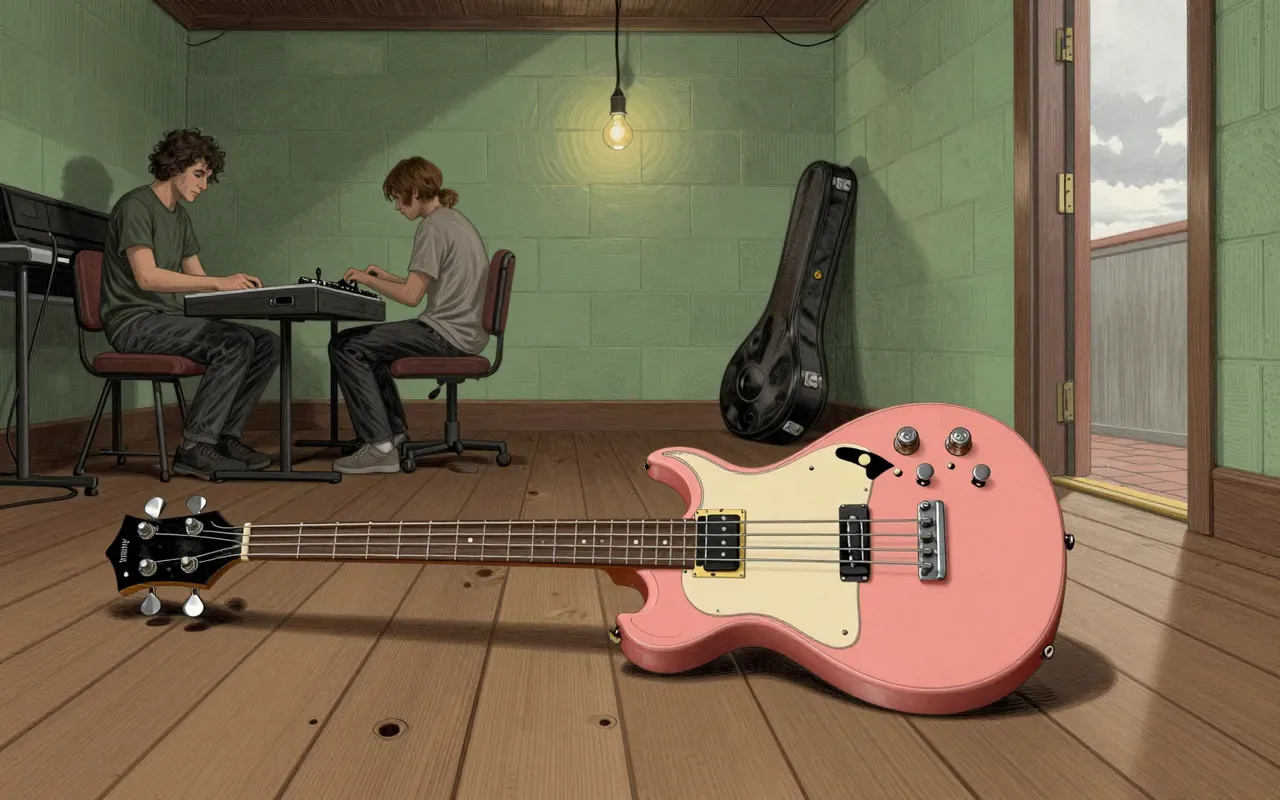
The Gibson EB-0 is a bass guitar introduced in 1959 to replace the underperforming EB-1. It used the EB-1’s mahogany neck, body, and 30.5-inch scale but adopted a double-cutaway body inspired by the Les Paul Junior. Production ended in 1979 after 20,844 units. Early models were cherry red only. In 1961, the body was redesigned to match the SG. In 1962, the pickup’s black plastic cover became metal. Around 1964/5, nickel hardware gave way to chrome.

9:48

Gibson EB-2

Gibson

The Gibson EB-2 is a purpose-built, no-compromise semi-hollow bass: warm, resonant, limited. Its design gives you one voice — rich and rounded — and refuses all others.

10:26

Gibson ES-125

Gibson

The Gibson ES-125 is a purpose-built, no-compromise entry into hollow-body electric guitar playing. It gives one voice, one circuit, and one physical response—nothing more, nothing less.

10:12

Gibson ES-175

Gibson · 1949

The ES-175 is a purpose-built hollowbody jazz guitar: functional, focused, and frozen in time.

8:28

Gibson ES-295

Gibson

The ES-295 is a hollow body guitar introduced in May 1952. It shares dimensions with the ES-175. It was conceived as a full-sized hollowbody archtop intended to complement the solidbody Les Paul. Its original price was $295. Les Paul claimed involvement in its creation. The first ES-295s came outfitted with one pickup. By 1953 the guitar was shipping with two pickups. It was discontinued in 1959 and reissued multiple times. Scotty Moore used it.

8:50

Gibson ES-330

Gibson

The ES-330 is a thinline hollow-body electric guitar introduced in 1959. It uses P-90 pickups and has no center block. It is prone to feedback. It was discontinued in 1972.

9:56

Gibson ES-335

Gibson · 1958

The ES-335 is a semi-hollow body semi-acoustic guitar introduced in 1958 as a compromise between hollow-body warmth and solid-body feedback resistance, featuring a solid maple center block with hollow upper bouts and f-holes. It achieved commercial success and continuous production due to its tonal flexibility across blues, jazz, and rock.

9:31

Gibson Explorer

Gibson

The Gibson Explorer is a solid-body electric guitar released by Gibson in 1958. It features a radical, futuristic body design derived from the 1957 Futura prototype. Only 19 were produced in 1958 and 3 in 1959. Early models had a 'split'-shaped headstock with 3+3 tuners; later models used a long drooping 'hockey-stick' headstock with tuners in a straight line on one side.

9:11

Gibson Firebird

Gibson

The Gibson Firebird is a solid-body electric guitar introduced in 1963. It features neck-through-body construction—the first Gibson solid-body to do so—with a stepped neck, reverse headstock, treble-side banjo-style planetary geared tuners, and fully covered mini-humbucking pickups with metal surrounds. The neck is built from five plies of mahogany and four narrow strips of walnut.

9:32

Gibson Flying V

Gibson · 1958

The Gibson Flying V is an electric guitar introduced in 1958 with a radical futuristic body design, initially made from korina (limba) wood, with only 98 units produced in its first run due to poor sales. It was reissued in 1967 using mahogany and design updates including a new bridge and larger pickguard. Its physical design — including 17-degree headstock angle and central pickup placement — was intended to enhance sustain.

8:56

Gibson Grabber

Gibson

The Gibson Grabber is a bass guitar introduced in 1973. It features a bolt-on 34½-inch neck, an adjustable pickup that slides to simulate neck or bridge positions, brighter output than traditional Gibson humbuckers, simple controls (one volume, one tone), and a removable bridge cover. Its body changed from maple to alder in 1975 — the year it peaked in sales at 2,637 units, largely due to Gene Simmons’s use with Kiss. It was discontinued in 1982, with limited production until 1984.

9:41

Gibson L-5

Gibson

The Gibson L-5 is a hollow body guitar introduced in 1923. It was one of the first guitars with F-holes. Its construction uses carving, bracing, and tap-tuning like a cello. It amplifies string vibration through carved and tuned woods using F-holes as projection points. The lower bout width increased from 16" to 17" in 1934 and has remained 17" since. It was originally offered as an acoustic instrument. In 1951, the 17" L-5 was outfitted with a pair of P-90 pickups. Starting in 1958, the P-90 pickups were replaced by humbuckers.

10:29

Gibson Les Paul

Gibson · 1952

A physically dense, sonically authoritative solid-body guitar built for sustain and midrange focus — not speed or lightness.

10:14

Gibson Les Paul Special

Gibson

The Les Paul Special is a 1955 Gibson variation designed as an intermediate instrument between the Junior and Standard Les Paul. It launched in TV Yellow for black-and-white television visibility. In 1958, it shifted from singlecut to doublecut. In 1961, it became the SG after Les Paul’s contract expired; original models returned in 1968 upon renewal.

8:42

Gibson Marauder

Gibson

The Gibson Marauder is a 1975–1979 bolt-on electric guitar designed to compete with Fender’s single-coil models. It features a custom Bill Lawrence humbucker in the neck and an angled blade-style single coil at the bridge — both sealed in clear epoxy. Its construction includes a Les Paul–shaped contoured single-cutaway body and bolt-on maple neck. Only 7,111 units were made before discontinuation in 1979 (though some were made until 1982). Endorsed by Ace Frehley and Paul Stanley, it failed to gain traction against Fender due to its compromised playability and lack of tonal flexibility.

8:54

Gibson Ripper

Gibson

The Gibson Ripper is a purpose-built electric bass: set-neck, two Bill Lawrence Super Humbuckers, and a Q System circuit that prioritises midrange control over flexibility. It delivers punch and presence but withholds neck-pickup isolation and tonal versatility.

10:34

Gibson SG

Gibson

The Gibson SG is a 1961 solid-body electric guitar built to deliver upper-fret access and playing speed at the expense of body mass and low-end sustain. Its design choices — double cutaway, thinner contoured body, outward-shifted neck joint, slender mahogany neck — are all functional responses to physical limits players hit on earlier Gibsons. It does not try to be a Les Paul. It tries to be faster, lighter, and more direct — and succeeds on those terms alone.

11:16

Gibson ES-345

Gibson · 1959

The Gibson ES-345 is a semi-hollow electric guitar introduced in 1959. It was designed as a hybrid between a solid-body electric guitar and a jazz guitar. It was developed in 1958 as an upscale version of the ES-335. Gibson announced the ES-345 as the ES-345T in May 1959. The ES-345T had a price of $345 in the standard sunburst finish. From the guitar's 1959 introduction through 1979, 10,560 ES-345s were shipped. Gibson designed the guitar to create a guitar which could be used to play jazz, as would be typical of an Electric Spanish guitar, but with a maple block running through the guitar to allow the versatility of a solid body electric guitar. The bodies were made of laminated maple with spruce bracing, and a solid maple center block - designed to prevent unwanted feedback from the pickups - extending from the base of the body (where the strap button is mounted) all the way to the mahogany neck, along with a rosewood fingerboard.

9:12

Gibson ES-355

Gibson · 1958

The ES-355 is Gibson’s most complex semi-hollow — a stereo, varitone-equipped evolution of the ES-335. It launched in mono in 1958, added stereo in 1959, and was discontinued in 1984 after failing to meet commercial expectations. Many players disabled the varitone. Gibson revived it in 2018.

9:55

Gibson Les Paul Custom

Gibson · 1954

The Gibson Les Paul Custom is a luxury electric guitar introduced in 1953 at Les Paul’s request for a black, tuxedo-like instrument. It featured the ABR-1 bridge from 1954, adopted the PAF pickup in mid-1957, and switched to Grover Rotomatics by 1958. It remained a double-cutaway model until 1963, when it was renamed the SG Custom after Les Paul’s endorsement ended.

8:24

Gibson Les Paul Junior

Gibson

The Gibson Les Paul Junior is a stripped-down, single-pickup electric guitar introduced in 1954 as Gibson’s affordable entry into the solid-body market. It features one P-90 'dog-ear' pickup at the bridge, one volume and one tone control, no binding, and no carved top. A double-cutaway version launched in 1958 nearly doubled sales. The original run ended in 1963. Its raw, overdrivable tone made it a favourite among rock and blues players in the 1960s and 1970s.

9:44

Gibson Moderne

Gibson

The Gibson Moderne is a non-instrument: a shape conceived in 1957, patented in 1958, rejected at NAMM the same year, and absent from musical use for 25 years. It has no verified sound, no operational history, no confirmed prototype, and no functional distinction from later reissues. Its only property is ambiguity.