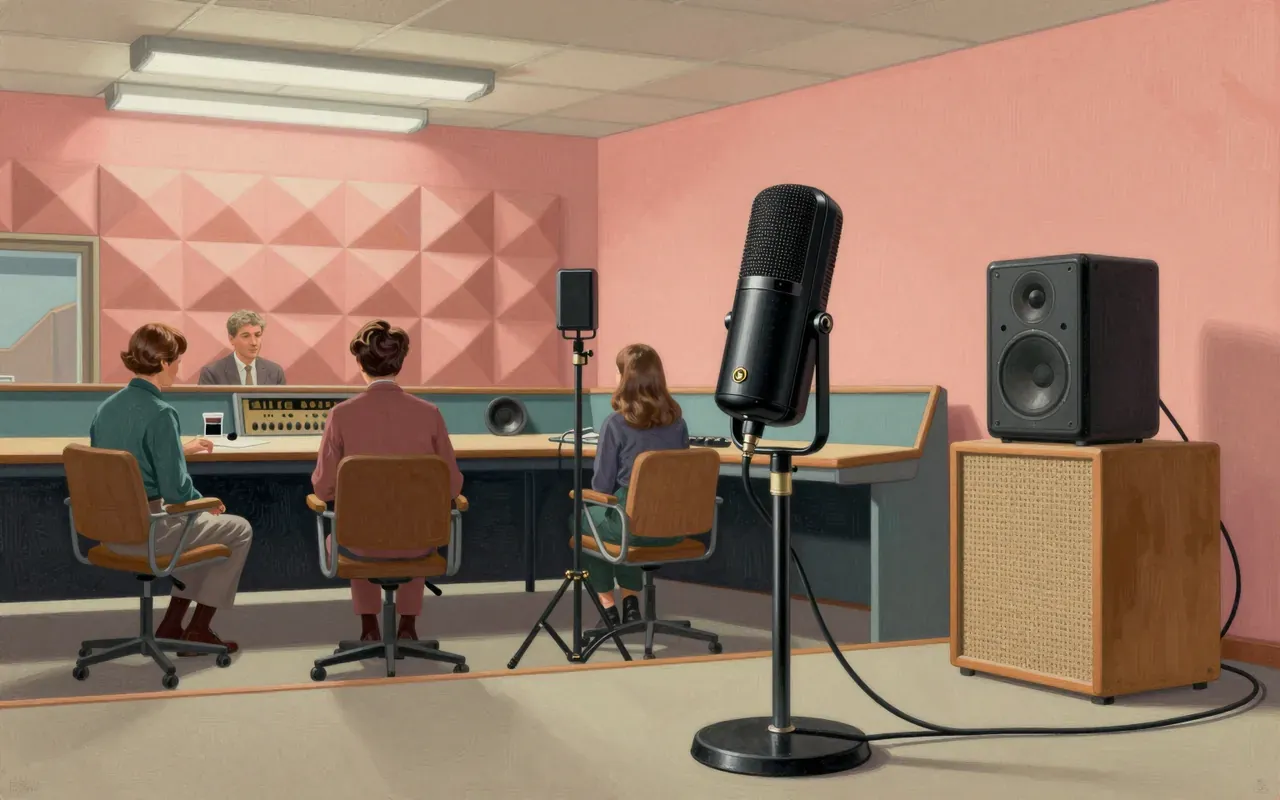
What it is and what it was built for
A cardioid dynamic microphone introduced in 1960 as the successor to the MD 21. Built for broadcast speech, studio drum overheads, guitar cabinets, and live vocal work.
How it works, in terms a player would use
It uses a 27 mm large diaphragm in a portless closed plastic housing. A hum-compensation coil wired in opposite polarity cancels low-frequency interference. Its cardioid pattern holds steady no matter how it is held.
What it does better than anything else
It retains directional integrity under aggressive handling better than any ported dynamic mic of its era—or most since. Its 30–17,000 Hz ± 3 dB response delivers punch and presence where other dynamics roll off early.
What it does badly
It does not reject off-axis low frequencies as tightly as modern multi-pattern condensers. It offers no high-pass filtering, no pad, no pattern switching—only one fixed cardioid response.
What people made with it
More than 500,000 units have been used across professional broadcasting, studio recording, and live performance since 1960.
Who should use it, and who should not
Engineers who track loud sources and need predictable rejection without fiddling with positioning. Broadcasters who hold mics on stands or in hand. Anyone who values unchanged design over modularity. It is not for users needing variable patterns, built-in attenuation, or extended top-end air.
Is it worth your time
Yes—if you need a rugged, consistent, speech-and-instrument dynamic mic that does not require phantom power or careful positioning to retain directionality.