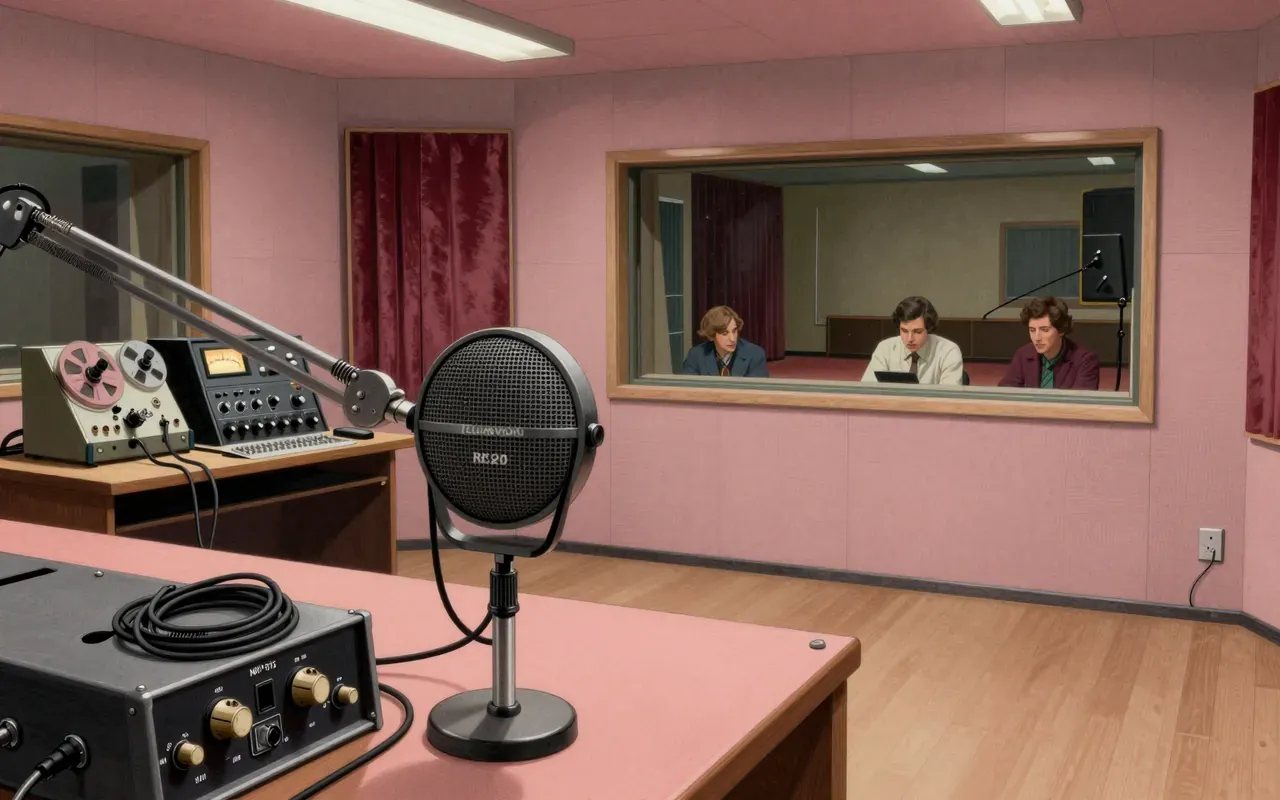
It kills proximity effect so thoroughly, you can’t use it for bass-boosted intimacy—and that’s exactly why it still rules the airwaves.
The Electro-Voice RE20 is a professional cardioid dynamic microphone introduced in 1968 for broadcasting applications. It employs Variable-D technology—a single transducer element with internal porting—to eliminate proximity effect and maintain stable frequency response regardless of source distance. It features a switch to attenuate frequencies below 400 Hz, a humbucking coil for EMI rejection, and a deeply mounted element to handle high SPLs. It delivers excellent fidelity despite its large size and weight. It continues to be used in recording studios and on the concert stage.
Built for broadcasters in 1968, not studios or stages—yet it outlasted its brief.
2:36
How it kills proximity effect
Variable-D uses one element and internal ports—not two capsules—to lock tone at any distance.
4:11
Three practical fixes built in
A 400 Hz switch, humbucking coil, and deep-mounted element make it tough, quiet, and loud-source-ready.
5:59
Still used where it was never meant to go
Its fidelity holds up despite size and weight—and it still works where others fail: on stage and in studios.
Worth your time?
Yes. Use the whole thing.
4.5/ 5
What works
maintains consistent tonal balance regardless of distance
handles high SPLs without distortion
rejects electromagnetic interference reliably
What does not
capture fine high-frequency detail or air
provide tight off-axis rejection
allow bass-boosted vocal effects via proximity
Use it if
broadcasters
podcasters
voice-over artists
Skip it if
vocalists seeking warmth via proximity effect
producers needing surgical high-frequency control
The written brief1 min read
What it is and what it was built for
A professional cardioid dynamic microphone introduced in 1968 for broadcast use. Built for announcers who move, shout, and work near lighting rigs and power cables.
How it works, in terms a player would use
It uses Variable-D technology: one transducer element, multiple internal ports that route sound to the rear of the diaphragm. A switch cuts frequencies below 400 Hz. Its humbucking coil rejects electromagnetic interference. The element sits far from the grille to handle loud sources without overloading.
What it does better than anything else
It maintains consistent tonal balance regardless of distance from the source. Nothing else eliminates proximity effect so completely while retaining full low-end extension and handling high SPLs without distortion.
What it does badly
It does not capture fine high-frequency detail or air. Its cardioid pattern is less precise off-axis than modern multi-element designs. It cannot be used close-up for bass-boosted vocal effects—the Variable-D design actively prevents that.
What people made with it
Radio and television broadcasts since 1968. Studio recordings and live concert stage vocals—continuously, across decades.
Who should use it, and who should not
Broadcasters, podcasters, voice-over artists, and engineers tracking loud sources like bass cabinets or snare drums. Not vocalists seeking warmth via proximity effect, or producers needing surgical high-frequency control.
Is it worth your time
Yes—if you need a dynamic mic that stays neutral as you move, handles high SPLs cleanly, and resists hum in electrically noisy environments. No—if you need extended high-end detail, tight off-axis rejection, or fast transient response for delicate acoustic sources.