audiobriefs
8:40in productionCh. 1 · Patchable Sound/ 8:40 · ceiling 15 min
Sound design & sampling · Instruments

E-mu Systems E6400

It doesn’t sample cleanly — it corrupts, reroutes, and convolves until the source is unrecognisable.

The E-mu Systems E6400 is a hardware sampler built for radical sample transformation — not faithful reproduction. Its strength is in routing: the modulation matrix and modular-style processing blocks (quantize, flipflop, diode, lag) let users rewire signal flow in ways few samplers allowed. Its SCSI support exceeds its 9GB spec — users ran 18GB drives. Its DACs are transparent; its ADCs are not. It includes Z-plane, formant, phaser, flanger, Doppler, bitreducer and Convolver tools — and its reverb uses impulse response sampling. It ships with EOS 3.00b and 1MB CPU RAM. It is for sound designers who treat samples as raw material to be corrupted, rerouted and convolved — not archived.

Chapters & takeaways4
  1. 0:54
    Patchable Sound

    Its modulation matrix and internal routing tools let you patch modular-style logic blocks — quantize, flipflop, diode, lag — between any parameter.

  2. 2:23
    Beyond the Spec Sheet

    It handles 18GB SCSI drives despite a 9GB theoretical limit — and ships with Doppler, bitreducer and Convolver as core tools.

  3. 3:58
    Input/Output Asymmetry

    Its ADCs colour input; its DACs deliver transparent output — and its filter set includes Z-plane, formant, phaser and flanger.

  4. 5:18
    Sampling as Synthesis

    Reverb uses impulse response sampling, and processing blocks behave like modular synth modules — not presets.

Worth your time?

Yes. Use the whole thing.

4/ 5
What works
  • modular-style internal routing
  • SCSI storage beyond 9GB
  • Z-plane and formant filtering
  • impulse-response reverb
What does not
  • deliver clean input capture
  • support modern file formats or DAW integration
  • offer real-time editing speed
Use it if
  • sound designers who treat samples as raw material to be corrupted, rerouted and convolved
Skip it if
  • field recordists needing pristine ADCs
  • producers relying on fast iterative editing or DAW sync
The written brief2 min read

What it is and what it was built for

The E-mu Systems E6400 is a professional rack-mount sampler built for sound designers and studio engineers who needed deep, non-linear sample manipulation — not playback, but transformation — using sampling synthesis under the EOS operating system.

How it works, in terms a player would use

It runs EOS 3.00b or 4.62, with a modulation matrix and modular-style processing blocks — quantize, flipflop, diode, lag processor — that reroute parameters on the fly. It uses SCSI storage, supports up to 18GB drives despite a 9GB theoretical limit, and routes audio through Z-plane, formant, phaser, flanger, Doppler, bitreducer and Convolver tools. Its reverb uses impulse response sampling. It has 8 separate outputs, expandable to 16, and polyphony expandable to 128 voices via optional hardware.

What it does better than anything else

It offers modular-style internal routing unmatched in contemporaneous rack samplers: the matrix lets you patch quantize, flipflop, diode and lag processor blocks between any parameter, turning static samples into evolving, generative sources.

What it does badly

Its analog-to-digital converters are not transparent on input, colouring or degrading source material before it is sampled. It lacks built-in effects beyond its processing tools — users explicitly note they did not use the effects section. Its CPU RAM is fixed at 1MB, limiting sample depth and multitasking headroom.

What people made with it

Users processed samples through Doppler, bitreducer and Convolver; routed modulation via lag and flipflop blocks; applied Z-plane and formant filters; and stored assets on SCSI drives larger than the stated 9GB limit — including 18GB internal and external units.

Who should use it, and who should not

Sound designers who work with hardware-first workflows and want tactile, patchable sample mangling. Not for field recordists needing pristine ADCs, or producers relying on fast iterative editing, DAW sync, or modern file formats.

Is it worth your time

Yes — if you need deep, hands-on sample mangling in hardware, with routing flexibility rare in samplers of its era. No — if you rely on clean input capture, real-time editing speed, or modern workflow integration.
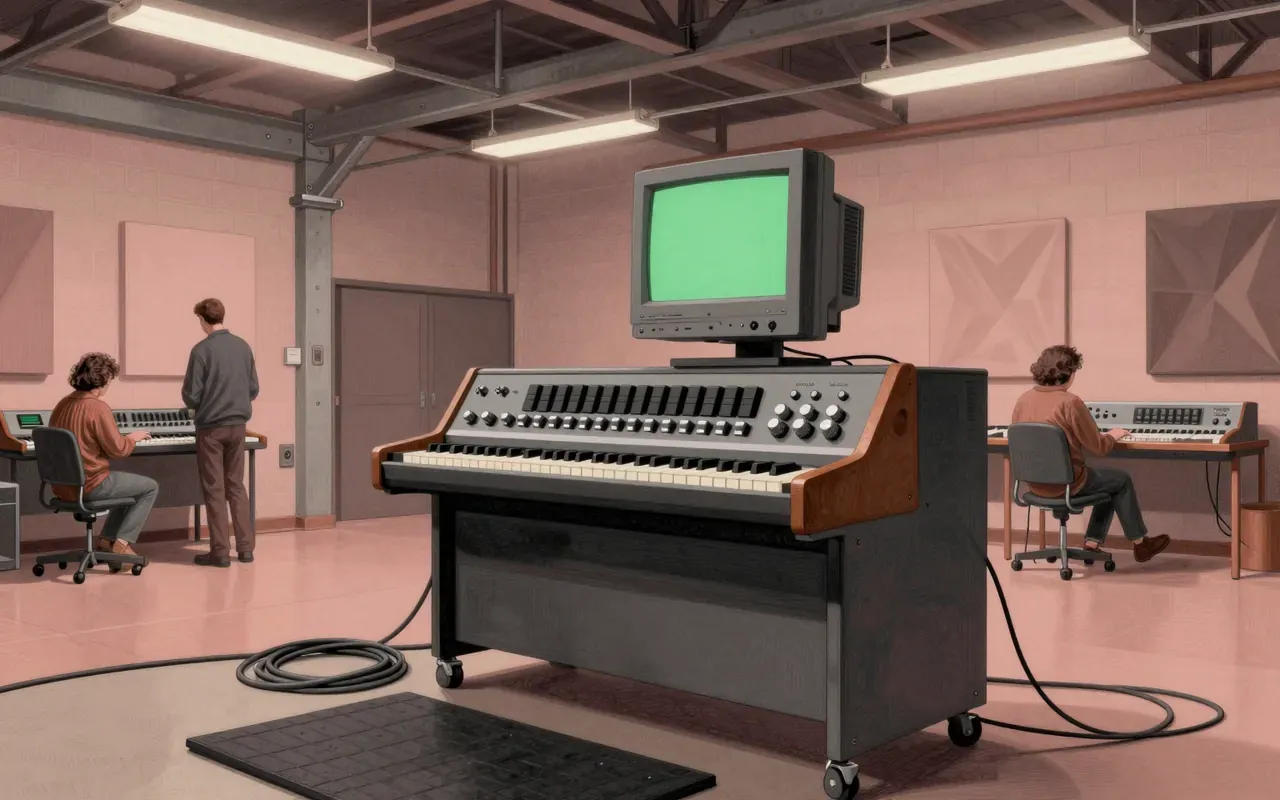
Same bench · Sound design & sampling4 of 107
9:41
SynclavierNew England DigitalThe Synclavier was not a keyboard for players. It was a digital sound laboratory — built for engineers, not performers. Its additive core was brittle. Its sampling was revolutionary. Its 100 kHz rate had no peer. Its role in film sound began at Glen Glenn Sound. Its legacy is infrastructural: the first hard-disk recorder, the first layered digital timbre system, the first computer-based sound editor. It belongs in history — not on a stage.
8:56
PPG WavePPGPPG Wave pioneered real-time interpolated wavetable scanning—making timbre itself a sequenced parameter. Its hybrid digital-analog signal path (digital oscillators, analog filters and VCAs) delivered spectral animation impossible on analog synths of the era. But it demands peripheral hardware for editing, sampling, or expressive control—and offers no direct waveform manipulation or polyphonic sequencing. It belongs in a studio built for sound design, not stage performance.
9:38
E-mu Systems E4XT UltraE-mu SystemsThe E-MU E4XT Ultra is a 1999 hardware sampler. It delivers verbatim audio playback, 128-voice polyphony, and studio-grade reliability. It has no onboard effects, shallow editing, and fixed storage. It belongs in a rack—not a laptop bag.
8:53
Akai S6000AkaiThe Akai S6000 is a 1999 rack sampler. It supports up to 256 MB RAM, optional SCSI hard drives, virtual hard disk sampling, and remote operation via detachable RS-232 screen. Its 26 filter types and extensive modulation routing enable synthesis from single-cycle waveforms. OS 2.14 resolved major bugs in OS 1.0. It includes a large built-in sound library.
Up next in Audio

Audio Electronics EchoCzar

Audio Electronics · 8:11

A guitar delay that tells you nothing about how it delays — and expects you to trust the name.

8:11