audiobriefs
8:57in productionCh. 1 · What it is/ 8:57 · ceiling 15 min
Effects & pedals · Studio & recording

MXR Flanger/Doubler

Thick flanging and reliable doubling—but only if your studio has rack space and no need for stereo or foot control.

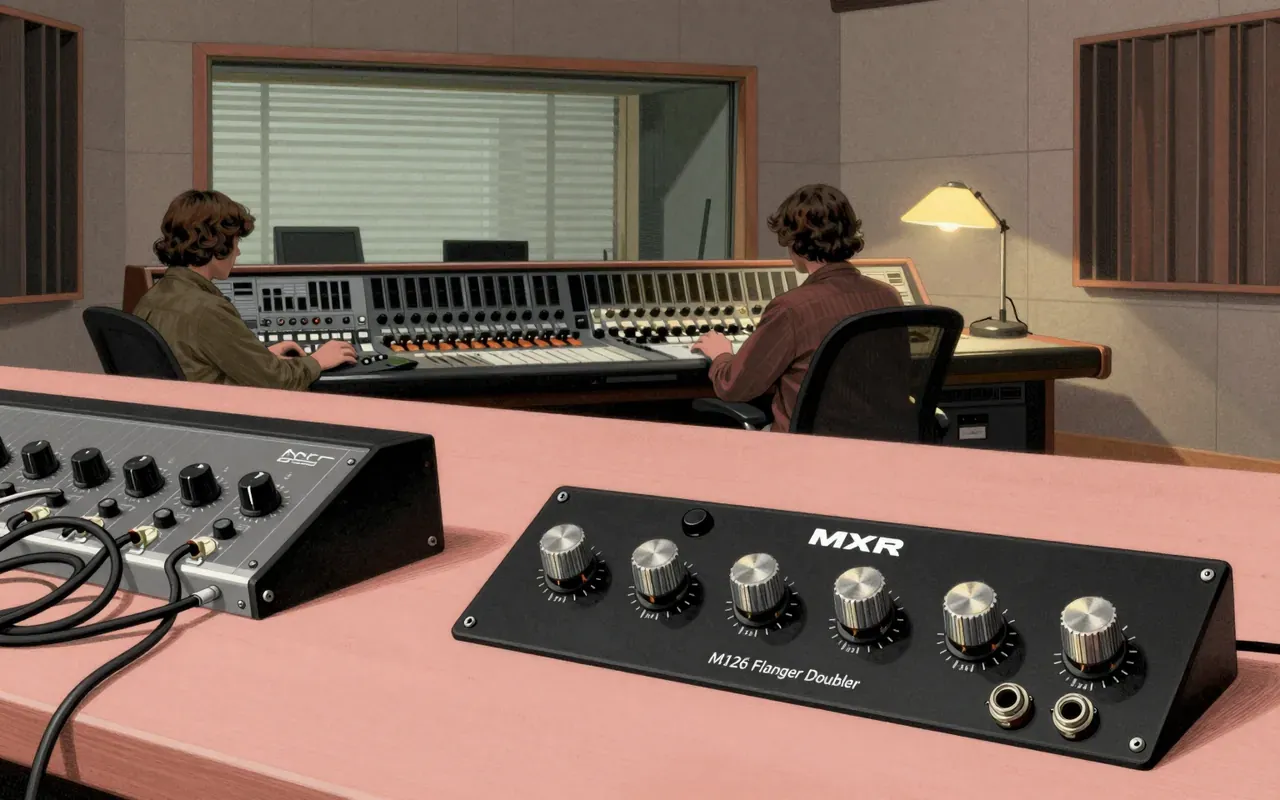
The MXR M126 Flanger/Doubler is a two-space analog rack unit with front-panel 1/4" TRS I/O. It gives players manual, sweep width, sweep speed, mix, and regen knobs plus mode and bypass/invert buttons. It delivers a thick flanging sound and fulfils its synthetic doubling function as advertised. It has no stereo I/O, no expression input, no tap tempo, and no presets. No verified recordings or users are cited. Studio engineers needing fixed, tactile analog flanging or doubling should consider it. Live performers, modular users, and those requiring stereo or foot control should not.

Chapters & takeaways4
  1. 1:00
    What it is

    It is a two-space analog rack unit built for studio flanging and synthetic doubling.

  2. 2:15
    How it works

    Five knobs and two buttons give direct, immediate control over flanger depth, speed, feedback, and mode.

  3. 3:49
    What it does well

    It produces a notably thick flanging sound—and its doubler does exactly what it claims.

  4. 5:26
    What it lacks

    Front-panel 1/4" TRS I/O and no stereo, expression, or tap options limit its flexibility.

Worth your time?

Yes. Use the whole thing.

3.5/ 5
What works
  • thick flanging
  • stable synthetic doubling
What does not
  • offer stereo I/O
  • accept expression pedal input
  • support tap tempo
  • store presets
Use it if
  • studio engineers with rack space
  • players who prefer hands-on knob control
Skip it if
  • live guitarists
  • modular synthesists
  • anyone needing stereo operation
The written brief1 min read

What it is and what it was built for

The MXR M126 Flanger/Doubler is a two-space analog rack-mount effect unit built to generate flanger effects and synthetic doubling for studio use.

How it works, in terms a player would use

It is an analog rack unit with front-panel 1/4” TRS I/O. Players twist manual, sweep width, sweep speed, mix, and regen knobs. They press buttons to toggle between flanger and doubler modes, or to bypass or invert the signal.

What it does better than anything else

It delivers a thicker flanging sound than many contemporaries—dense, saturated, and immediately present—while its doubler mode provides a stable, repeatable synthetic doubling effect without artefacts or drift.

What it does badly

It offers no stereo inputs or outputs. It has no expression pedal input, no tap tempo, no external LFO sync, and no preset storage. The doubler lacks pitch-shifting or delay-based depth.

What people made with it

No verified uses by specific people or recordings are stated in the sources.

Who should use it, and who should not

Studio engineers who want a dedicated, rack-fixed analog flanger/doubler with tactile front-panel control. Not for live guitarists, modular users, or anyone needing stereo or footswitch operation.

Is it worth your time

Yes—if you need thick analog flanging or a no-frills synthetic doubler in a fixed studio rack. No—if you need stereo I/O, foot control, or real-time modulation flexibility.
Same bench · Effects & pedals4 of 121
Up next in Audio

Fulltone Fulldrive 2

Fulltone · 10:08

A hand-wired analog overdrive that forces you to choose your voice — then lets you boost it, but only if you’re already dirty.

10:08