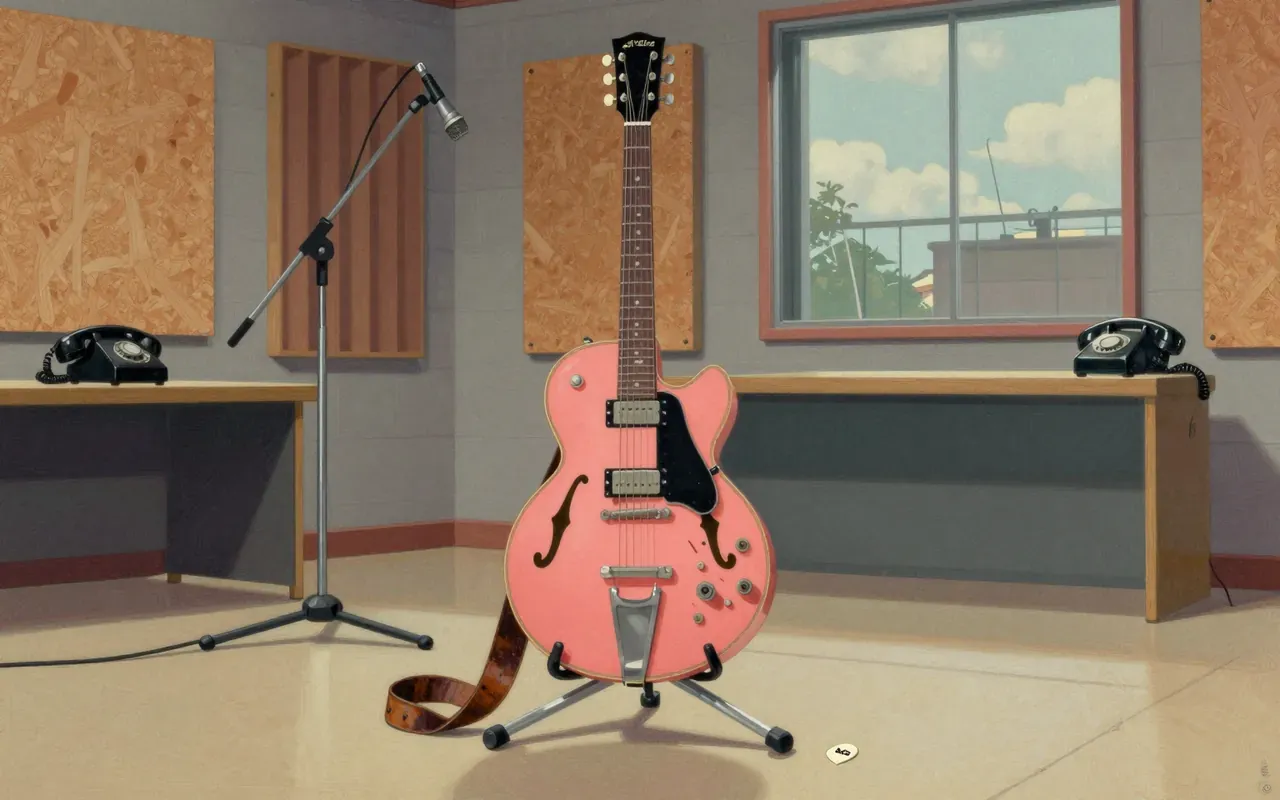
The Epiphone Sheraton is a thinline semi-hollow body electric guitar introduced in 1958 under Gibson’s ownership but exclusively manufactured by Epiphone. It was reworked from Epiphone’s Century archtop and shares its body design with Gibson’s ES-series. Key spec changes include the 1958 twin-pickup configuration, 1961 switch to mini-humbuckers, and 1970 shift to full-sized humbuckers and Japanese production.
The 1958 Sheraton launched as a twin-pickup, double-cut thinline with New York single coils and a Frequensator tailpiece.
2:24
1961: Mini-humbucker pivot
In 1961, mini-humbuckers replaced single coils, and the Frequensator remained—but hardware began shifting to Gibson-sourced parts.
3:32
1970: Full humbuckers, Japan-built
By 1970, full-sized humbuckers arrived alongside Japanese production—and Epiphone became the sole manufacturer of all variants.
4:46
Same body, different DNA
Its body is identical to the Gibson ES-335, ES-345, and ES-355—but its appointments—tailpiece, pickups, inlays—are exclusively Epiphone.
Worth your time?
Yes. Use the whole thing.
3.5/ 5
What works
shares ES-335 body resonance while asserting Epiphone identity
offers distinct visual ornamentation unmatched in Gibson’s ES line
gives players access to three discrete pickup eras in one model lineage
What does not
deliver consistent pickup voicing across eras
offer modern hardware reliability
provide a single identifiable 'Sheraton sound'
Use it if
players who value Epiphone-specific appointments
collectors interested in pre-Gibson hardware lineage
players exploring how pickup changes affect response
Skip it if
players needing matched vintage-spec consistency
those prioritising modern serviceability
musicians relying on documented tonal precedent
The written brief1 min read
What it is and what it was built for
A thinline semi-hollow body electric guitar introduced in 1958. Built for players wanting archtop warmth with solid-body sustain, plus Epiphone’s decorative identity within Gibson’s corporate structure.
How it works, in terms a player would use
It has a glued-in neck and a semi-hollow body with a solid maple block down the centre. It uses two volume and two tone controls with a pickup selector switch. The bridge is tune-o-matic, with no retainer wire. Early models use a Frequensator tailpiece or Bigsby vibrato. Controls are accessible via double cutaways.
What it does better than anything else
It delivers more ornate visual distinction than any Gibson ES model of the same era—especially the abalone/pearl block ‘V’ fingerboard inlays and tree-of-life pearl peghead design. Its co-development with the ES-335 gave it identical body resonance but differentiated hardware and aesthetics.
What it does badly
It does not deliver stable, repeatable pickup voicing across its production life. The shift from New York single coils (1958) to mini-humbuckers (1961) to full-sized humbuckers (1970) means no single ‘Sheraton sound’ exists. Japanese-era hardware lacks the U.S.-built inventory’s 5-piece neck construction and ‘V’ chunky back shape.
What people made with it
The material does not name any player, recording, genre, or musical output made with the Sheraton. No verified usage examples are provided.
Who should use it, and who should not
Players who value tactile distinction—like the Frequensator tailpiece or ‘V’ neck profile—and want to explore how pickup changes alter response across decades. Not for players who require matched vintage-spec consistency or modern serviceability.
Is it worth your time
Yes—if you want a thinline semi-hollow guitar with Epiphone-specific appointments and evolving pickup voicings across eras. No—if you need consistent tonal character across decades or rely on modern hardware reliability.