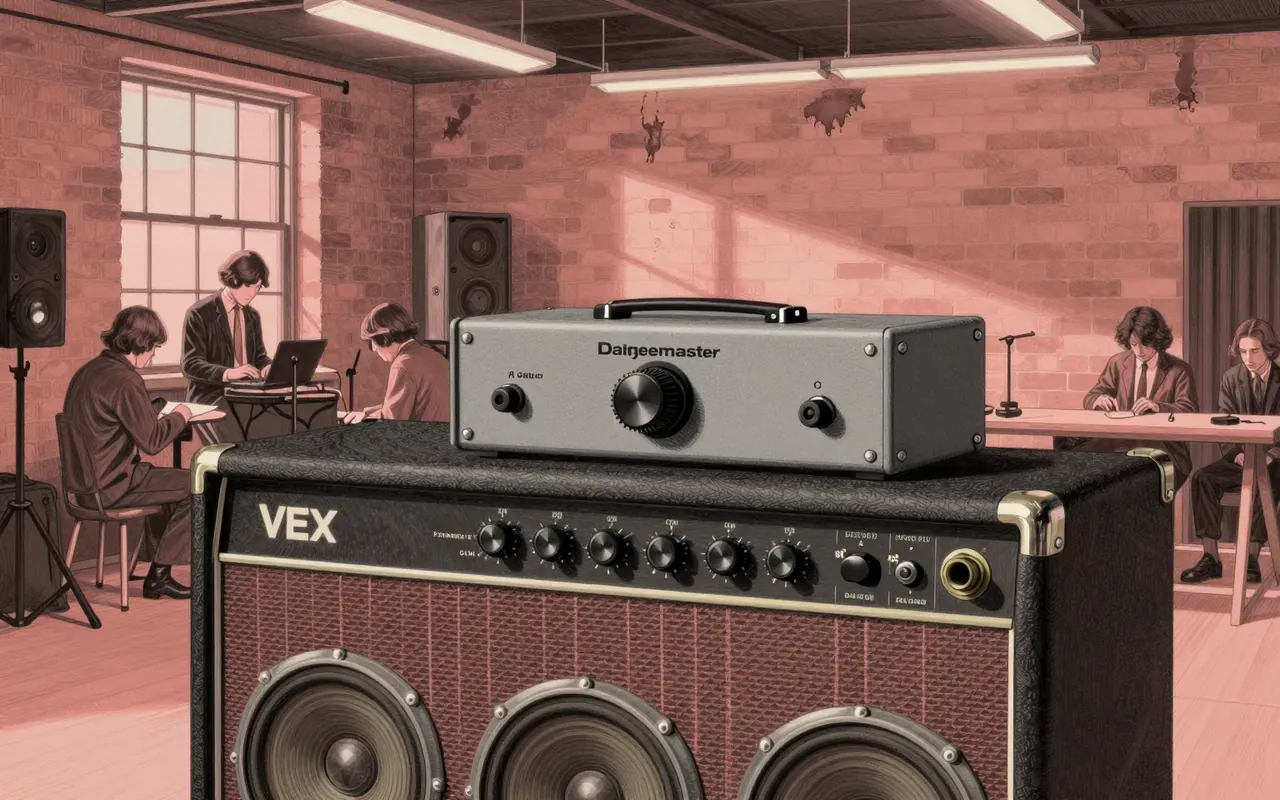
The Dallas Rangemaster Treble Booster is a 1965 desktop effects unit made for guitarists in the 1960s. Its function was two-fold: to increase the signal strength of the guitar going into the amplifier, and to increase tones at the high end of the spectrum (a treble booster). The need for a treble booster arose in the mid-1960s, as British tube amplifiers such as the Vox AC30 or Marshall JTM45 tended to produce a slightly dark, muddy sound when overdriven, particularly when used with humbucking pickups. A pre-amplifier that also boosted treble proved a solution. Additionally, the vintage components in the Rangemaster circuitry could add characteristic distortion and overtones to color the guitar sound, much in the way of the more modern overdrive pedals. The Rangemaster Treble Booster was first made in the 1965 by London company Dallas Musical Ltd., incorporated in 1959. The unit is simple and consists of a grey folded metal casing with an on/off switch, a potentiometer controlling the boost setting, and in- and output jacks. It was designed to sit on top of an amplifier rather than on the floor, where most effects units live.
Born in 1965, it was built for one job: fixing the dark, muddy overdrive of British tube amps.
2:35
How it actually works
It’s a pre-amp — not a filter — that lifts signal strength and high-end simultaneously.
4:42
What it adds (and why)
Its germanium circuit adds distortion and overtones — but only as a side effect of boosting.
6:20
Where it lives — and why
No footswitch. No bypass. Just a grey metal box designed to sit on your amp.
Worth your time?
Yes. Use the whole thing.
4/ 5
What works
pushes British tube amps into singing overdrive
adds characteristic distortion and overtones
cuts through a band with focused high-end lift
What does not
add midrange control
offer true bypass
run on external power
remain stable across temperatures
Use it if
players chasing 1960s UK rock lead tone
owners of Vox AC30 or Marshall JTM45 amplifiers
Skip it if
pedalboard-based players
those needing clean boost or silent switching
The written brief1 min read
What it is and what it was built for
A 1965 desktop treble booster made by Dallas Musical Ltd. Built for guitarists needing more signal strength and high-end clarity into dark-sounding British tube amplifiers.
How it works, in terms a player would use
It sits on top of an amplifier. It takes the guitar signal, boosts its strength and high-end tones using a single germanium transistor. A potentiometer controls boost level. It runs on a 9V battery. It has no footswitch — just an on/off switch.
What it does better than anything else
Nothing else pushes a Vox AC30 or Marshall JTM45 into that specific searing, harmonically rich, slightly unruly overdrive — especially with humbuckers — while adding just enough distortion and overtones to cut through a band.
What it does badly
It does not shape mids or lows. It cannot be used silently — no true bypass, no LED, no power supply option. Its germanium transistor drifts with temperature and ages unpredictably. It offers no tonal flexibility beyond treble boost and gain.
What people made with it
Players used it to sharpen overdriven tones from Vox AC30s and Marshall JTM45s. They placed it directly in front of those amps — not in a pedalboard chain — to provoke a specific kind of saturated, singing lead tone.
Who should use it, and who should not
Use it if you own a vintage-style British tube amp and want that exact 1960s UK rock lead voice. Do not use it if you rely on pedals before the amp, need consistency, or play at low volumes.
Is it worth your time
Yes — if you want to push a British tube amp into singing overdrive with extra cut and grit. No — if you need clean boost, midrange control, or silent switching.