audiobriefs
8:10in productionCh. 1 · One box, many jobs/ 8:10 · ceiling 15 min
Studio & recording · Sound design & sampling

Publison Infernal Machine 90

A timecode-synced DVR masquerading as an effects unit — indispensable for film dubbing, useless without SMPTE.

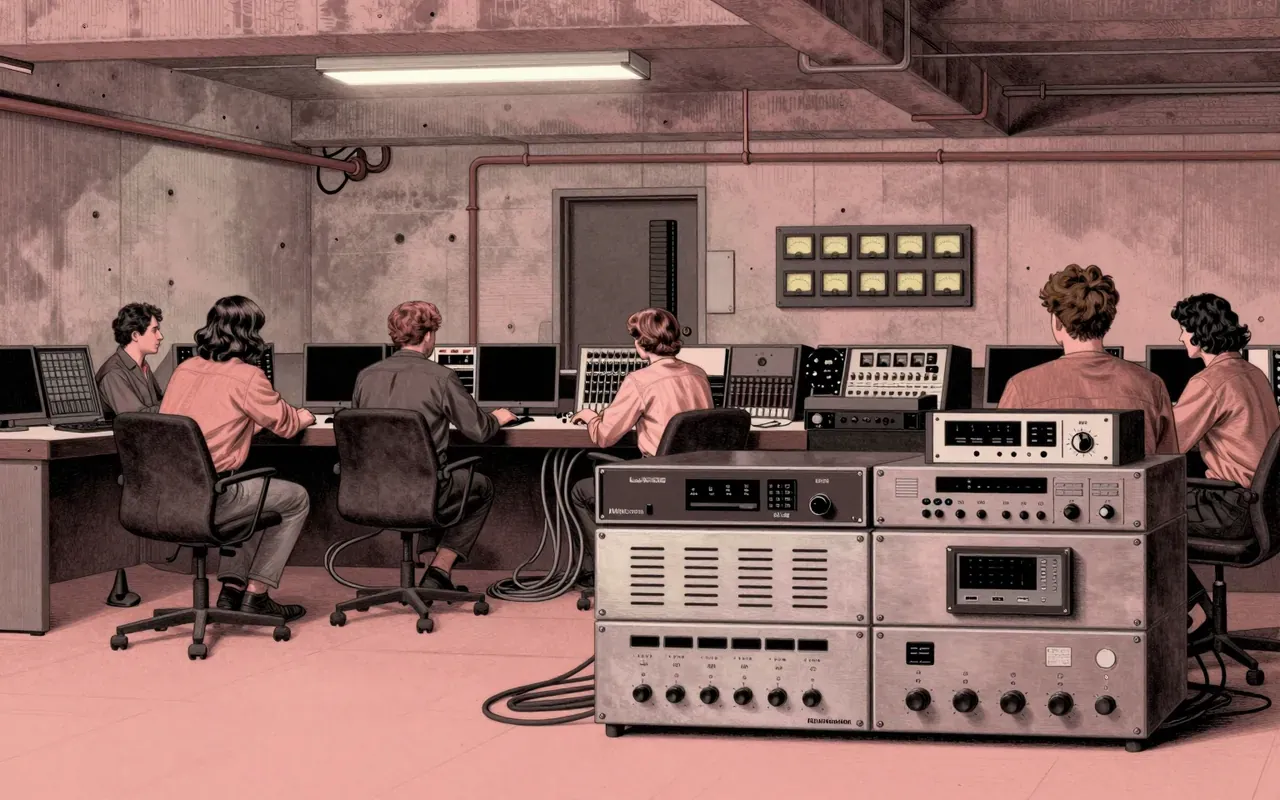
The Publison Infernal Machine 90 is a 3U rackmount analog/digital multi-effects processor built for video post-production. It delivers delay, echo, harmonizer, sampler, reverb, transposition, time compression/expansion, and DVR-style long-sample playback — all synchronised to SMPTE timecode. All programs are editable on-device; no external editor exists. It excels at frame-accurate effect triggering in film dubbing. It fails for anyone needing patch libraries, remote editing, or non-video workflows.

Chapters & takeaways4
  1. 0:48
    One box, many jobs

    It is a 3U rack unit that delivers multi-effects — reverb, delay, echo, harmonizer, sampler — in one analog/digital box.

  2. 2:09
    Time compression, long samples, DVR mode

    It stretches and shrinks audio without pitch shift — and records long samples, acting as a full DVR.

  3. 3:32
    Synced to the image

    SMPTE timecode locks effects to picture — letting users trigger and fade reverbs, delays and samples frame-accurately.

  4. 4:52
    No editor. No escape.

    All editing happens on the unit. There is no external editor — no library, no patch dump, no remote control.

Worth your time?

Yes. Use the whole thing.

3.5/ 5
What works
  • SMPTE-triggered effect sequencing
  • long-sample DVR operation
  • real-time time compression/expansion
  • multi-effect layering in fixed hardware
What does not
  • support external editing
  • offer patch libraries
  • function outside SMPTE-synced environments
Use it if
  • video post-production engineers
  • film dubbing specialists
  • timecode-dependent sound designers
Skip it if
  • live performers
  • music producers without video sync needs
  • users requiring recall or remote control
The written brief1 min read

What it is and what it was built for

The Publison Infernal Machine 90 is a 3U rackmount analog/digital multi-effects processor built for video post-production. It combines delay, echo, harmonizer, sampler, reverb, transposition, time compression/expansion, and DVR-style long-sample playback.

How it works, in terms a player would use

It runs as a 3U rackmount unit with XLR I/O, MIDI In/Thru, and SMPTE timecode jacks. Programs are edited directly on the hardware — no external editor exists. Timecode sync lets users trigger delays, reverbs, harmonizer patches, or samples in lockstep with video. Sampling, pitch/time shifting, inversion, and time compression/expansion are all performed in real time.

What it does better than anything else

It handles timecode-synchronised triggering of sampled sounds, reverb, delay, and harmonizer effects better than any contemporaneous unit cited in the material — especially when paired with long sampling and time compression/expansion for film/video workflows.

What it does badly

It does not support external editing or patch libraries. Its interface forces all programming on-device, limiting workflow speed and recall. It offers no stated stereo imaging control, no user-accessible filter parameters, and no indication of latency, headroom, or dynamic range limits.

What people made with it

People used it to program and trigger effects — sampled sounds, reverb, delay, harmonizer — in tight synchronisation with image, fading effects one after another in film and video sound mixing.

Who should use it, and who should not

Video post-production engineers who need timecode-synced, self-contained multi-effects with sampling and DVR functions should use it. Musicians seeking flexible real-time sound design without video sync should not.

Is it worth your time

It is worth your time only if you work in video post-production and need timecode-synced multi-effects with long-sample DVR functionality built into one analog/digital rack unit.
Same bench · Studio & recording4 of 146
Up next in Audio

Focusrite ISA 110

Focusrite · 8:52

A discontinued solid-state preamp with no documented features — useful only as a footnote.

8:52