audiobriefs
8:53in productionCh. 1 · Origin/ 8:53 · ceiling 15 min
Synths & drum machines · Sound design & sampling

Serge Modular

It doesn’t play music—it invites you to rewrite the circuit while it’s running.

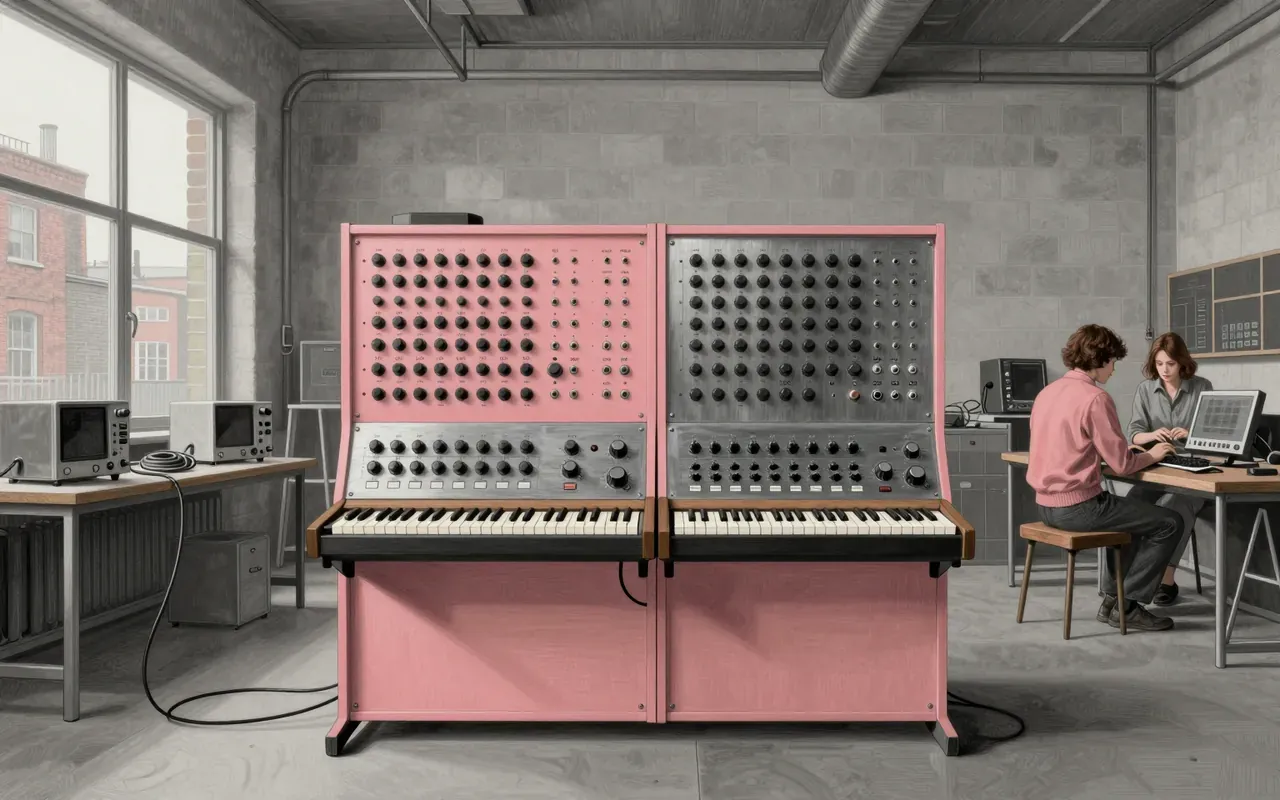
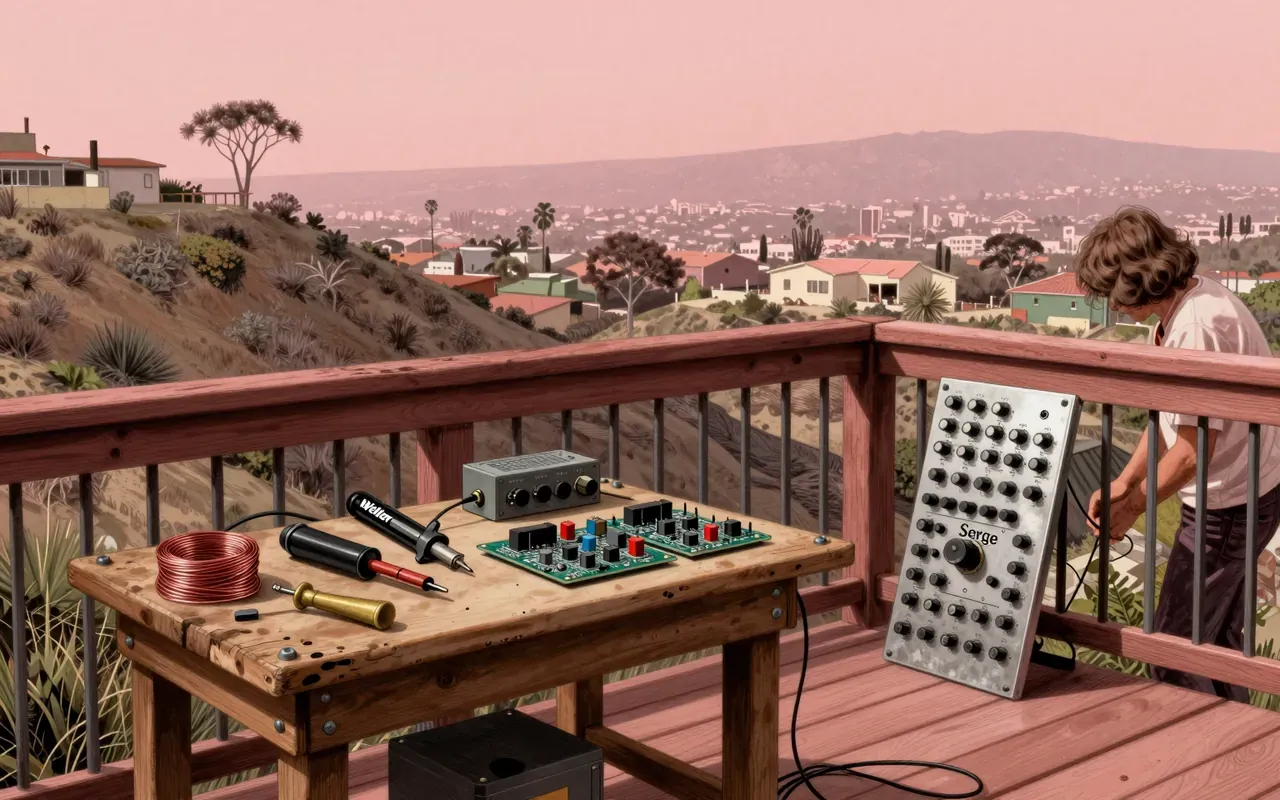
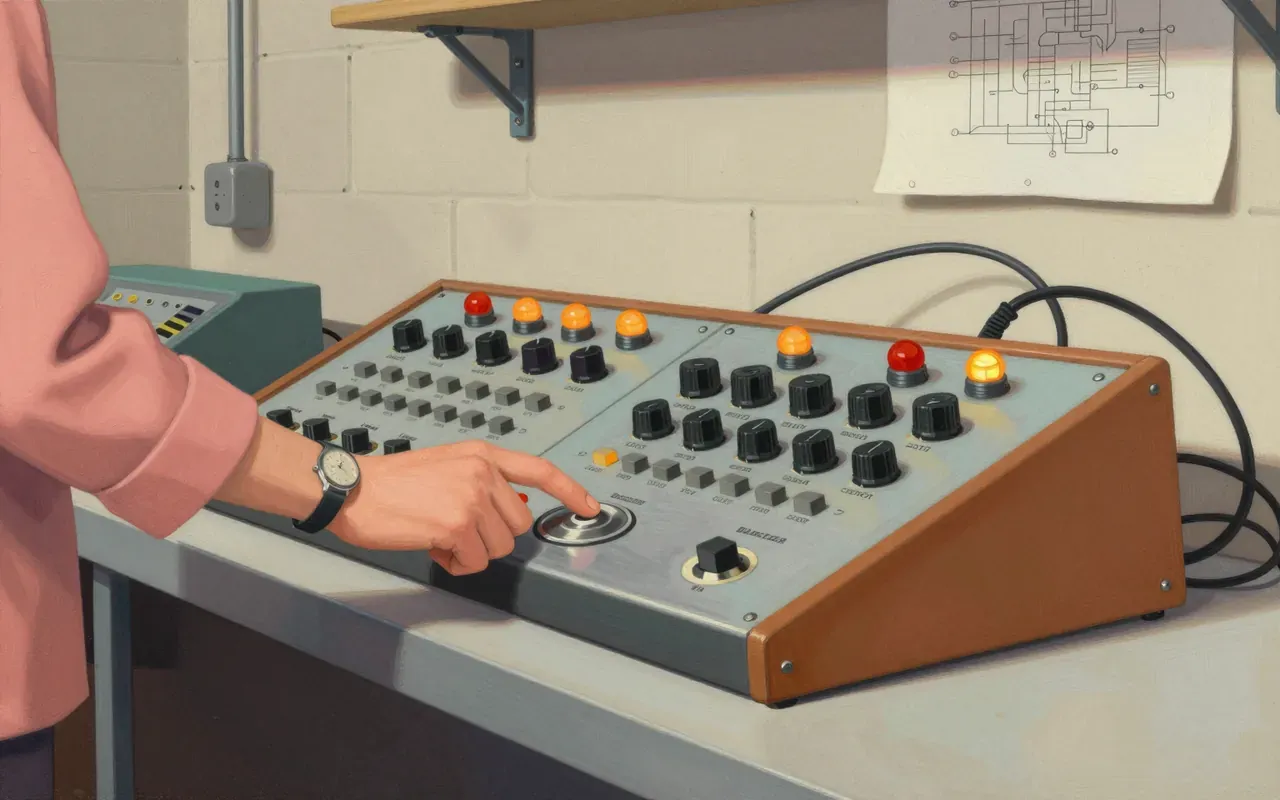
The Serge synthesizer is an analogue modular system developed at CalArts in late 1972. It was built to be inexpensive and powerful, a democratic alternative to Buchla systems. It shipped as DIY kits assembled unofficially on a CalArts balcony. Modules expose circuit aspects on the front panel for unconventional patching. All signals use banana jacks—no separation between audio and control voltage. Stackable banana plugs reduce the need for mults. One unit was used on the 1975 Greenpeace anti-whaling expedition to approximate and broadcast whale sounds.

Chapters & takeaways4
  1. 0:58
    Origin

    Born at CalArts in late 1972, the first 20 units were hand-built in 1973.

  2. 2:18
    Philosophy

    Designed to be cheap and powerful, it shipped as student DIY kits assembled on a CalArts balcony.

  3. 3:36
    Patch Logic

    Front-panel circuit access and unified banana-jack patching enable radical signal rerouting.

  4. 5:14
    Proof of Use

    A 1975 Greenpeace expedition used one unit to synthesise and broadcast whale sounds at sea.

Worth your time?

Yes. Use the whole thing.

4.5/ 5
What works
  • real-time circuit reconfiguration
  • unconventional patching via front-panel nodes
  • low-impedance signal routing without screened cables
What does not
  • offer MIDI
  • include presets
  • guarantee stable tuning
  • support standard 1V/octave scaling
Use it if
  • experienced modular players
  • circuit tinkerers
  • sound designers who prioritise access over automation
Skip it if
  • beginners
  • live performers needing reliability
  • anyone unwilling to calibrate by ear
The written brief1 min read

What it is and what it was built for

It is an analogue modular synthesizer system developed at CalArts in late 1972. It was built to be inexpensive and powerful—a democratic alternative to Buchla systems—and distributed as DIY kits assembled unofficially on a CalArts balcony.

How it works, in terms a player would use

It uses banana jacks for all signals—audio and control voltage share the same patch points. Modules expose circuit nodes directly on the front panel, inviting re-routing beyond intended functions. Stackable banana plugs let one output feed multiple inputs without mults. Panels are 4U tall and mount on 17-inch-wide frames, arranged freely by the user.

What it does better than anything else

It enables real-time circuit reconfiguration more directly than any contemporaneous modular: front-panel test points, unbuffered signal paths, and unified audio/CV routing let players hijack oscillator cores, reroute filter feedback loops, and repurpose comparator outputs as gates or LFOs—on the fly.

What it does badly

It offers no built-in timing, sequencing, or quantisation. There is no master clock, no CV-to-MIDI conversion, no standard 1V/octave scaling guarantee, and no documentation of module response curves. Patching is physically demanding and electrically unshielded.

What people made with it

One unit approximated and broadcast whale sounds during the 1975 Greenpeace anti-whaling expedition in the open Pacific.

Who should use it, and who should not

Experienced modular players who solder, troubleshoot, and value raw signal access over convenience. Not for beginners, live performers needing stability, or anyone unwilling to calibrate oscillators by ear or chase drifting voltages.

Is it worth your time

Yes—if you want hands-on circuit-level control and tolerate no built-in presets, no MIDI, no standardised scaling, and no factory calibration. No—if you need reliability, repeatability, or integration with modern studio gear.
Same bench · Synths & drum machines4 of 241
7:51
Buchla 100Buchla · 1962The Buchla Electronic Musical Instruments (1965) were modular, voltage-controlled systems designed for creating novel sounds—not imitating existing ones—using touch/pressure interfaces instead of keyboards, with synthesis based on FM, AM, and dynamic waveshaping.
10:43
EMS Synthi AKSEMS · 1972The EMS Synthi AKS is a portable modular analog synthesiser introduced in March 1972. It features a built-in keyboard and sequencer, a patch pin matrix, and shares design DNA with the VCS 3. Its sequencer creates eight-note repeating patterns. Users have described it as a 'noise machine'. One full album—Music from the SYNTHI—was made using only this instrument.
9:12
EMS Synthi 100EMSThe EMS Synthi 100 is a large analogue/digital hybrid synthesizer commissioned by Radio Belgrade, designed by David Cockerell and documented in 1971. It developed from a concept of three VCS3 systems but contains analogue modules equivalent to six VCS3s. It features 12 voltage-controlled oscillators and eight voltage-controlled filters. Two monophonic keyboards produce four control voltages and two triggers. Its digital sequencer has three duophonic layers and 256 duophonic note events. Two 60×60 matrices connect modules via patch pins. Keyboard spread adjusts for equal temperament or microtonal tunings up to 61 divisions per semitone.
9:53
EMS VCS 3EMS · 1969The EMS VCS 3 is a portable analogue synthesizer introduced in 1969 by Electronic Music Studios. Designed largely by David Cockerell and styled by Tristram Cary, it uses a pin-based patchboard matrix instead of cables. It lacks a built-in keyboard, making it better suited for sound effects generation and external signal processing than melodic playing. Its tuning instability stems from exponential voltage-to-frequency conversion. It was one of the first portable commercially available synthesizers, housed entirely in a small wooden case.
Up next in Audio

Gibson SG

Gibson · 10:34

It trades body mass for fingerboard speed — and never apologises for either.

10:34