audiobriefs
9:49in productionCh. 1 · What it is/ 9:49 · ceiling 15 min
Instruments · Keyboards & organs

ARP String Ensemble

It doesn’t play strings — it drowns everything in them.

The ARP String Ensemble is a fixed-architecture string machine. Twelve tone generators feed 49 keys via divide-down. Its triple BBD chorus — driven by two LFOs — defines the sound. No envelopes. No filters. No expression. Just one lush, unchanging texture.

Chapters & takeaways4
  1. 0:45
    What it is

    It is not a synth in the modern sense — it’s a digital/analog hybrid built for one job: string texture.

  2. 2:21
    How it makes notes

    Twelve tone generators feed 49 keys via organ-style divide-down — no oscillators per note, no polyphony beyond the architecture allows.

  3. 3:40
    How it moves

    Two LFOs drive three BBDs to generate its signature vibrato — the only source of movement or life in the sound.

  4. 6:03
    Why it sounds like itself

    Its chorus isn’t an effect — it’s the instrument. Turn it off, and you lose the point.

Worth your time?

Yes. Use the whole thing.

3.5/ 5
What works
  • as a fixed-texture generator
  • as a stereo chorus engine
  • as a period-accurate backdrop
What does not
  • offer dynamic control
  • allow sound design
  • support expressive playing
Use it if
  • producers needing quick string beds
  • artists working in 1970s-inspired genres
Skip it if
  • performers requiring articulation
  • sound designers needing flexibility
The written brief1 min read

What it is and what it was built for

The ARP String Ensemble is a 49-key, fully polyphonic string synthesizer built for instant orchestral texture — not synthesis, not performance, but background colour.

How it works, in terms a player would use

It uses twelve discrete tone generators with octave divide-down to produce full polyphony across 49 keys. A built-in triple chorus effect — using bucket-brigade devices controlled by two LFOs — adds vibrato and width. The keyboard is fully polyphonic, but not velocity-sensitive or expressive beyond the chorus depth and tone controls.

What it does better than anything else

It delivers a thick, immersive, stereo-wide string ensemble sound with zero programming. Nothing else from its era stacks twelve tone generators with a triple BBD chorus and presents it as one unbroken, shimmering wall of sound.

What it does badly

It cannot articulate individual notes. There is no envelope shaping, no filter, no oscillator modulation, no sustain pedal input, and no way to isolate or layer voices. It offers no control over the chorus speed or depth beyond a single knob.

What people made with it

It was used to create lush string pads in 1970s pop, soul, and disco records — the kind that fill space without drawing attention to themselves.

Who should use it, and who should not

Producers seeking a fixed, vintage string bed. Not performers needing real-time expression, not sound designers chasing flexibility, not engineers expecting clean dry signals.

Is it worth your time

Yes, if you want a fixed, lush, chorus-drenched string pad that sits in a mix without competing. No, if you need articulation, dynamic response, or tonal variation beyond the preset sections.
Same bench · Instruments4 of 145
9:11
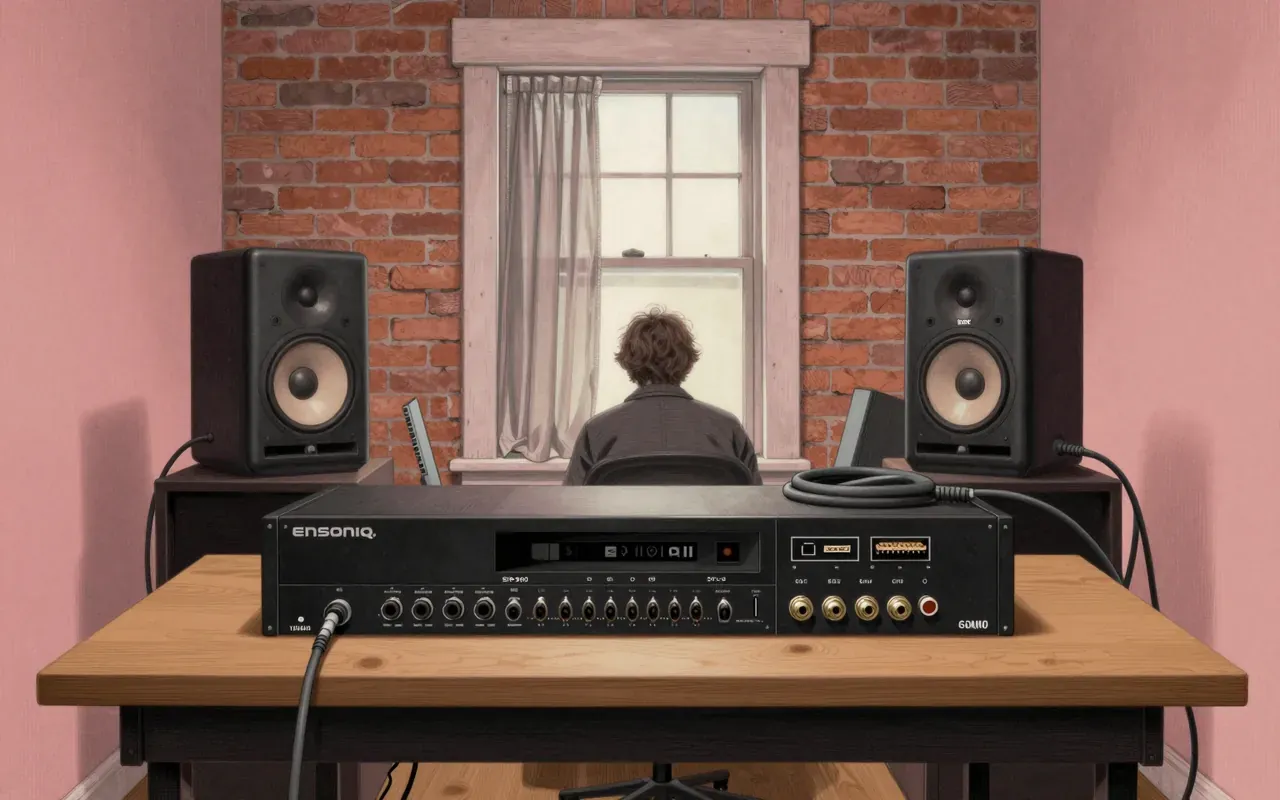
Ensoniq EPS-16 PlusEnsoniqThe EPS-16 Plus is a purpose-built 1990 sampler that trades flexibility for immediacy. It records mono, plays back 16-bit samples at seven fixed rates, and routes everything through stereo panning and 13 effects. Its ES5505 OTIS chip gives it tight, responsive playback—but no sample rate conversion, no stereo input, and no non-destructive editing. Turbo versions added flash and SCSI, but Ensoniq replaced it with the ASR-10 in 1992. It belongs in a room where decisions are made by ear and fingers—not by menu diving.
8:09
Roland S-760RolandThe Roland S-760 is a 1990 rackmount sampler. It samples at 44.1 kHz or 48 kHz with 16-bit stereo resolution. It supports 24-voice polyphony across 32 multitimbral parts. It uses no synthesis method beyond sampling. It has built-in filters but no effects.
9:33
Oberheim OB-8OberheimThe OB-8 gave players twice the programming depth of earlier OB synths—via Page 2—while anchoring Oberheim’s ‘The System’ with the DSX and DMX. It runs on a Z80 CPU, stores 120 patches, and plays eight voices across a 61-note keyboard. It does not hide its age: cassette storage, no effects, and bi-timbral mode cuts voice count in half.
9:00
Roland MSQ-700RolandThe Roland MSQ-700 is an 8-track MIDI sequencer with lithium battery-backed memory, step-time and real-time recording, punch-in, merge, quantization, chaining, and analog tape sync. It stores 6500 notes per track. It has no screen, no file export, no velocity editing, and no USB.
Up next in Audio

Marshall Super Lead

Marshall · 1965 · 9:10

No master volume means no compromise: this amp forces you to choose between silence and saturation.

9:10