audiobriefs
Topic

Materials

Every era is named after one, which should be a clue.

3
in audio
9:38
average
29 min
in total
132
across the network
Materials across the network →
All briefs3
9:32

Gibson Flying V

Gibson · 1958

The Gibson Flying V is an electric guitar introduced in 1958 with a radical futuristic body design, initially made from korina (limba) wood, with only 98 units produced in its first run due to poor sales. It was reissued in 1967 using mahogany and design updates including a new bridge and larger pickguard. Its physical design — including 17-degree headstock angle and central pickup placement — was intended to enhance sustain.

video still
10:27

Parker Fly

Parker

The Parker Fly rethinks the electric guitar as a lightweight, resonant, hybrid-voice platform — built around a carbon-fibre exoskeleton and dual-pickup architecture. It succeeds where mass and material convention fail. It falters where tradition, repairability, and passive tone control matter.

video still
8:54

Steinberger

Steinberger · 1979

Steinberger L-series instruments are headless, graphite-bodied basses and guitars introduced in 1979. They eliminate the headstock, use double-ball-end strings, and feature precise tailpiece-mounted tuners and the TransTrem transposing vibrato. Their design prioritises tuning stability, low weight, and immediate key shifting over acoustic resonance or traditional playability.

More from audio

All briefs →
video still
9:43

Epiphone Crestwood

Epiphone

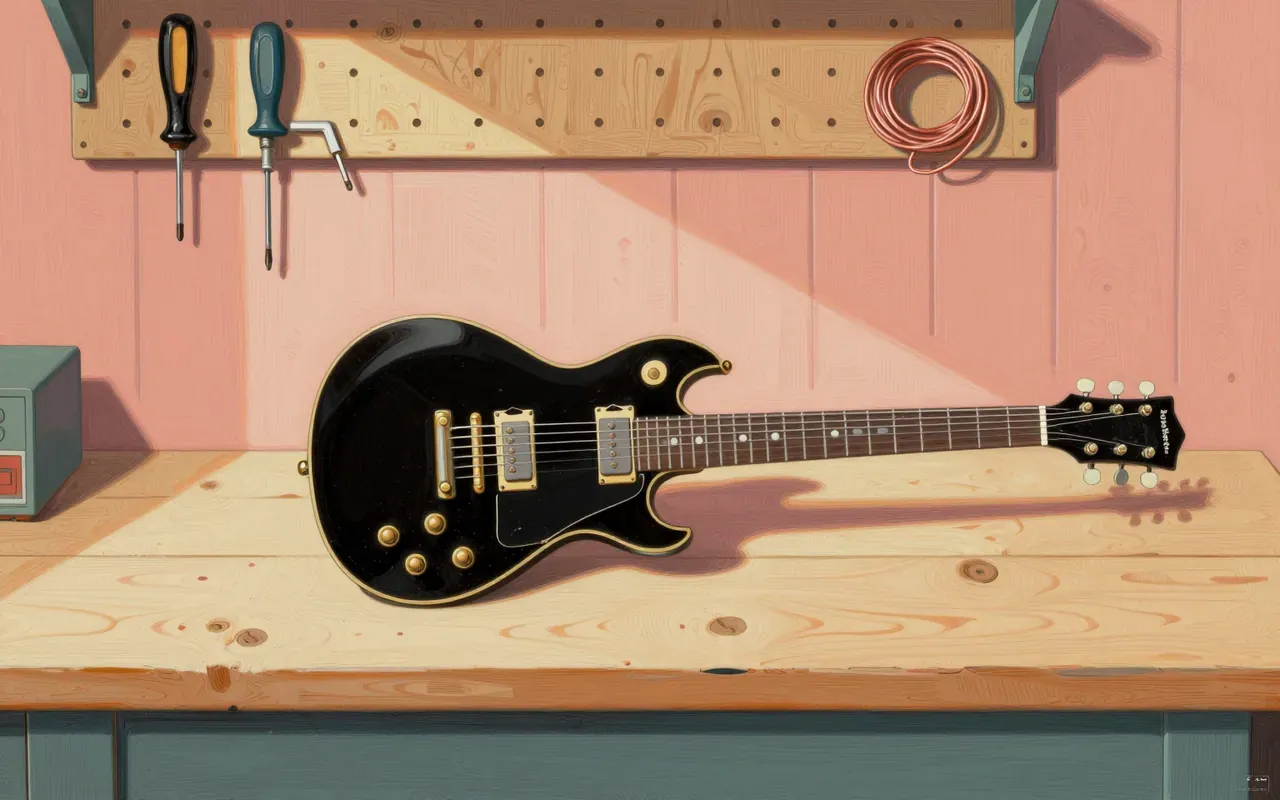
The Epiphone Crestwood is a solid-body electric guitar introduced in 1958. It has no Gibson equivalent. It evolved through named variants—Crestwood Custom, Crestwood DeLuxe—before ending production in 1970. Its construction is mahogany. Its pickups are New Yorker. Its headstock changed from three-on-a-side to six-on-a-side. Its pickguard changed design and lost the Epiphone logo. Its fretboard markers changed from dots to ovals. Its plating changed from gold to nickel. Its upper horn lengthened slightly by 1963. The Crestwood DeLuxe added a third pickup and an ebony fretboard with block inlays.

video still
8:08

Moog synthesizer

Moog · 1964

The Moog synthesizer is a modular, voltage-controlled analog synthesizer invented by Robert Moog in 1964. It was the first commercial synthesizer and established the analog synthesizer concept through its use of patch-cord-connected modules—including voltage-controlled oscillators, filters, envelope generators, and amplifiers—to implement subtractive synthesis.

video still
8:27

Streamer bass

Warwick

The Streamer bass is a functional, ergonomic, and legally contested instrument. It does one thing well: deliver focused low-end articulation in a comfortable, German-built package. It does nothing else — no tonal flexibility, no innovation, no independent identity in its first years. Its history is defined by imitation, negotiation, and eventual divergence — not invention.

video still
8:47

Warwick Thumb SC

Warwick

The Warwick Thumb SC is a 2010 single-cut bass born from a fan forum contest. It adapts the Thumb NT shape with new tonewoods and adds coil-splitting via two mini toggles—its sole functional departure from the NT. It has no passive mode, no 6-string option, and no historical lineage beyond its 2009–2010 development cycle.