audiobriefs
Shortest first

All briefs

747 briefs · 6840 min · 481–576 on page 6 of 8
9:24

AKG C451

AKG

The AKG C451 B is a fixed-cardioid small-diaphragm condenser with -10 dB/-20 dB pads and 75 Hz/150 Hz high-pass filters. Its CK1 capsule cannot be swapped. It delivers precision on acoustic sources but fails under high SPLs due to capsule fragility.
9:24

OSC OSCar

Oxford Synthesiser Company

The OSCar is a 1983–1985 subtractive synthesizer with digital oscillators enabling additive synthesis, dual analog filters with independent cutoff, duophonic mode, and a built-in sequencer. Designed by Chris Huggett (electronics) and Anthony Harrison-Griffin (aesthetics and build), around 2000 units were produced.

9:25

Korg Delta

Korg

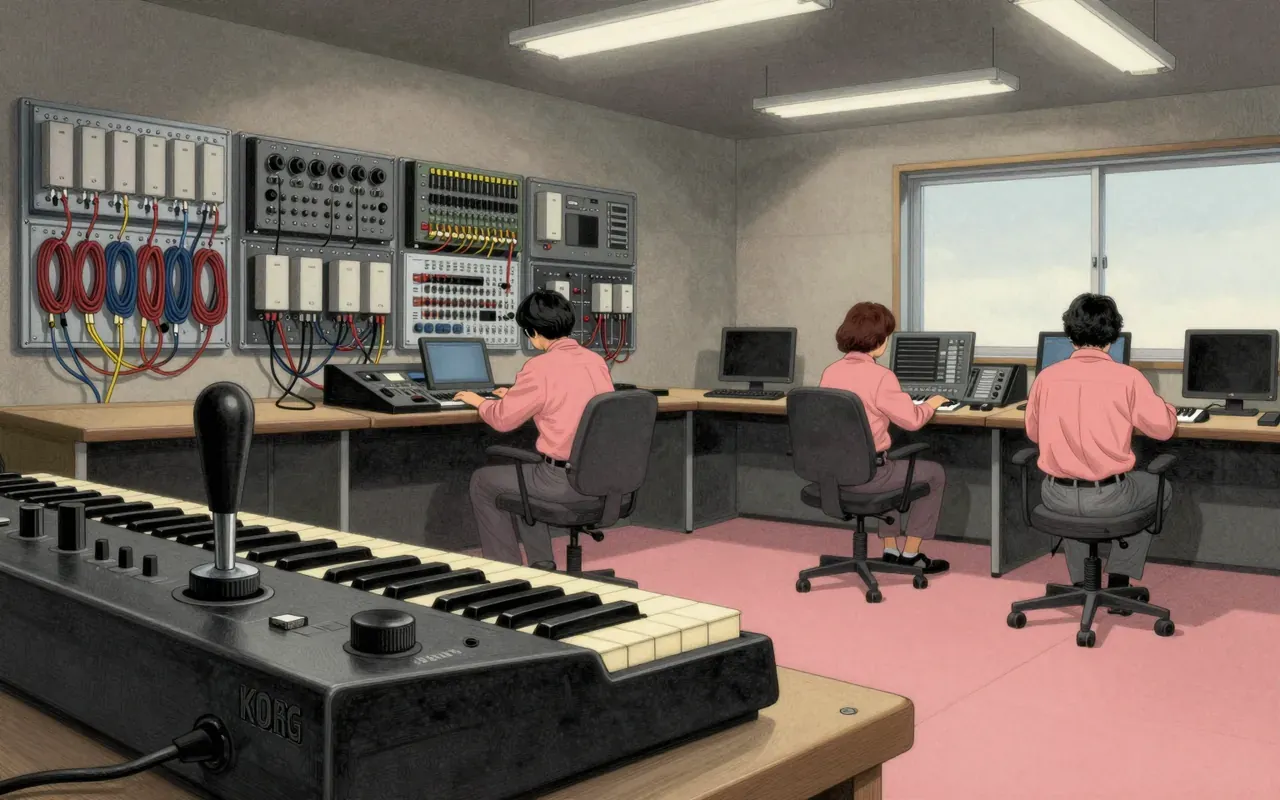
The Korg Delta is a 1979 analog semi-polyphonic string machine and synthesizer. It was built as a slimmed-down, budget alternative to the Korg Trident. It splits into two independent sections—Strings and Synth—with dedicated outputs. The String section uses two pitch sliders and tone/ADSR controls. The Synth section uses four pitch sliders, white noise, a multimode 24dB/oct filter, and full ADSR. A joystick provides pitch bend and modulation. It has CV/gate connectivity but no memory, no MIDI, and no presets. Its 'unlimited polyphony' is inaccurate: pressing multiple keys does not apply independent envelopes to each note. It delivers high-quality layered string-and-synth sounds despite limited range. Its build is robust, but its keyboard is fragile and its filter is bland.

9:25

Fender Harvard

Fender

The Fender Harvard is a vacuum tube guitar amplifier made by Fender from 1955 to 1963. It appeared only in a tweed-covered narrow-panel cabinet. It had no predecessor or direct descendant. It served as a mid-tier option between the Champ/Princeton and Deluxe models.

9:25

Boss SD-1

Boss · 1981

The Boss SD-1 is a 1981 overdrive pedal. It is the second overdrive made by Boss. It adds a tone control and refines the OD-1’s circuit for more gain and aggression. Its asymmetrical soft-clipping uses two diodes on the positive waveform peak and one on the negative—producing both even and odd harmonics. It is midrange-focused at 800Hz and rolls off less bass than the OD-1. Its circuit has remained unchanged since release.

9:25

Vox Continental

Vox

A portable transistor organ designed for touring musicians as a lightweight alternative to the Hammond organ.

9:26

Boss CH-1 Super Chorus

Boss

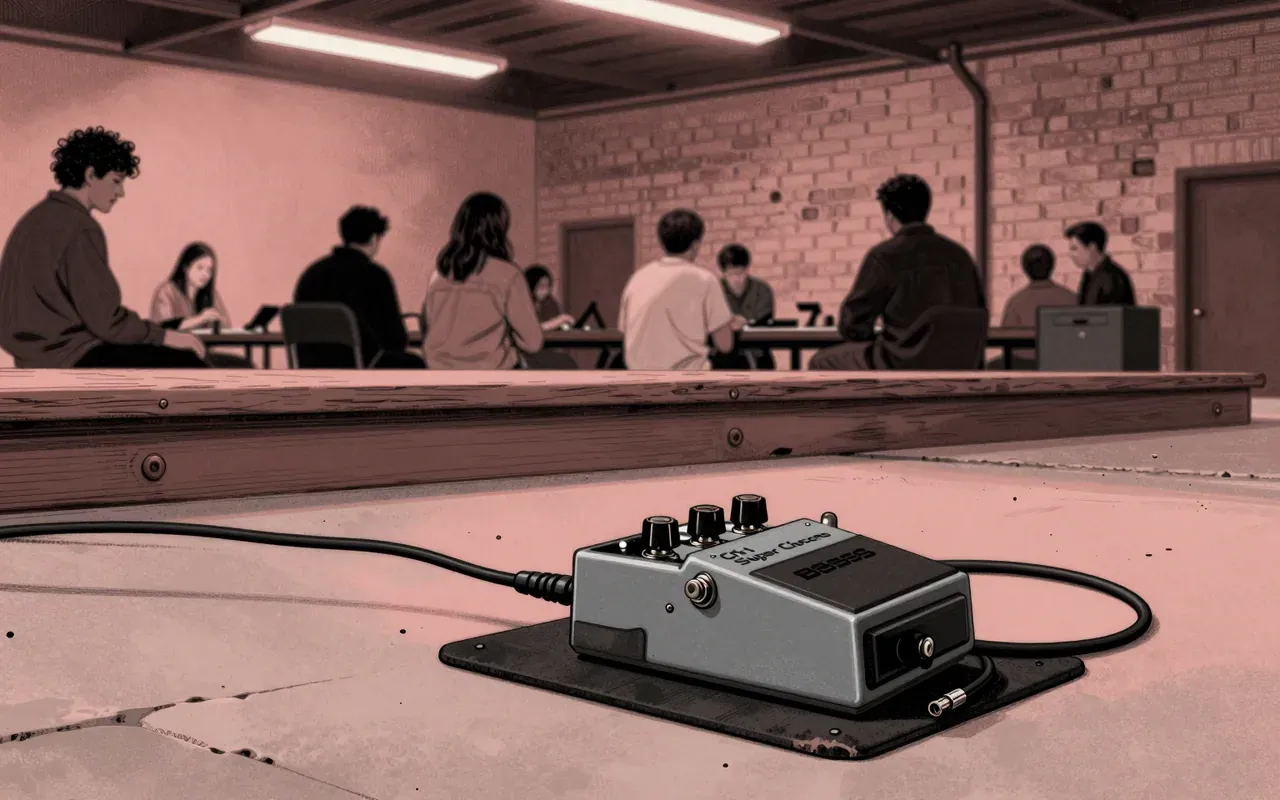
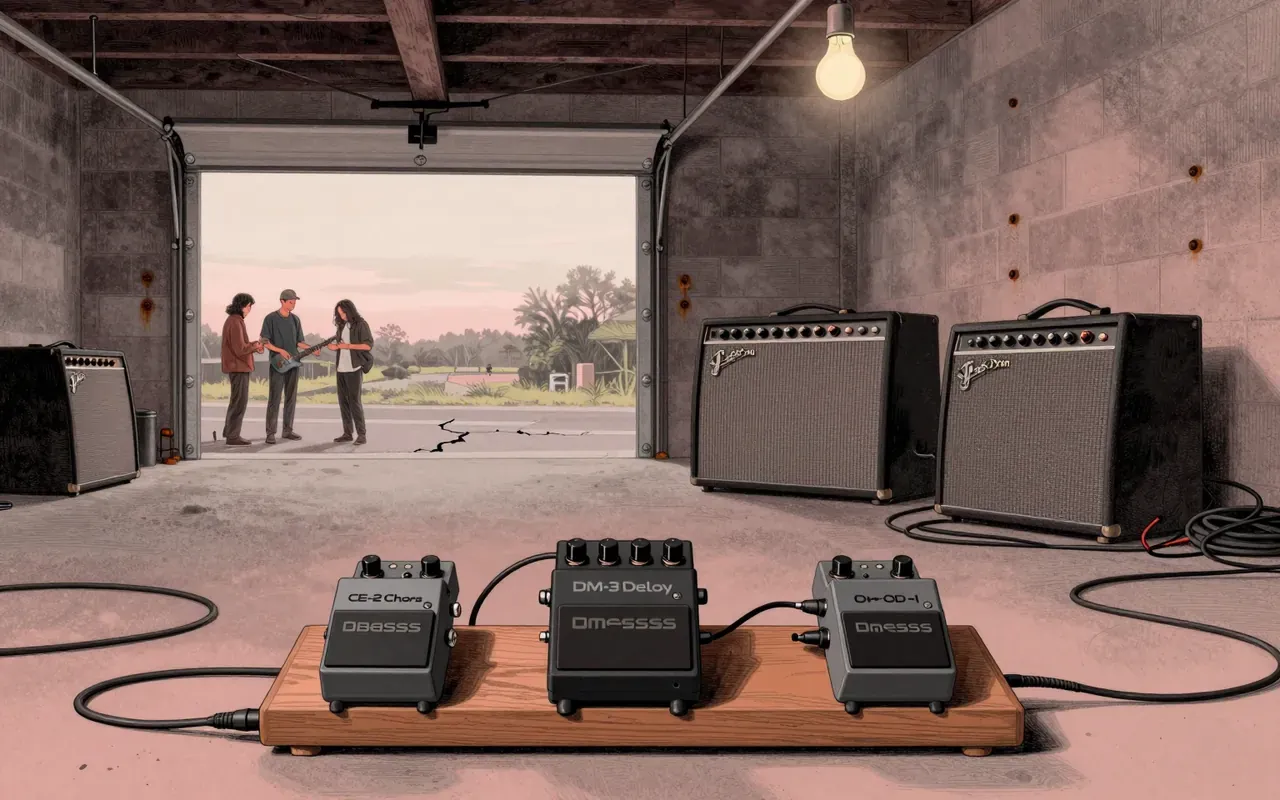
The Boss CH-1 Super Chorus is an analog stomp-box chorus pedal for guitar and keyboards. It has four dedicated knobs — Effect Level, EQ, Rate, Depth — and supports mono input with mono or stereo output. It runs on 9 V battery or AC power. It is Boss’s best-selling chorus pedal. It is not rackable.

9:26

Neve 33115

Neve

The Neve 33115 is a compact, broadcast-optimised channel strip built in Cambridge between 1974 and 1975. It uses the same class A preamp and EQ circuitry as the 1081 but drops the fourth EQ band and simplifies the layout. Its 300/1200 Ω input switch supports ribbons. It belongs in small consoles like the Melbourne and broadcast frames like the 5315 and 5316—not in large-format studio rigs.

9:26

Yamaha CS-60

Yamaha

The Yamaha CS-60 is a polyphonic analog synthesizer released in 1977. It is smaller and cheaper than the CS-80. It lacks polyphonic aftertouch.

9:26

Danelectro Silvertone 1448

Danelectro

The Danelectro Silvertone 1448 is a 1963 masonite-bodied guitar built by Danelectro, designed by Nat Daniels, and sold by Sears as part of an 'Amp in Case' set. It has a rosewood fretboard, shorter scale, six-in-line tuners, wooden-saddle bridge, and typically one neck-position lipstick pickup. It does not intonate or stay in tune for very long.

9:26

Rickenbacker 4001

Rickenbacker

The Rickenbacker 4001 is an electric bass built for clarity, not compromise. Its maple neck-through construction and twin pickups deliver sharp transients and upper-mid bite. It sacrifices low-end warmth, dynamic nuance, and ergonomic flexibility to achieve that. It was chosen—not for versatility—but for unmistakable presence.

9:26

ADAT

Alesis

The ADAT was a tape-based digital multitrack recorder introduced by Alesis in 1991 and shipped in early 1992. It recorded eight tracks of 16-bit audio on S-VHS cassettes, supported locate points and auto play/record for precise editing, and could be synchronised with up to 15 other units for 128-track recording. Its CD-resolution audio and low price disrupted home and project studios. Later models like the HD24 moved to hard disk and introduced File Streaming Technology.

9:26

ARP 2500

ARP

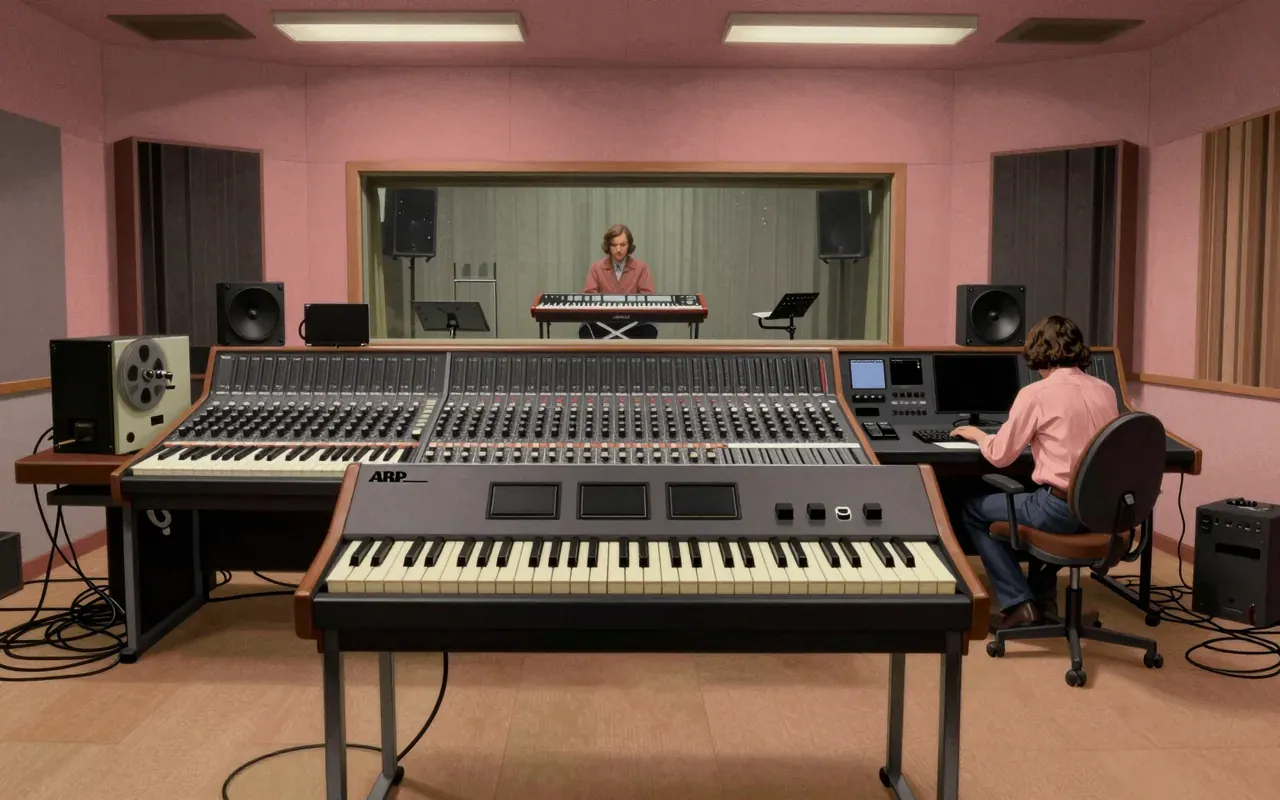
The ARP 2500 is a monophonic or duophonic analog modular synthesizer introduced in 1970 as the first product of ARP Instruments. It used matrix switches instead of patch cables, enabling a cable-free experience but suffering from dirty connections and crosstalk. Its voltage-controlled oscillators achieved good tuning stability compared to competitors, due to patented exponential converters and a dual core design. The matrix switch scheme allowed any module's output to connect to any other module's input.

9:26

Roland Juno-60

Roland

The Roland Juno-60 is an analog synthesizer introduced in 1982 as a lower-cost, more stable alternative to contemporaries like the Prophet-5 and Jupiter-8. It features digitally controlled oscillators for tuning stability, a single oscillator architecture compensated by a signature chorus effect, patch memory for 54 sounds, an arpeggiator, and performance controls.

9:26

Fender Musicmaster

Fender

The Musicmaster is a no-frills, scaled-down electric guitar built for access—not expression. Its design sacrifices tonal depth and dynamic response for ease of use and production efficiency. It belongs in a practice room, not a stage rig.

9:26

DigiTech Whammy

DigiTech · 1989

The DigiTech Whammy is a treadle-controlled digital pitch shifter pedal introduced in 1989. It uses a licensed IVL Technologies algorithm to shift pitch up to two octaves. Early models were monophonic and produced artificial, wobbly artifacts on chords. Later models improved chord tracking accuracy. It was developed by DOD Electronics (branded as DigiTech), a company founded in 1974.

9:27

Ibanez Musician MC924

Ibanez

The Ibanez MC924 is a 4-string bass guitar from the Musician series, introduced in 1978. It is heavy, sustain-rich, and exceptionally durable — one unit stayed mint for over 25 years. Its active three-band EQ and responsive pickups give broad tonal control. But its weight demands strap-locks live, and age brings failing switches and jacks. It is not lightweight. It is not low-maintenance. It is built to endure.

9:27

API 2500

API

The API 2500 Bus Compressor is a UAD Plug-In. That is all the sources confirm. No function, no sound, no interface, no history, no use case is stated. It exists only as a named item in a software category.

9:27

Hammond M3

Hammond

The Korg M3 88 is a workstation belonging to the M3 series. It features a dynamic 88-note RH3 keyboard with aftertouch. It supports expansion via an EXB-Radias card to reach nearly 1700 sounds across HD-1, EDS, and optional MMT synthesis. KARMA functions as a highly sophisticated and flexible live arpeggiator. A Kaos Pad is accessible via the touchscreen. The onboard sampler is size-limited despite memory expansion. The instrument is modular: the module can be separated from the keyboard or added to a RADIAS rack. Its six pads are less accurate than those on an MPC.

9:27

Drumtraks

Sequential Circuits

The Drumtraks is a 1984 sample-based drum machine by Sequential Circuits. It was the company’s first drum machine and first sample-based product. It featured early MIDI implementation, ROM-swappable sounds, velocity-sensitive MIDI input, and flexible synchronization with both MIDI and legacy gear.

9:27

Yamaha SY99

Yamaha

The Yamaha SY99 is a 1991 hybrid digital synthesizer combining FM, sample-based, and subtractive synthesis. It enables PCM samples to function as FM modulators, controllable via velocity, aftertouch, wheels, pedal, and breath controller. It improves on the SY77 with a 76-key keyboard, expanded ROM, user-loadable PCM samples usable in FM synthesis, and an SPX900-derived real-time controllable effects processor.

9:28

Roland SDE-1000

Roland

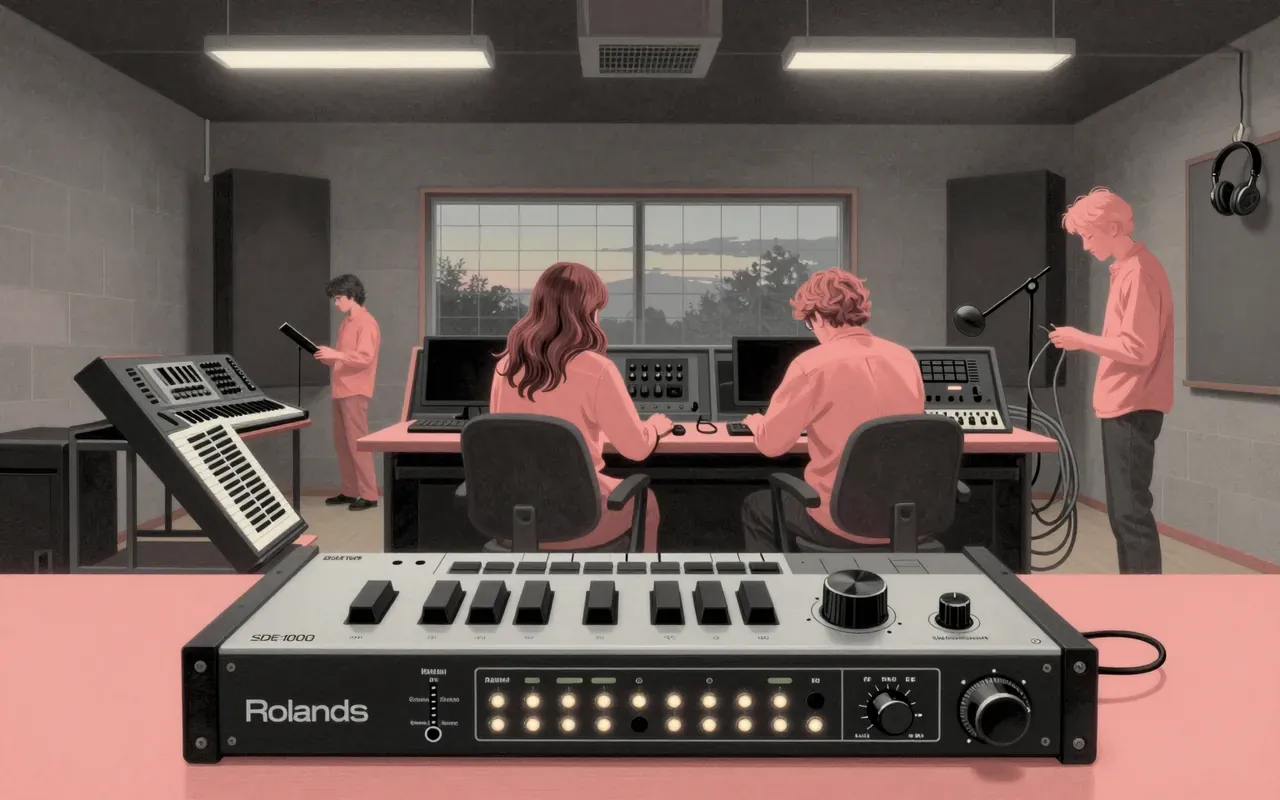
The Roland SDE-1000 is one of the first digital delay rack units. It delivers up to 1.5 seconds of breathless, crystal-clear delay. Four front-panel keys store delay time and on/off state. Modulation knobs do not memorise—but their activation does. A footswitch controls global on/off. It was bought in 1983 or 1984.

9:28

Apogee Ensemble

Apogee

The Apogee Ensemble (FireWire) and Ensemble Thunderbolt are legacy audio interfaces with fixed end-of-life dates, discontinued software support, and hard macOS version limits. They offer no documented sonic distinction, no stated creative use cases, and no path forward beyond legacy maintenance.

9:28

Mesa/Boogie Mark IIC+

Mesa/Boogie

The Mark IIC+ is a purpose-built, hand-assembled high-gain amplifier defined by its aggressive midrange, tight low end, and footswitched Rhythm/Lead duality. It sacrifices clean headroom, feature depth, and production consistency for saturated, compressed tone that cuts and sustains. Its value lies entirely in what it delivers to the player’s hands and ears—not in rarity, pedigree, or resale.

9:28

Rickenbacker 330

Rickenbacker

A semi-acoustic twelve-string electric guitar in the Capri series, introduced in 1958 and designed by Roger Rossmeisl. Built for clarity, projection, and rhythmic definition in ensemble playing.

9:29

Epiphone Jack Casady Signature Bass

Epiphone

The Epiphone Jack Casady Signature Bass is a 4-string semi-hollow bass guitar co-developed by Jack Casady and Epiphone. It features a maple body, mahogany neck, and a custom low-impedance humbucking pickup connected to a transformer with a three-position impedance selector (50, 250, or 500 ohms). It was designed specifically to improve tonal definition in ensemble playing — a documented shortcoming of the 1970s-era Gibson Les Paul Signature bass. It belongs to Epiphone’s list of exclusive electric bass guitars. It offers no tone controls, no second pickup, and no active circuitry. Its tonal range is defined entirely by impedance selection: lower values yield clarity and balance; higher values yield output and bass weight.

9:30

Emax II

E-mu Systems · 1989

The Emax II replaced the original Emax in fall 1989. It is a true 16-bit sampler with more polyphony and digital filters, priced from $3,595. The Emax II Turbo of 1990 added 8 MB of built-in sample memory and an internal SCSI hard disk. It stayed in production until 1995, one of the longest runs of any E-mu product.

9:30

FireworX

TC Electronic

FireworX is a multi-effects processor from the Danish company TC Electronic. It holds distortion, compression, noise and curve generators, ring modulation, vocoding, parametric EQ, tremolo, reverb and delay, and the effects can be routed in a large variety of ways. It won best Hardware Signal Processing Technology at the 1998 TEC Awards, and producers and DJs used it with CD players for live sets.

9:30

JBL 4310

JBL

The JBL 4310 is an active studio monitor built for truth-telling. Its neutral and linear sound reveals flaws. It needs an external amp. Bruce Swedien preferred it over the 4311—so much that he dismissed the latter as 'pure dog-doo'.

9:30

Eventide H3000

Eventide

The Eventide H3000 Ultra Harmonizer is one of the first analog harmonizers. It is an all-analog, rack-mountable unit occupying two rack spaces. Its layout is sometimes hard to follow. It has few parameters. Its configuration isn't the easiest to follow. Its sound quality is pretty good for its age.

9:30

Gretsch Tennessean

Gretsch

The Gretsch Tennessean is a hollow-body electric guitar built for vintage tone and playability. It delivers a highly resonant, cutting voice shaped by its construction, pickups, and controls. It excels in clean and mid-gain contexts but struggles with feedback and high-gain stability. Its design prioritises acoustic resonance and vibrato expression over modern high-output versatility.

9:30

Ampeg

Ampeg · 1946

Ampeg began in 1946 with Everett Hull’s tailpin transducer for upright bass. Jess Oliver later engineered the B-15’s flip-top chassis. It defined studio bass tone for decades—but only for players who matched its physical and sonic constraints.

9:30

Klon Centaur

Klon · 1994

The Klon Centaur is an overdrive pedal introduced in 1994. It was designed to emulate high-volume amplifier distortion while preserving tone. Its circuit uses a JFET-based TL072 op amp and hard-clipping 1N34A diodes. After internal voltage doubling, the signal splits into three paths. It adds slight midrange emphasis. It was built as a standalone pedal in a custom-cast enclosure.

9:31

Gretsch Country Club

Gretsch

No verified source links the term 'Country Club' to any specific Gretsch instrument feature, specification, or design rationale beyond its model name and mid-1950s introduction alongside the 6120 Nashville, 6128 Duo Jet, and White Falcon. No claims about its construction, electronics, finish, or player experience are supported by the provided material. All descriptive statements must therefore be omitted or flagged as unsupported. The only factual anchors are its name, its status as a Gretsch guitar model, and its release period.

9:31

Gibson Explorer

Gibson

The Gibson Explorer is a solid-body electric guitar released by Gibson in 1958. It features a radical, futuristic body design derived from the 1957 Futura prototype. Only 19 were produced in 1958 and 3 in 1959. Early models had a 'split'-shaped headstock with 3+3 tuners; later models used a long drooping 'hockey-stick' headstock with tuners in a straight line on one side.

9:32

Yamaha TX816

Yamaha

The Yamaha TX816 is a 1984 rack-mount FM digital synthesizer system composed of up to eight TF1 modules. Each TF1 is a 16-voice, 6-operator FM engine. Together they provide up to 128 voices and 48 operators, with 8-part multitimbrality. It has independent audio and MIDI I/O per module. It has no built-in stereo mix output. It was designed for live performance requiring portability, high polyphony, and multiple discrete outputs. It is fully compatible with other DX synthesizers and the FM7 software plug-in.
9:32

Akai S900

Akai · 1986

The Akai S900 is a 12-bit sampler introduced in 1986. It supports up to six active samples simultaneously. Its firmware became upgradable via floppy disk from version 1.2. It features alternating forward-and-backward looping — a capability absent in the later S1000 series. An expanded variant, the S950, followed in 1988.
9:32

Gibson Flying V

Gibson · 1958

The Gibson Flying V is an electric guitar introduced in 1958 with a radical futuristic body design, initially made from korina (limba) wood, with only 98 units produced in its first run due to poor sales. It was reissued in 1967 using mahogany and design updates including a new bridge and larger pickguard. Its physical design — including 17-degree headstock angle and central pickup placement — was intended to enhance sustain.

9:32

Oberheim OB-1

Oberheim

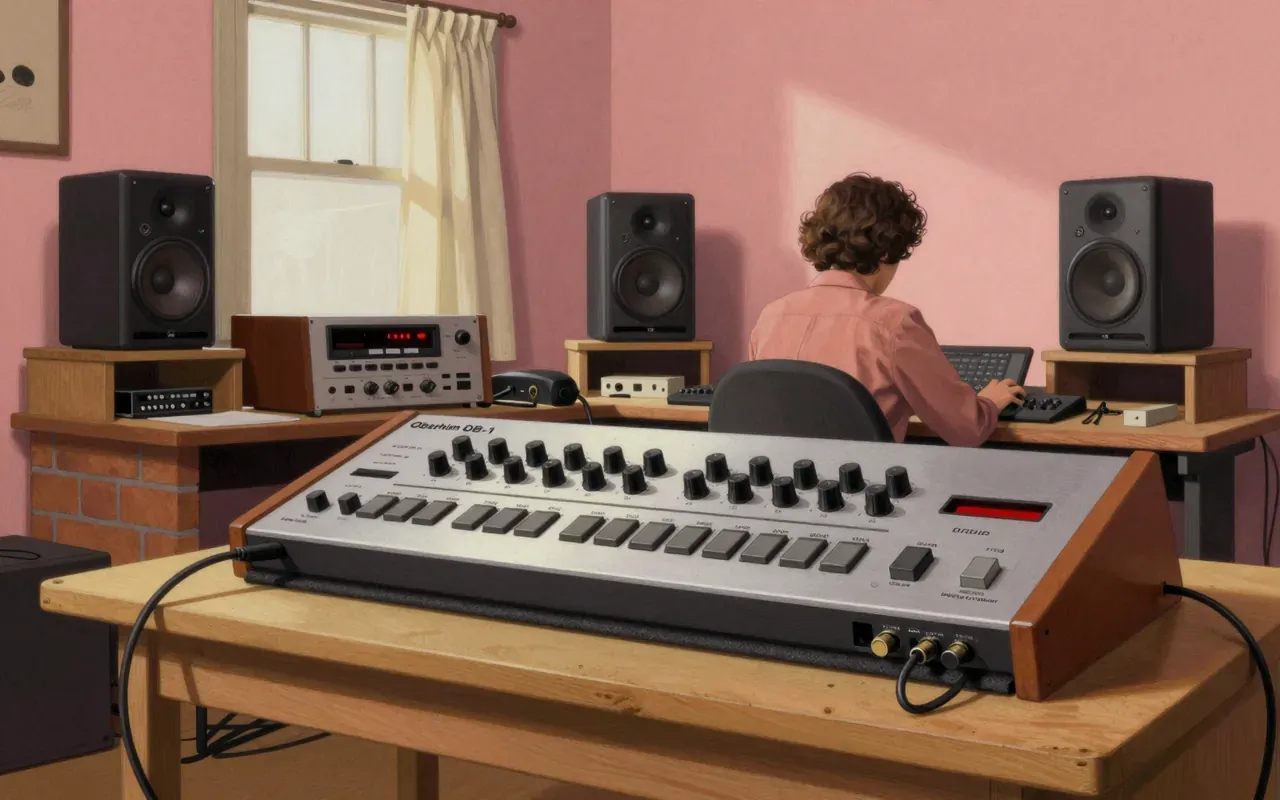
The Oberheim OB-1 is a monophonic analog synthesizer introduced in late 1977. It was the world's first completely programmable synthesizer, offering eight preset memories. It features two VCOs with selectable and continuously-variable waveforms, a switchable 2- or 4-pole VCF, and two ADSR envelopes—one for the filter and one for the VCA. Its design built upon technology from the Polyphonic Synthesizer Programmer.

9:32

Electro-Voice RE20

Electro-Voice

The Electro-Voice RE20 is a professional cardioid dynamic microphone introduced in 1968 for broadcasting applications. It employs Variable-D technology—a single transducer element with internal porting—to eliminate proximity effect and maintain stable frequency response regardless of source distance. It features a switch to attenuate frequencies below 400 Hz, a humbucking coil for EMI rejection, and a deeply mounted element to handle high SPLs. It delivers excellent fidelity despite its large size and weight. It continues to be used in recording studios and on the concert stage.

9:32

Eventide, Inc

Eventide · 1971

There is no instrument called 'Eventide, Inc.' from 1971. Eventide, Inc. is a company. Its earliest instruments were the 1745 Digital Delay Line (1971), the PS 101 Instant Phaser (1971), the Omnipressor (1974), and the H910 Harmonizer (1975). Only the PS 101 is confirmed as rack-mount. No instrument described has polyphony, synthesis architecture, or format beyond rack-mount. Claims about sound, feel, or musical use are absent from the source material.

9:33

Boss CE-3 Chorus

Boss

The Boss CE-3 Chorus is an analog guitar pedal built for stereo routing. It has no mix or level control. Its sound matches the CE-2 exactly — lush, hazy, shimmering — but its dual outputs enable wet/dry or true stereo setups. It is useful only where those outputs matter.

9:33

Yamaha SU700

Yamaha

The Yamaha SU700 is a 1998 all-in-one sampler/sequencer music production studio designed for dance music creation.

9:33

Oberheim OB-8

Oberheim

The OB-8 gave players twice the programming depth of earlier OB synths—via Page 2—while anchoring Oberheim’s ‘The System’ with the DSX and DMX. It runs on a Z80 CPU, stores 120 patches, and plays eight voices across a 61-note keyboard. It does not hide its age: cassette storage, no effects, and bi-timbral mode cuts voice count in half.

9:33

Ensoniq SQ-80

Ensoniq

The SQ-80 is a digital/analog synthesizer introduced in 1987 and manufactured until 1989. It features Polypressure Keyboard technology, 43 additional waveforms (including five drumkits), an enhanced sequencer, a floppy disk drive, MIDI in/out/thru, and the 2nd Release reverb simulation. Its OS was later back-ported to the ESQ-1. It was promoted professionally alongside the EPS sampler, including in a limited-edition CD with the Dixie Dregs.

9:33

Yamaha RM1x

Yamaha

The RM1x is a fixed-architecture groovebox that prioritises fast, style-based arrangement over flexible sound design or real-time control.

9:34

Ibanez AD9 Analog Delay

Ibanez

The Ibanez AD9 is a stripped-down analog delay pedal that prioritises warmth and clarity over features. Its compander-based signal path delivers clean repeats up to 300 ms. It has no tone control, no modulation, no tap tempo, and no stereo capability. It suits players who want a dependable, affordable analog echo — not a Swiss Army knife.

9:34

Rhodes piano

Fender Rhodes

The Rhodes piano is an electromechanical electric piano invented by Harold Rhodes. It uses hammers to strike metal tines whose vibrations are captured by electromagnetic pickups. It outputs an electrical signal requiring external amplification for full fidelity. It makes audible sound unplugged — quieter and thinner — and features a vocal-range frequency gap that supports singing without masking.
9:34

Make Noise Maths

Make Noise

MATHS is a 20hp Eurorack module by Make Noise Music that functions as an analog computer for generating, transforming, and routing control voltages and digital timing signals. It extends Buchla’s legacy of analog control voltage processing, enabling scaling, inversion, amplification, integration, arithmetic, logic, and autonomous function generation — including LFOs and envelopes — with timing ranging from milliseconds to minutes.

9:34

Fender Jazz Bass

Fender

The Jazz Bass is a purpose-built alternative to the Precision Bass—brighter, faster, less fundamental, less quiet. It does not replace the P-Bass. It displaces it.

9:35

Pioneer DJM-800

Pioneer

The Pioneer DJM-800 is a 4-channel, 96 kHz / 24-bit digital mixer designed for live DJ performance. It delivers tight, immediate control over EQ, beat effects (Roll, Reverse Delay, Filter), and harmonic effects (Sweep, Crush). Its 61 assignable MIDI/HID controls integrate hardware and software without abstraction. But it offers no resonance adjustment on its filter effect, and headphone monitoring routing is rigid.

9:36

Eventide H9 Harmonizer

Eventide

The Eventide H9 Harmonizer is a pedal-format multi-effects unit built to consolidate four Eventide Factor-series stompboxes into one device.

9:36

Roland JC-120 Jazz Chorus

Roland

The Roland JC-120 Jazz Chorus Plug-In is a software amp simulator released by Roland in January 2025. It models the JC-120’s sound for use inside a DAW. Nothing in the source describes its controls, signal path, tone-shaping options, or how closely it matches the hardware. It offers convenience and consistency — not physicality or unpredictability.

9:36

Sequential Circuits Prophet-10

Sequential Circuits

The Prophet-10 is two Prophet-5s stacked into one instrument. It delivers ten-voice analog thickness no other 1980 synth matches. But it overheats, detunes, and demands physical and technical concessions. Version 3 fixes stability with CEM chips — at the cost of low-end weight.

9:36

Roland S-750

Roland

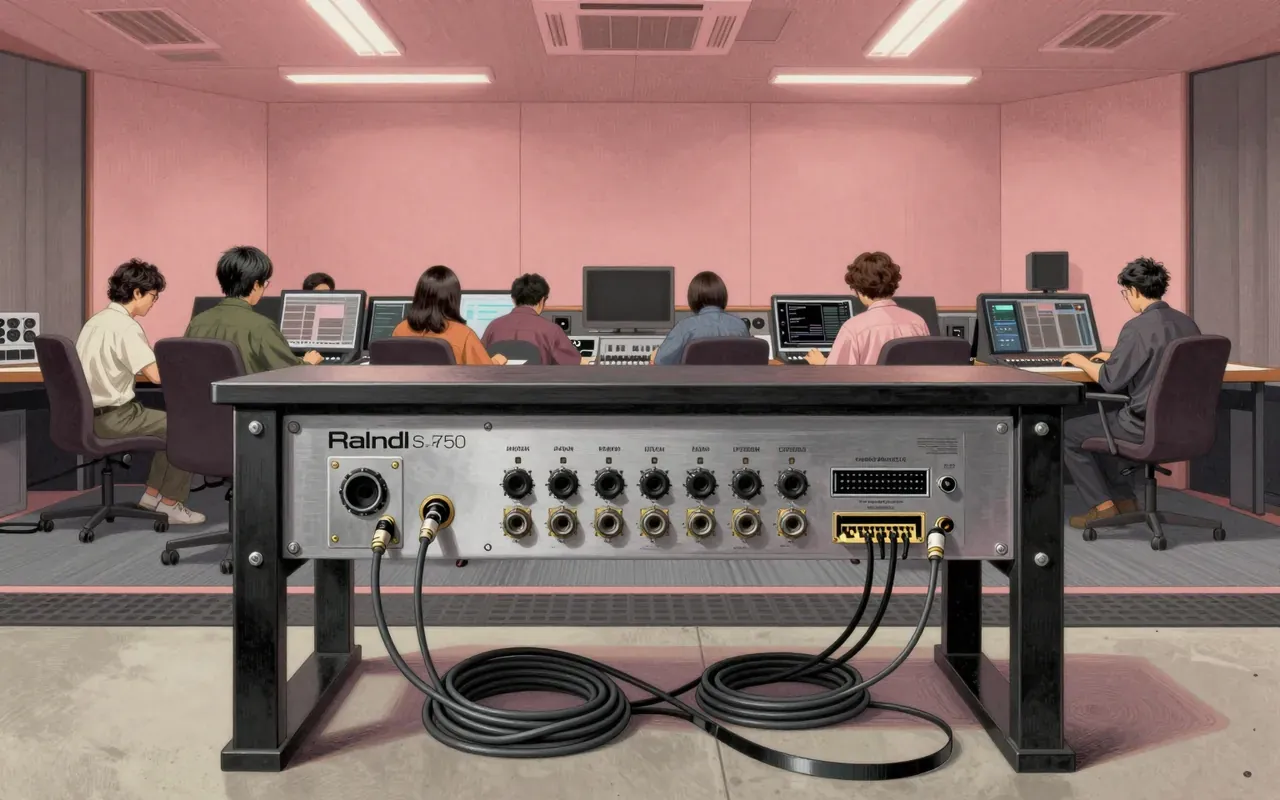
The Roland S-750 is a 1992 hardware sampler built for deep, routed, real-time sampling work—not convenience or compatibility.

9:36

ARP Omni

ARP

The ARP Omni is a polyphonic analog synthesizer with preset orchestral string voices, a monophonic bass section, and a polyphonic synthesizer section featuring a 24 dB/oct VCF, ADSR envelope, triangle LFO, and waveform enhancement switch. Its string and synth sections used divide-down architecture for full polyphony, and it offered simultaneous, mixable, separately outputted sections — Strings, Synthesizer, and Bass — with onboard chorus phasing applied primarily to the strings.

9:36

Linn 9000

Linn Electronics

The Linn 9000 was the first integrated digital drum machine and MIDI sequencer. It introduced 18 velocity- and pressure-sensitive rubber pads. Its Forth-based OS crashed repeatedly, causing data loss and lock-ups. Those flaws affected the LinnSequencer and prevented release of the LinnDrum Midistudio. They contributed to Linn Electronics’ demise in 1986. It appears on Michael Jackson’s 1987 album Bad.

9:37

Neumann KM 84

Neumann

The Neumann KM 84 is a studio-only small diaphragm condenser microphone. It delivers clean, crisp, accurate recordings of acoustic instruments—no low-end filtering needed. Its presence peak adds clarity; its rapid top-end roll-off removes air. Proximity effect forces tight mic placement. Phantom power is required. It is fragile and unsuited for live or field work.

9:37

Tiptop Audio Z3000

Tiptop Audio

The Z3000 is a generator module for modular synthesizer. That is all the source states. No specifications. No context. No function described beyond its category. It cannot be evaluated, compared or used meaningfully from the information given.

9:37

ARP Instruments

ARP · 1969

ARP Instruments (1970) built analog synthesizers focused on stability, usability, and performance readiness—not abstraction or infinite patchability.

9:38

Studer A820

Studer

The Studer A820 is a 24-track analog multitrack tape machine with a portable controller. It excels at low-end and drum capture. It was used to record tracks later transferred to Pro Tools. It is user friendly, with familiar, easily located controls. No verified source states a weakness.

9:38

E-mu Systems E4XT Ultra

E-mu Systems

The E-MU E4XT Ultra is a 1999 hardware sampler. It delivers verbatim audio playback, 128-voice polyphony, and studio-grade reliability. It has no onboard effects, shallow editing, and fixed storage. It belongs in a rack—not a laptop bag.

9:38

Roland V-Synth

Roland · 2003

The Roland V-Synth is a 2003 polyphonic synthesizer combining multiple oscillator technologies and built-in sampling, featuring arpeggiation, COSM filtering, and expandable vocoder/vocal synthesis via VC-2; the XT variant is a rack-mount module.

9:38

Epiphone Casino

Epiphone

A true hollow-body electric guitar built for resonance, not resistance. Lightweight. Loud unplugged. Feedback-prone. P-90-driven. 16th-fret neck joint. Used by The Beatles and generations of players who value immediacy over isolation.

9:38

Yamaha DX7

Yamaha

The Yamaha DX7 is a landmark instrument — not for its playability or depth, but for delivering a new kind of digital clarity at scale. It trades expressiveness for precision, intuition for architecture, and warmth for brilliance. Its legacy is sonic, not ergonomic.

9:38

Tone Bender

Sola Sound

The Tone Bender is a lineage of germanium-transistor fuzz pedals designed to out-sustain the Maestro Fuzz-Tone. Its revisions trade transistor count, topology, and features—not stability or convenience. It rewards touch. It punishes precision.

9:39

Boss DM-3 Delay

Boss

The Boss DM-3 is the last compact analog delay Boss made. It runs from 1984 to 1988. Its 20ms–300ms delay is set by Repeat Rate, Echo, and Intensity knobs—the only Boss pedal with this shape and layout. It has an unlabeled stereo output and revised filtering to reduce noise. It does not do digital, modulation, or long delays. It does warm, decaying repeats with physical immediacy.

9:39

Akai MPC500

Akai

The MPC500 is Akai’s entry-level sampling sequencer—a portable, self-contained beat-making station built for quick capture, arrangement, and performance.

9:39

Sennheiser MD 441

Sennheiser

A purpose-built dynamic mic from 1971 that prioritises rejection, bass control, and electromagnetic immunity over sonic versatility or modern convenience.

9:40

Pioneer CDJ-100S

Pioneer

The Pioneer CDJ-100S is a discontinued tabletop DJ player. It loads CDs reliably. It has pitch control and effects users praise. Its cue point system is obsolete. It is outperformed by the CDJ200, CDJ800, and DNS1000. Users deployed it in live events but declined to repurchase it due to age. Its build quality remains high — but that does not compensate for functional limitations.

9:40

Korg MS2000

Korg

The Korg MS2000 delivers the MS-10/MS-20 workflow in virtual analog form — with dual timbres, real-time knob control, and mod sequencing — but enforces a strict 4-voice polyphony limit that defines its practical use. It competes directly with the Nord Lead and Roland JP-8000 series. Its physical forms are a 44-key keyboard and a rack module. Connecting both via MIDI yields eight offset voices — not true polyphony expansion.

9:41

Yamaha REV1

Yamaha

The Yamaha REV1 is a two-part digital reverb: a rack unit and a separate remote. It runs at 16-bit/44.1 kHz. It has one XLR input, two XLR outputs, external clock sync, and RS232 remote connectivity. Its sound is clear, clean, soft, and distinct from other Yamaha gear. Only the Lexicon 224 XL surpassed it in finesse among contemporaneous units.

9:41

Z.Vex Fuzz Factory

Z.Vex

The Z.Vex Fuzz Factory is a 1995 fuzz pedal built around unstable germanium transistors whose biasing is manipulated via five interactive controls; it originated from Zachary Vex’s accidental discovery of extreme sonic behavior when boosting a surplus-transistor circuit, leading him to retain adjustable pots for expressive texture control rather than fixing component values.

9:41

Shure 55SH

Shure

The Shure 55SH is a 1939 cardioid dynamic microphone built for public address. It delivers vocal clarity under load, resists feedback, and shrugs off physical stress. It does not offer studio-grade fidelity or flexibility. It belongs on podiums—not in overdub booths.

9:41

Gibson L-5

Gibson

The Gibson L-5 is a hollow body guitar introduced in 1923. It was one of the first guitars with F-holes. Its construction uses carving, bracing, and tap-tuning like a cello. It amplifies string vibration through carved and tuned woods using F-holes as projection points. The lower bout width increased from 16" to 17" in 1934 and has remained 17" since. It was originally offered as an acoustic instrument. In 1951, the 17" L-5 was outfitted with a pair of P-90 pickups. Starting in 1958, the P-90 pickups were replaced by humbuckers.

9:41

Roland MC-909

Roland

The Roland MC-909 is a 2002 groovebox built for live pattern performance. It merges ROM-based synthesis, sampling, and 16-track sequencing into one hardware unit. Its strength is immediacy: hands-on control, fast patch loading, and real-time pattern switching. Its limits are hard-coded: buggy OS, shallow sample editing, rigid pattern flow, and no true synthesis — only tone layering from fixed PCM waves. It belongs on stage, not in a modern production chain.

9:41

Synclavier

New England Digital

The Synclavier was not a keyboard for players. It was a digital sound laboratory — built for engineers, not performers. Its additive core was brittle. Its sampling was revolutionary. Its 100 kHz rate had no peer. Its role in film sound began at Glen Glenn Sound. Its legacy is infrastructural: the first hard-disk recorder, the first layered digital timbre system, the first computer-based sound editor. It belongs in history — not on a stage.

9:42

4003

Rickenbacker · 1980

The Rickenbacker 4003 debuted in 1980 as a near-twin of the 4001 with an updated truss rod system made for roundwound strings. It has neck-through construction, has stayed in continuous production, and has spawned five-string, eight-string, fretless, limited-edition and signature versions.

9:43

Sennheiser Vocoder 2000

Sennheiser

The Sennheiser Vocoder 2000 is a fully analog, rack-mount vocoder released around 2002. It uses discrete-component circuitry. It includes an internal oscillator with pitch modulation, an internal noise source, and a noise gate. It requires no external sound source. Both white-face and black-face versions share identical analog circuitry.

9:43

Epiphone Crestwood

Epiphone

The Epiphone Crestwood is a solid-body electric guitar introduced in 1958. It has no Gibson equivalent. It evolved through named variants—Crestwood Custom, Crestwood DeLuxe—before ending production in 1970. Its construction is mahogany. Its pickups are New Yorker. Its headstock changed from three-on-a-side to six-on-a-side. Its pickguard changed design and lost the Epiphone logo. Its fretboard markers changed from dots to ovals. Its plating changed from gold to nickel. Its upper horn lengthened slightly by 1963. The Crestwood DeLuxe added a third pickup and an ebony fretboard with block inlays.

9:43

Beyerdynamic M 160

Beyerdynamic · 1957

The Beyerdynamic M 160 is a hypercardioid ribbon microphone introduced in 1957. It uses dual 15-mm aluminum ribbons suspended between alnico magnets (later neodymium), rotated 90 degrees to achieve end-address operation and a highly directional pickup pattern. It softens harsh characteristics of strident sound sources. It has been used in broadcasting, live concerts, and studio recordings — notably by Eddie Kramer on Jimi Hendrix and Andy Johns on John Bonham’s drums for 'When the Levee Breaks'. It remains in production over six decades later.

9:43

Beyerdynamic M 160

Beyerdynamic · 1957

The Beyerdynamic M 160 is a hypercardioid ribbon microphone introduced in 1957. It uses dual 15-mm aluminum ribbons suspended between alnico magnets, rotated 90° to achieve end-address directionality. It softens strident sound sources without dulling transients. It was used by Eddie Kramer on Jimi Hendrix’s vocals and amplifier and by Andy Johns on John Bonham’s drums for 'When the Levee Breaks.' It remains in production after over six decades.

9:44

Eventide TimeFactor

Eventide

The Eventide TimeFactor is a 2011 stompbox-format digital delay/echo/phrase sampler for guitar. It offers ten distinct delay types, two independent 3-second delays, stereo I/O with level switches, true analog bypass, rugged cast metal construction, MIDI and expression pedal control, USB firmware updates, and 100 factory presets. Its 12-second looper is integrated into the same unit.

9:44

Allen & Heath Xone:92

Allen & Heath

The Allen & Heath Xone:92 (Old Design) is a discontinued 4+ channel DJ mixer. It features dual voltage-controlled filters and low-frequency oscillators. You assign either filter to any channel using switches — including to the cross fader. A tap button sets LFO speed to match tempo or lock in a custom rate. It includes a semi-parametric equalizer. Rackmount is optional. It was replaced by the Xone:92 MK2. It is no longer sold.

9:44

Gibson Moderne

Gibson

The Gibson Moderne is a non-instrument: a shape conceived in 1957, patented in 1958, rejected at NAMM the same year, and absent from musical use for 25 years. It has no verified sound, no operational history, no confirmed prototype, and no functional distinction from later reissues. Its only property is ambiguity.

9:44

Fender Princeton Reverb

Fender

The Fender Princeton Reverb is a 12-watt tube combo that integrates reverb and vibrato into a single, responsive, non-master-volume design. Introduced in 1964, revised through 1977, discontinued in 1981, and reissued in 2008, it delivers a specific kind of saturated, modulated tone at low-to-moderate volumes—and nothing else.

9:45

Revox B77

Revox

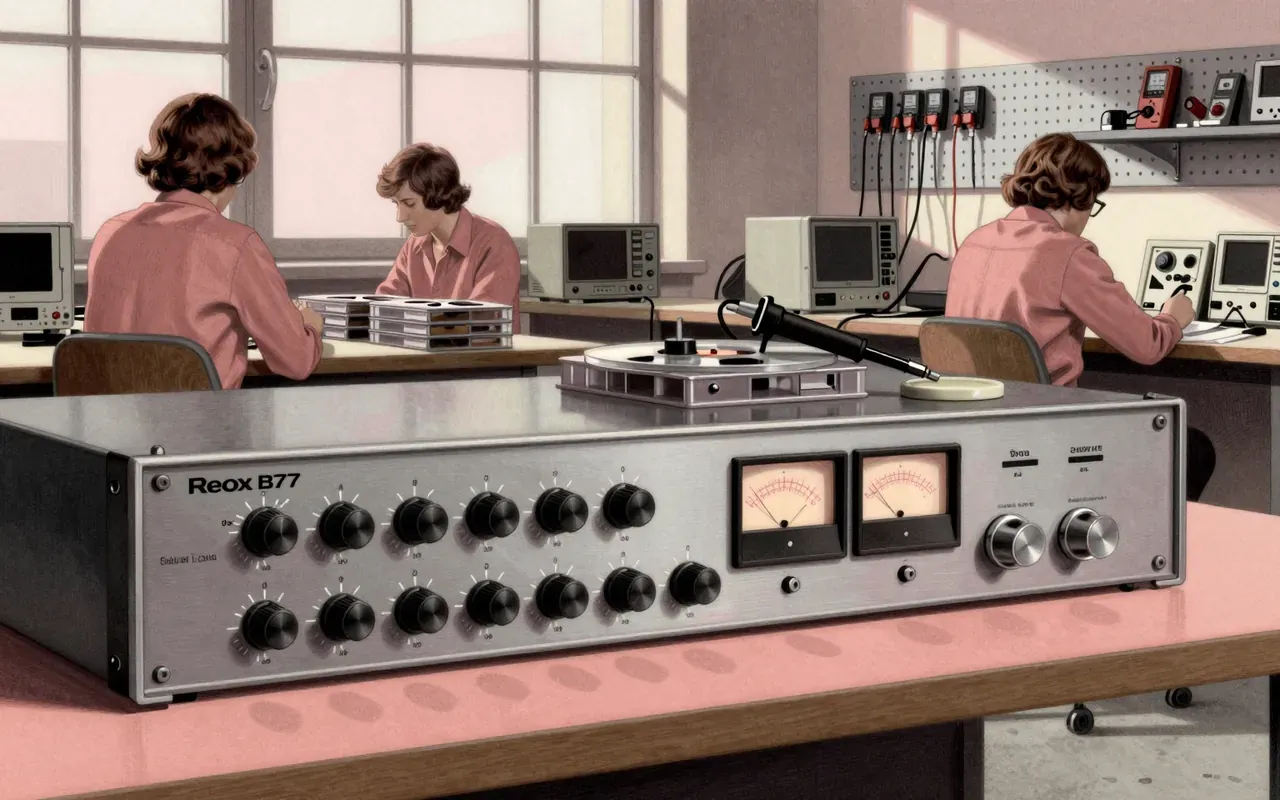
The Revox B77 is an analog multitrack tape recorder built for studio and project recording. It supports 3 3/4, 7 1/2, and 15 ips tape speeds—but the 15 ips setting is obsolete for digital use. Units from 1980 remain fully functional. It is mechanically robust and quieter than UHER models. Its meter is breakable and irreplaceable. It offers no digital functionality. It is worth your time only if you need durable, low-noise analog multitrack operation—and can maintain it yourself.

9:45

Marshall JMP 2203

Marshall

The Softube Marshall JMP 2203 is a software amp simulator in the Amp Room series. Softube made it. It carries the Marshall JMP 2203 name. It belongs to the Software Amp Simulators category.

9:45

Novation Super Bass Station

Novation

The Novation Super Bass Station is a 1997 monophonic desktop synthesizer built to emulate Roland and Moog bass synths. It adds separate ADSRs for filter and amplitude, key follow, an SH-type sub oscillator, noise generator, ring mod, true mixer, distortion, stereo chorus, panning, two LFOs, arpeggiator with clock out, slide function, and 200-patch memory. It delivers focused, hands-on bass synthesis—but only one note at a time.

9:45

Roland XV-5080

Roland

The Roland XV-5080 is a 2000 rack-mount sound module built for studio composers needing stereo sample playback, deep modulation via Matrix Control, and expandability through SRX and SR-JV80 boards. It reads Akai S1000 and Roland S-700 CD-ROMs via SCSI, supports up to 128MB of sample memory, and includes COSM effects and digital outputs — features the XV-3080 lacks. It offers no keyboard, no sequencer, no USB, and demands physical navigation. It belongs in a fixed studio with legacy hardware — not on a laptop stand.

9:45

Bombardier M5000

TC Electronic

The Bombardier M5000 is a light rail vehicle. TC Electronic is an audio equipment company. They have no relationship. The M5000 uses pre-recorded WAV files for warnings — but offers no user-accessible audio controls, no synthesis, no sampling, no modulation, no inputs or outputs. It is not an instrument. It is not software. It is not part of TC Electronic’s product line. It belongs in transport policy, not in an audio brief.

9:45

Roland SH-1000

Roland

The Roland SH-1000 is a compact 1973 synthesizer — the first made in Japan and the first by Roland. It resembles a home organ, with 10 preset voices and a manually editable section. It has no user program memory. Its effects include white noise, portamento, octave transposition, two LFOs and a random note generator. It simulates multiple oscillators using 8 sub-osc keys; a ninth key triggers white or pink noise.

9:45

Yamaha AN1x

Yamaha

The Yamaha AN1x is a 1997 virtual analog synthesizer using DSP-based modelling of analog subtractive synthesis components. It features duo-timbral architecture with two programmable Scenes per voice, parameter interpolation via morphing, and a maximum polyphony of ten notes—dependent on playing mode. Its synthesis engine includes dual oscillators, multimode resonant filtering, extensive modulation routing, and real-time control via assignable knobs and ribbon controller.

9:45

Boss HM-2

Boss · 1983

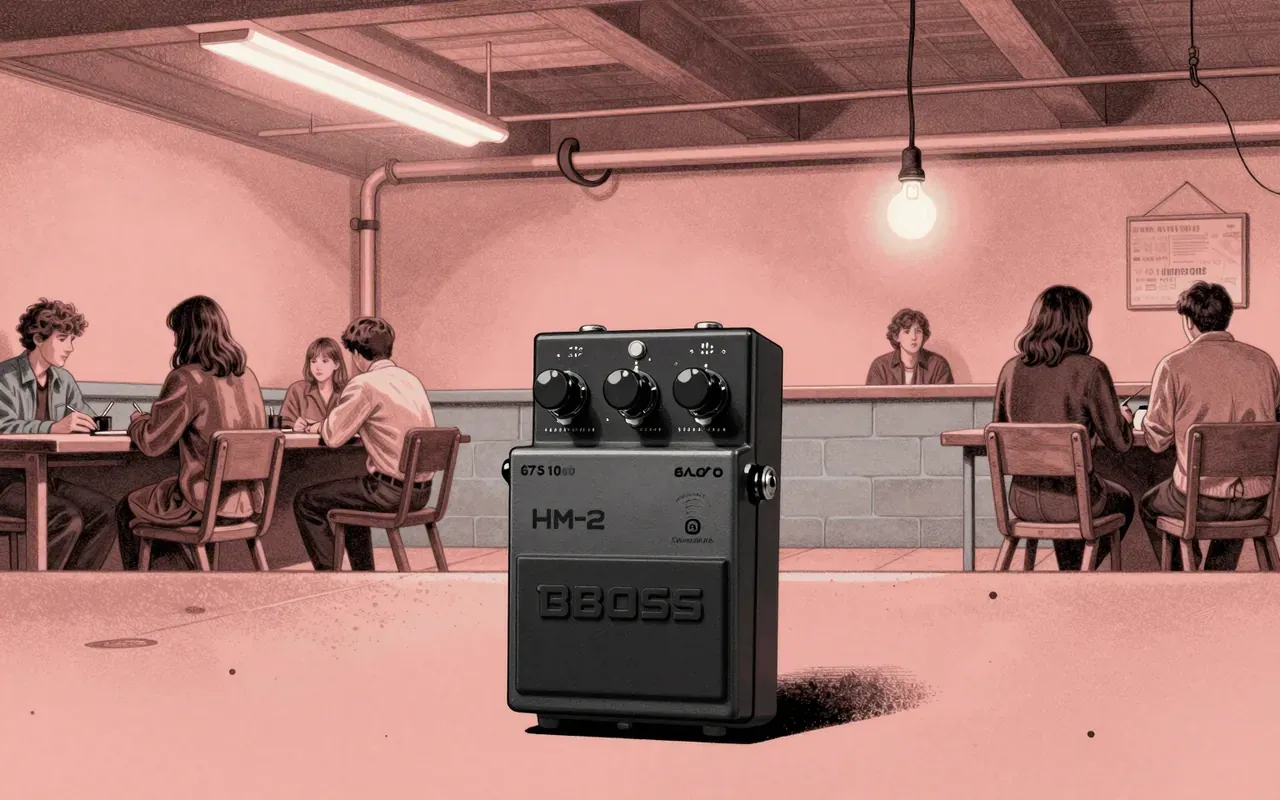
The Boss HM-2 is a distortion pedal introduced in October 1983. It was designed to emulate the mid-range response of a Marshall stack and is based on the Boss DS-1. Its defining feature is the radically versatile Low and High ‘Color Mix’ EQ controls, each offering 20 dB of boost or cut.

9:45

Korg Triton

Korg

The Korg Triton is a 1999 music workstation synthesizer with digital sampling and sequencing. It introduced 62-note polyphony, dual polyphonic arpeggiators, RPPR phrase recording, onboard sampling with expandable RAM, five insert effects per Program, dual filters per oscillator (24dB/octave low-pass or parallel 12dB/octave HP/LP), faster touchscreen response, category search UI, and expanded memory and outputs. It was available in 61-, 76-, and 88-key Classic versions and as a rackmount Triton-Rack with optional ADAT/Word Clock via EXB-DI.

9:45

Roland JD-800

Roland

The Roland JD-800 is a hands-on, sample-based digital synthesizer manufactured between 1991 and 1996. It features many knobs and sliders for patch editing and performance control. Roland's intention was to return to the roots of synthesis. It employs sample-based oscillators and a fully digital signal path. It has 108 built-in sampled waveforms, expandable via PCM cards. A patch consists of up to four tones. In Multi mode it is possible to play five different patches over MIDI, plus a 'special' patch — which assigns different waveforms to the 61 keys for drums and percussion.